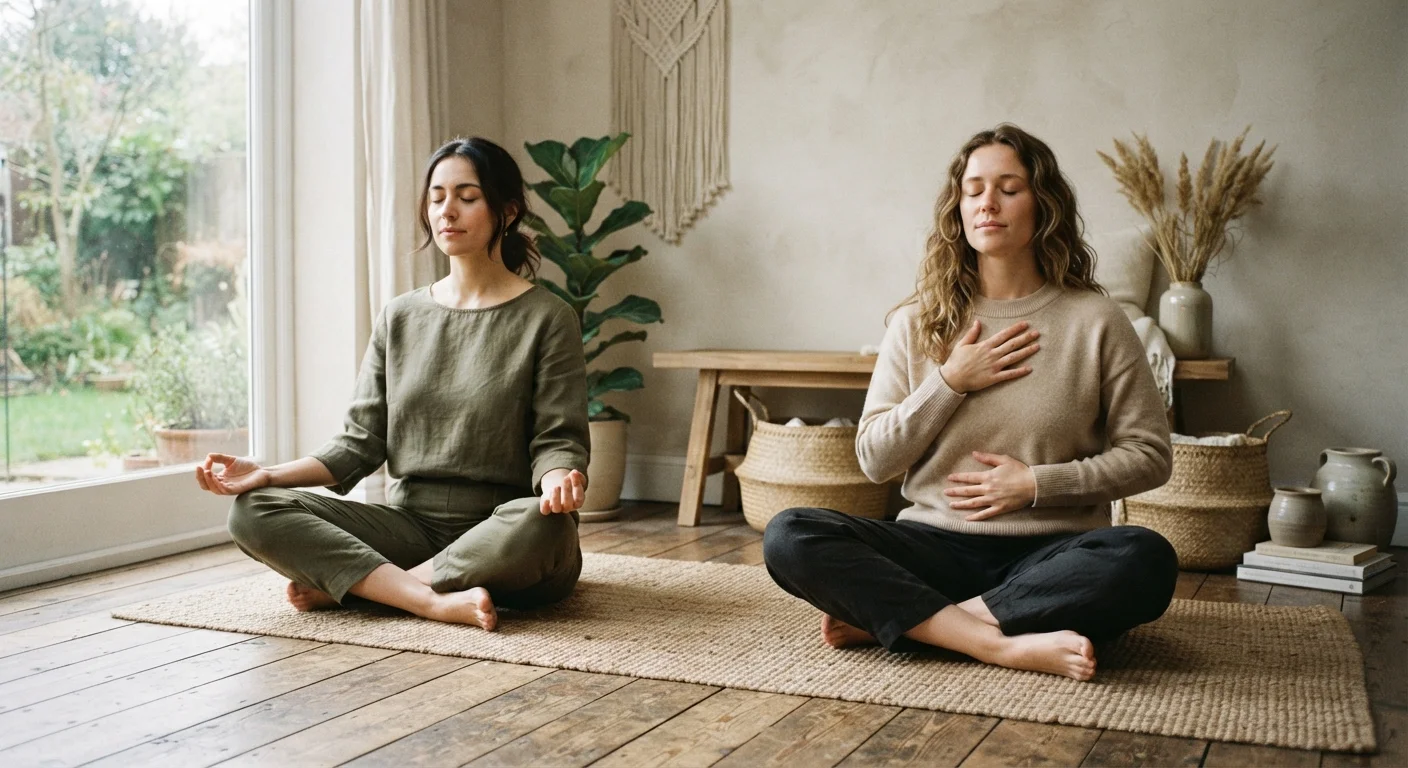
How Each Technique Works
Though both mindfulness meditation and deep breathing are often lumped together as "relaxation techniques," they operate through distinct mechanisms worth understanding.
Deep breathing — sometimes called diaphragmatic or belly breathing — works primarily through the body. Slow, deliberate breaths stimulate the vagus nerve, which signals the parasympathetic nervous system (the body's "rest and digest" system) to counteract the stress response. Heart rate slows, blood pressure can decrease, and stress hormones like cortisol begin to drop. The physiological effect is relatively fast, often noticeable within two to five minutes. This is a direct counter to how chronic stress wears the body down by interrupting the fight-or-flight cycle at the physical level.
Mindfulness meditation works primarily through attention training. It involves deliberately focusing awareness — often on the breath, body sensations, or present-moment experience — and noticing when the mind wanders without judgment. Over repeated sessions, this builds metacognitive awareness: the ability to observe your own thoughts and feelings rather than being swept away by them. Neuroimaging research suggests that consistent practice is associated with structural and functional changes in brain regions linked to stress regulation and emotional processing, though researchers continue to refine understanding of exactly how and when these changes occur.
| Criterion | Mindfulness Meditation | Deep Breathing |
|---|---|---|
| Primary mechanism | Attention training; cognitive awareness | Vagal nerve activation; autonomic nervous system |
| Time to noticeable effect | Weeks of consistent practice | 2–5 minutes per session |
| Session length | Typically 10–20 minutes | 1–10 minutes |
| Learning curve | Moderate; benefits from guidance | Low; learnable in minutes |
| Best use case | Long-term emotional regulation | Immediate stress or anxiety relief |
| Evidence base | Strong; decades of clinical research | Strong; well-established physiology |
| Equipment needed | None (apps optional) | None |
What the Evidence Shows
Both practices carry a meaningful body of research support, though the nature of that evidence differs.
Deep breathing's effects on the autonomic nervous system are well-established and relatively immediate. Studies consistently show reductions in physiological stress markers after controlled breathing exercises. It's widely used in clinical and non-clinical settings — from surgery prep rooms to athletic training — precisely because its effects are reliable and fast.
Mindfulness meditation has accumulated a substantial evidence base over the past three decades, most prominently through Mindfulness-Based Stress Reduction (MBSR), an eight-week structured program developed at the University of Massachusetts. Research has associated regular mindfulness practice with reduced symptoms of anxiety and depression, improved attention, and better emotional regulation. However, it's worth noting that effect sizes vary across studies, and researchers acknowledge that not all mindfulness programs are equivalent in quality or intensity.
~8 weeks
Typical MBSR program duration
The Mindfulness-Based Stress Reduction program, developed at the University of Massachusetts Medical School, runs for eight weeks and is one of the most studied mindfulness interventions.
2–5 min
Time for breathing to reduce acute stress response
Research on slow-paced breathing consistently shows measurable reductions in heart rate and cortisol within a few minutes of practice.
~30 years
Span of active mindfulness research
Scientific investigation into mindfulness meditation's health effects has grown substantially since the 1990s, producing thousands of peer-reviewed studies.
For a broader look at approaches grounded in behavioral science, see stress management strategies backed by behavioral research.
Practical Differences: Time, Effort, and Context
Choosing between these tools often comes down to your situation and what you can realistically commit to.
Deep breathing requires almost no setup. A basic technique — such as inhaling for four counts, holding briefly, exhaling for six counts — can be practiced anywhere: at a desk, in a car (parked), before a difficult conversation, or in a waiting room. No prior training is needed, and even a single session offers noticeable benefit.
Mindfulness meditation, to be effective, generally requires a more sustained commitment. Most evidence-backed benefits are associated with regular practice over several weeks, typically 10–20 minutes per session. Apps, guided audio programs, and community classes can reduce the learning curve, but some initial friction is normal. The payoff — a more stable, less reactive relationship with your own stress — tends to emerge gradually rather than immediately.
These Tools Complement Each Other
Mindfulness meditation and deep breathing are not mutually exclusive — in fact, many structured mindfulness programs use breath awareness as a central anchor. Starting with a few minutes of deep breathing before a meditation session can help settle the nervous system and make focusing easier. Think of them as complementary layers of a single calming practice rather than competing alternatives.
These practices don't have to compete. Many people find deep breathing a useful "gateway" that makes settling into meditation easier, and most mindfulness sessions naturally incorporate conscious breathing as an anchor. Building both into a daily routine, as explored in our guide to structuring your day for emotional health, can offer the immediacy of one and the depth of the other.
This article is for general informational and educational purposes only and is not a substitute for professional medical or mental health advice. If you are experiencing significant anxiety, depression, or other mental health concerns, please consult a qualified healthcare provider.