The Three Rating Systems Explained
Walk down the filter aisle and you'll see at least three different rating labels — MERV, MPR, and FPR. Understanding what each one measures is the first step to buying the right filter.
MERV (Minimum Efficiency Reporting Value)
MERV is the only truly standardized scale, developed by ASHRAE (the American Society of Heating, Refrigerating and Air-Conditioning Engineers). It runs from 1 to 16 for residential use, and up to 20 for medical and industrial applications. The number reflects the filter's ability to trap particles between 0.3 and 10 microns in diameter. A MERV 4 filter catches large debris like lint and dust bunnies; a MERV 13 filter can capture fine particles including some bacteria.
MPR (Microparticle Performance Rating)
MPR is a proprietary scale used by one major filter manufacturer. It focuses specifically on particles smaller than 1 micron — the ultra-fine end of the spectrum. MPR ratings typically range from 300 to 2800. A rough comparison: MPR 600 is broadly similar to MERV 8, and MPR 1500 is roughly comparable to MERV 11–12.
FPR (Filter Performance Rating)
FPR is another proprietary system used by a major home improvement retailer for its store-brand filters. It runs from 4 to 10 and combines particle capture efficiency and airflow resistance into a single color-coded number. FPR 7 is approximately equivalent to MERV 10–11.
Converting Between MPR, FPR, and MERV
Because MPR and FPR are proprietary, there is no official conversion chart endorsed by a standards body. However, filter manufacturers often publish rough equivalency guides on their packaging or websites. When in doubt, MERV is the most portable and reliable reference point to use when comparing filters across brands.
What the Numbers Actually Mean for Your Home
Knowing the scale is helpful, but the key question is: which rating is right for your household?
MERV 8–11
Recommended range for most residential systems
ASHRAE guidance and HVAC industry practice broadly support this range as balancing filtration effectiveness with acceptable airflow resistance for standard home systems.
1–3 months
Typical replacement interval for 1-inch filters
The U.S. Department of Energy and HVAC manufacturers generally recommend checking 1-inch filters monthly and replacing them every one to three months depending on household conditions.
0.3–10 µm
Particle size range the MERV scale measures
ASHRAE Standard 52.2 defines the MERV rating based on a filter's efficiency at capturing particles across this range, covering everything from large dust to fine smoke particles.
- MERV 1–4: Basic fiberglass filters. Protect the HVAC unit from large debris, but do very little for indoor air quality.
- MERV 5–8: Good for most households. Capture dust, pollen, mold spores, and pet dander at a coarser level. Little impact on airflow.
- MERV 9–12: Better filtration of fine dust, auto emissions particles, and finer pet dander. Ideal if someone in the household has allergies or mild asthma. Check system compatibility.
- MERV 13–16: Hospital-grade filtration capturing bacteria and smoke particles. Usually requires a system specifically designed to handle the added resistance.
Households with no pets, no allergy sufferers, and good baseline air quality generally do well at MERV 8. Homes with pets or allergy-sensitive occupants often benefit from MERV 11. Going above MERV 13 in a standard residential system without verifying compatibility can restrict airflow and cause mechanical stress.
When to Upgrade Your Filter Rating
If someone in your household has developed new allergy symptoms, asthma, or respiratory sensitivities, stepping up from MERV 8 to MERV 11 is often a reasonable first move. Before doing so, locate your HVAC system's manual or check the manufacturer's website to confirm the maximum MERV rating the system can handle without reduced airflow.
How to Choose and Change Your Filter Confidently
Once you know your system's requirements, choosing and swapping a filter is a straightforward DIY task.
- Check your HVAC manual or filter slot. Many systems list the maximum MERV rating they support. The existing filter slot size (1-inch vs. 4-inch) also affects which filters fit.
- Note the current filter's size. Write down the three dimensions printed on the filter frame before you go shopping — length, width, and depth in inches.
- Match rating to your household's needs. Use the guidance above as a starting point, and consider consulting an HVAC technician if you want to step up significantly in MERV rating.
- Turn off the system before swapping. This prevents unfiltered air from being pulled through the system during the change.
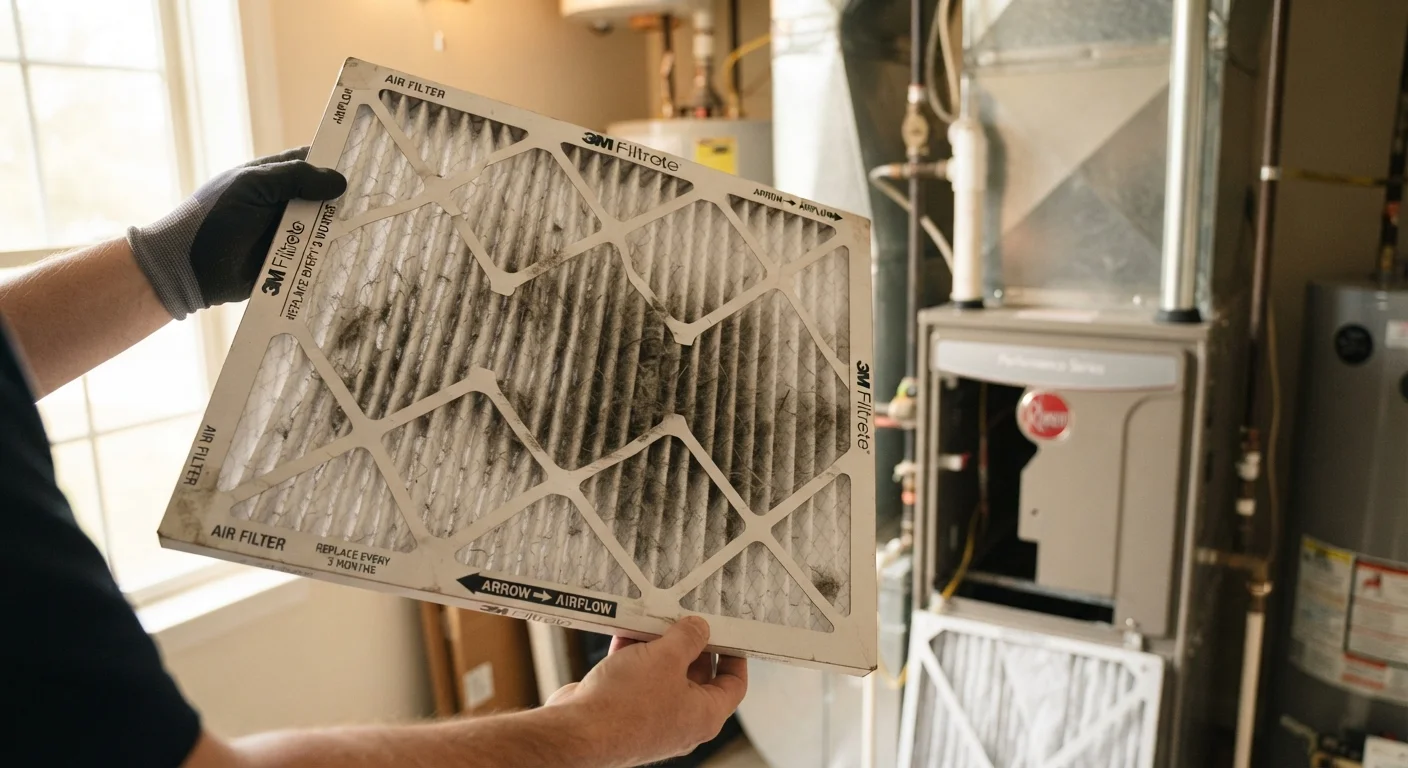
- Install with airflow arrow pointing toward the blower. Every filter has an arrow indicating direction of airflow. Installing it backward reduces effectiveness significantly.
- Set a replacement reminder. Mark the installation date on the filter frame with a marker. Check it monthly and replace it when dirty or per manufacturer guidance.
Just as vehicle filters protect different components — for context, the distinction between cabin and engine filters mirrors how home HVAC filters protect the system versus improving the air you breathe (see how cabin and engine air filters differ) — your HVAC filter has a dual job: protecting the equipment and cleaning your indoor air.