Two Different Tools, One Financial Foundation
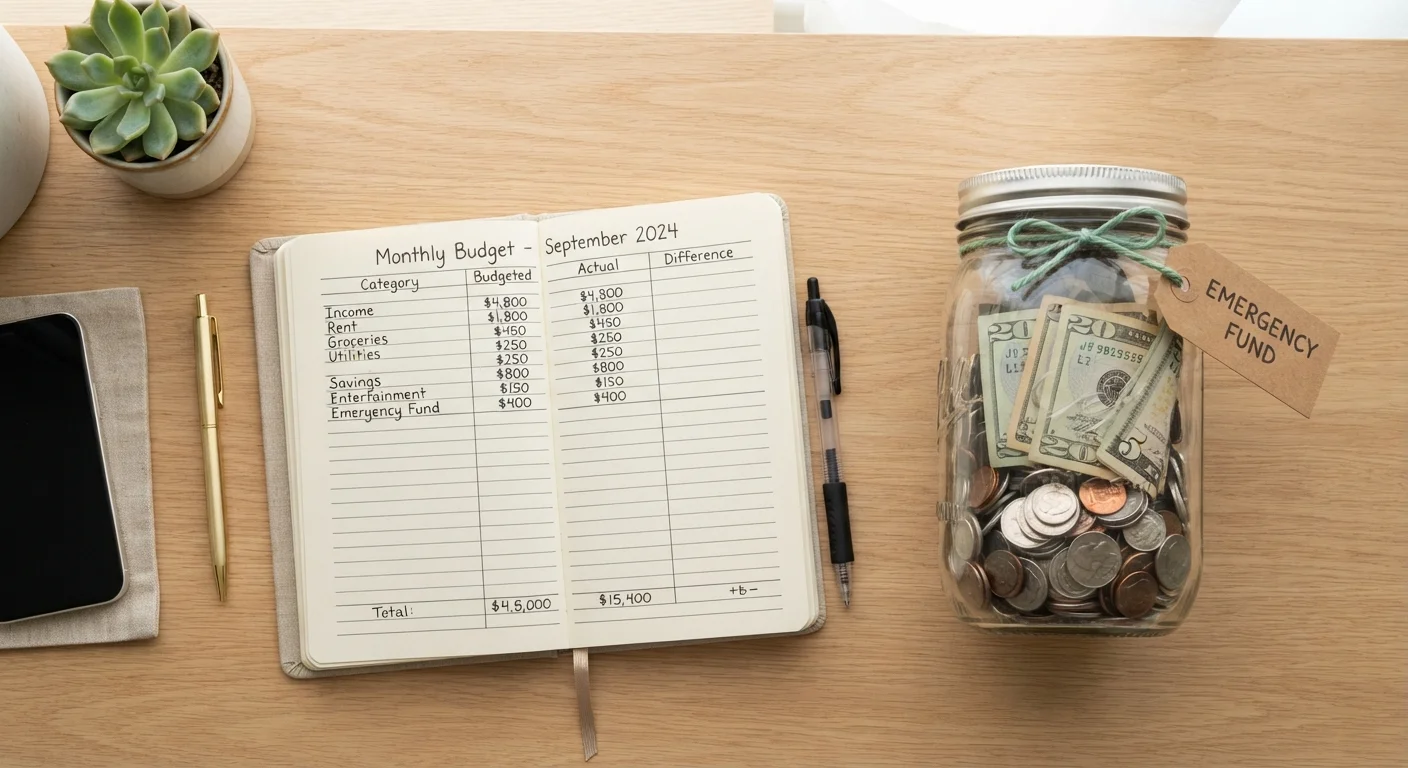
People often treat an emergency fund and a monthly budget as interchangeable — or worse, as competing demands on a limited paycheck. They are neither. Each tool serves a distinct purpose, and understanding that distinction is the first step to making them work together.
A monthly budget is a plan for your regular income and expenses. It tells your money where to go — rent, groceries, utilities, debt payments, subscriptions — before the month begins. It's a forward-looking tool for managing predictable cash flow.
An emergency fund is a pool of saved money set aside exclusively for genuine financial emergencies: an unexpected medical bill, a job loss, a car repair that can't wait. It's not earmarked for a vacation or a planned purchase. It exists to absorb shocks that your budget can't anticipate.
Think of the budget as the operating system of your finances and the emergency fund as the backup power. One keeps things running day to day; the other kicks in when something breaks down unexpectedly. For a deeper look at how much to save and why financial educators consistently recommend building this cushion early, see our guide to emergency fund sizing.
How They Complement Each Other
Without a budget, building an emergency fund is largely accidental — you save whatever happens to be left over, which is often nothing. Without an emergency fund, even a well-crafted budget can collapse the moment an unplanned expense appears. These two realities reveal why the tools are symbiotic, not separate.
| Monthly Budget | Emergency Fund | |
|---|---|---|
| Primary purpose | Manage predictable income and expenses | Cover unexpected financial shocks |
| Time horizon | Month-to-month planning | Held indefinitely as a safety net |
| Where the money lives | Checking or spending account | Separate savings account |
| How it's built | Allocating income across categories | Consistent monthly contributions over time |
| What it protects against | Overspending, debt accumulation | Debt from surprise expenses |
| When you use it | Every single month | Only during genuine emergencies |
Your budget is the mechanism that funds your emergency savings. A dedicated line item — even $25 or $50 a month — creates a consistent transfer to a separate savings account. Over time, that consistency is what builds the cushion. One effective approach is the pay-yourself-first method: treating your emergency fund contribution like a non-negotiable bill at the top of your budget rather than an afterthought. See how pay-yourself-first budgeting works for a practical walkthrough.
Conversely, your emergency fund protects your budget. When an unexpected $800 car repair arrives, having a funded emergency account means you don't have to blow your grocery or rent budget, take on high-interest credit card debt, or borrow from someone else. The budget stays intact because the emergency fund absorbed the hit.
Keep Your Emergency Fund Separate
Store your emergency fund in a separate savings account from your everyday checking account. The physical separation makes it less tempting to dip into for non-emergencies and gives you a clear view of exactly how much of a cushion you have. Many people choose a high-yield savings account so the funds grow modestly while remaining accessible when needed.
Common Mistakes That Pit Them Against Each Other
A frequent mistake is treating the emergency fund as a savings goal to tackle after the budget is perfect. In practice, waiting for the perfect budget means waiting indefinitely. A better approach: build a modest starter emergency fund — often cited as $500 to $1,000 — while you're still refining your budget. It won't cover everything, but it breaks the cycle of reaching for credit every time something unexpected happens.
Don't Wait for a Perfect Budget to Start Saving
Delaying emergency fund contributions until your budget is fully optimized is one of the most common and costly financial missteps. Budget fine-tuning can take months, and a single unexpected expense during that window can send you into debt. Prioritize a small starter fund now — even $25 a month — and refine the broader budget in parallel.
Another mistake is raiding the emergency fund for non-emergencies — a sale that's too good to pass up, a planned trip, or a gift. This erodes the buffer gradually and leaves you exposed when a real emergency hits. Setting clear, written criteria for what qualifies as an emergency (job loss, medical costs, essential home or car repairs) helps protect the fund's purpose.
Finally, some people build a solid emergency fund but neglect to run a budget at all — relying on the cushion as a substitute for spending discipline. An emergency fund is finite. Once it's depleted, the absence of a budget means it's unlikely to be replenished quickly. These tools reinforce each other; neither replaces the other.
For households managing finances jointly, aligning on both the budget and emergency fund rules matters even more. Budgeting as a couple explores how to coordinate these decisions without conflict.
Putting Both Into Practice
Getting these two tools working in tandem doesn't require a financial overhaul. Start by mapping your monthly income against your essential and discretionary expenses — this is your budget baseline. Then identify a realistic amount you can set aside each month for your emergency fund, even if it's small. Automate that transfer so it happens before discretionary spending can absorb it.
Review your budget monthly to track whether your emergency fund contribution is still realistic given your income and expenses. A monthly budget review is a structured way to confirm that your savings line item is holding and that no category is quietly crowding it out.
As your emergency fund grows toward the three-to-six-month target commonly recommended by financial educators, your budget can shift — potentially increasing contributions to other savings goals or paying down debt faster. The two tools scale together. For a comprehensive framework covering every layer of this process, the building a budget that actually lasts guide offers a full picture.
This article is for general informational and educational purposes only and does not constitute personalized financial advice. For guidance tailored to your specific circumstances, consider consulting a qualified financial professional.