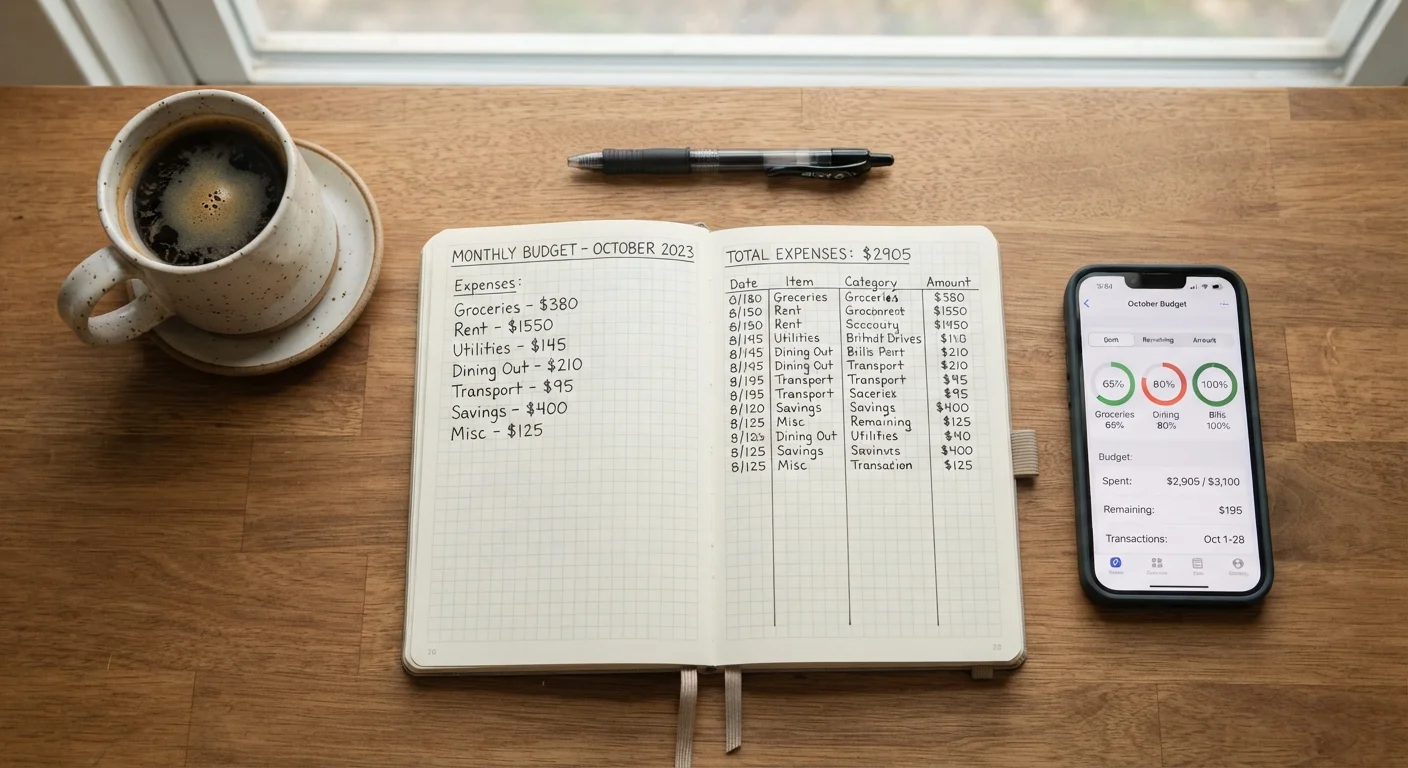
What Each Method Actually Involves
Tracking spending by hand means recording every purchase yourself — whether in a notebook, a printed ledger, or a spreadsheet you maintain manually. You assign categories, add up totals, and review the numbers on your own schedule. It requires discipline and a few minutes each day or week, but the process itself is part of the value.
Using a budgeting app typically means connecting the app to your bank accounts and credit cards. Transactions are imported automatically, categorized by algorithm, and displayed in dashboards or reports. Your main job shifts from data entry to review — checking that categories are correct and responding to what the app surfaces.
Both methods can work. The question is which fits your habits, your financial complexity, and your comfort with technology. For a broader look at how automation can support — or complicate — your financial routine, see our article on automating your finances.
| Criterion | Tracking by Hand | Using a Budgeting App |
|---|---|---|
| Setup time | Minutes — just a notebook or spreadsheet | 15–30 min to link accounts and configure |
| Daily effort required | 5–15 minutes of manual entry | 1–5 minutes of review |
| Accuracy | High if consistent; gaps if entries missed | High automation; errors from miscategorization |
| Privacy risk | Minimal — no third-party data sharing | Moderate — bank credentials linked externally |
| Scalability (multiple accounts) | Burdensome with 3+ accounts | Handles many accounts easily |
| Spending mindfulness | High — entry friction builds awareness | Lower — passive data collection |
| Cost | Free (pen and paper or free spreadsheet) | Free to paid tiers depending on platform |
The Case for Tracking by Hand
The strongest argument for manual tracking is behavioral. Research in behavioral economics consistently suggests that friction in financial decisions can work in your favor — slowing you down enough to make more deliberate choices. Writing out a $47 restaurant tab feels different from watching it appear automatically in an app.
Manual tracking also gives you complete control over your categories and format. You decide what counts as "dining out" versus "groceries," and you don't have to fight an algorithm's misclassifications. For people with irregular income or unconventional spending patterns, that flexibility matters.
Privacy is another genuine advantage. When you track by hand, no third party has access to your banking credentials or transaction history. This isn't a minor concern — app-linked credential systems do carry real security risks, however well-managed most platforms are.
The downside is time and consistency. Manual entry requires showing up every day or two. Miss a week, and catching up becomes a chore that many people abandon entirely. It also doesn't scale gracefully — tracking four bank accounts and two credit cards by hand is genuinely burdensome. If you're concerned about the small expenses that erode budgets over time, spending leaks that silently drain a budget is worth reading alongside whichever method you choose.
~33%
Americans who maintain a detailed household budget
Gallup surveys have consistently found that fewer than one in three U.S. adults keeps a detailed written or tracked budget, suggesting most people rely on informal awareness rather than a formal system.
~70%
Budgeters who abandon their system within months
Financial planning research broadly estimates that the majority of people who start a budgeting routine discontinue it — underscoring that method simplicity and habit fit matter more than tool sophistication.
The Case for Using a Budgeting App
Apps eliminate the most common reason people abandon budgets: the effort of upkeep. When transactions appear automatically, the barrier to maintaining a budget drops significantly. You're more likely to actually look at your numbers when looking takes 90 seconds rather than 20 minutes.
For households juggling multiple accounts — checking, savings, credit cards, a partner's accounts — apps provide a consolidated view that's simply impractical to replicate by hand. If you and a partner share finances, our guide on budgeting as a couple covers how shared digital tools can reduce friction and conflict.
Apps also tend to surface insights you'd miss manually: month-over-month spending trends, category creep, or subscription charges you've forgotten. The visualization tools in most budgeting platforms make patterns visible at a glance.
The trade-offs are real, though. Automation can create a passive relationship with money — you glance at a dashboard but never truly engage with the numbers. App-generated categories are frequently wrong, and correcting them regularly is a habit many users drop. And connecting accounts to any third-party platform involves some level of data-sharing risk that each person must weigh for themselves.
A Note on App Data Practices
Most budgeting apps use read-only access to your accounts via third-party aggregators, meaning they cannot move money — but they do store and process your transaction data. Policies vary significantly between platforms. Before linking your accounts to any app, review its privacy policy and understand how your data may be used or shared. This is general information; consider consulting the app's documentation and your bank's terms for specifics relevant to your accounts.
Choosing What Works for You
There's no universal answer. What matters most is whether you'll actually use the system consistently. A meticulous handwritten ledger beats an abandoned app every time — and an actively used app beats a notebook gathering dust.
Consider starting with the method that has less friction for your current situation. If you're new to budgeting, the deliberateness of manual tracking can accelerate your financial self-awareness in ways an app may not. If you're already stretched thin on time, an app removes the activation energy barrier that derails most budgeting efforts.
Some people find a hybrid approach works well: use an app to capture transactions automatically, then transfer weekly totals into a simple notebook or spreadsheet for reflection. This combines the convenience of automation with the intentionality of manual review. If you're applying spending discipline to a specific goal — like managing costs while traveling — budget travel from planning to return shows how these habits translate to real-world scenarios.
This article is for general informational and educational purposes only and does not constitute personalized financial advice. Consult a qualified financial professional for guidance specific to your situation.