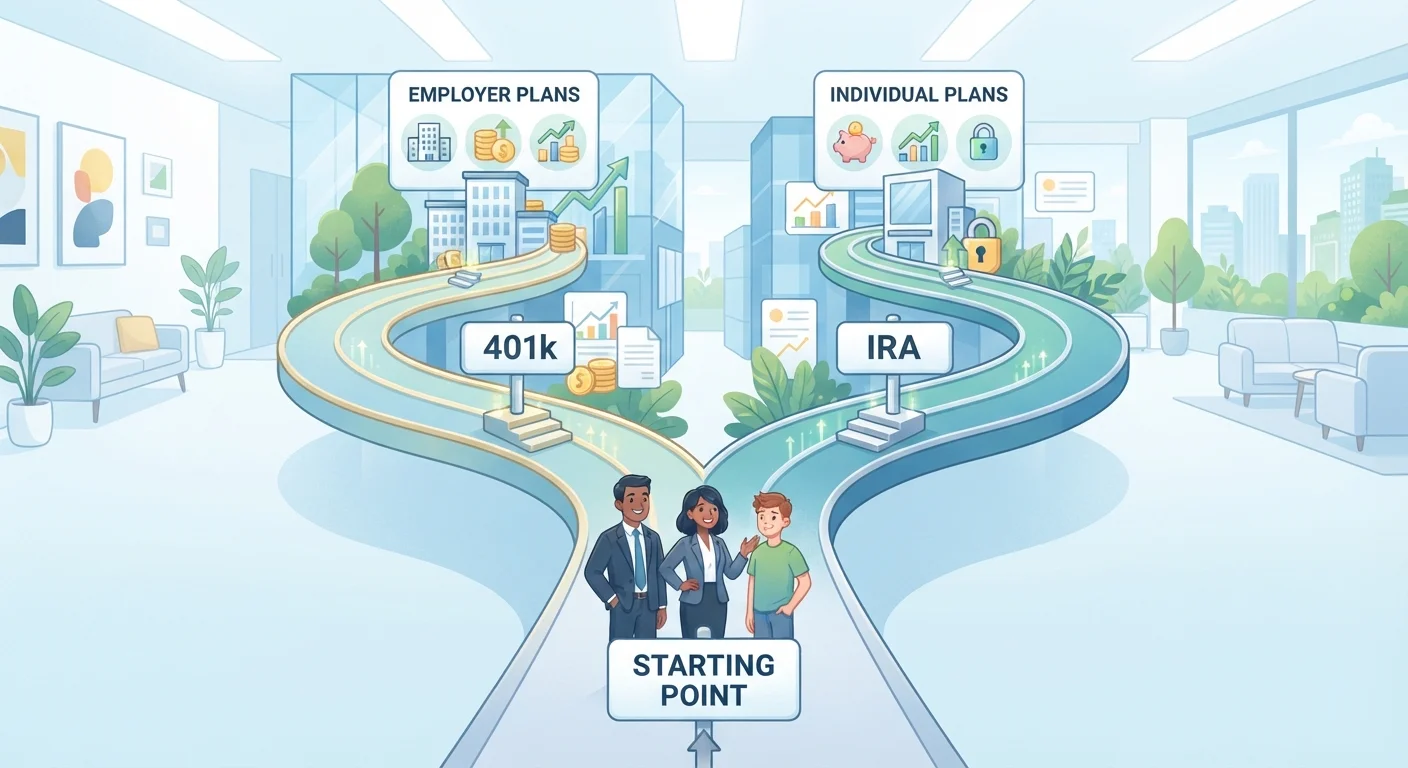
What Each Account Actually Is
A 401(k) is an employer-sponsored retirement savings plan governed by your company's plan rules and the IRS. You contribute a portion of each paycheck — before or after taxes, depending on the plan type — and investments grow tax-advantaged until withdrawal. Many employers sweeten the deal with matching contributions up to a certain percentage of your salary.
An IRA (Individual Retirement Account) is an account you open on your own, through a bank, brokerage, or financial institution. It is not tied to any employer. You fund it yourself up to annual IRS limits, and your money grows tax-advantaged based on whether you choose a traditional or Roth structure.
Both accounts exist specifically to encourage long-term retirement saving — the tax benefits are the reward for keeping the money invested for the long haul. If you are just starting out, our beginner's guide to investing covers how these accounts fit into a broader financial plan.
| Criterion | 401(k) | IRA |
|---|---|---|
| Who opens it | Employer on your behalf | You, independently |
| Annual contribution limit (general) | Significantly higher (IRS-set) | Lower ceiling (IRS-set) |
| Employer matching | Often available | Not available |
| Investment choices | Limited to plan menu | Broad (stocks, funds, bonds) |
| Roth option available | Yes (Roth 401(k)) | Yes (Roth IRA) |
| Income limits to contribute | None | Yes, for Roth IRA |
| Early withdrawal penalty | 10% + taxes (with exceptions) | 10% + taxes (with exceptions) |
| Loans against balance | Sometimes allowed | Not allowed |
Tax Treatment: Traditional vs. Roth
Both 401(k)s and IRAs come in two flavors: traditional and Roth. The difference comes down to when you pay taxes.
- Traditional accounts accept pre-tax contributions, reducing your taxable income today. You pay ordinary income tax when you withdraw funds in retirement.
- Roth accounts accept after-tax contributions — no upfront deduction. Qualified withdrawals in retirement, including earnings, are tax-free.
Choosing between traditional and Roth generally hinges on whether you expect your tax rate to be higher now or in retirement. Younger investors often benefit from the Roth structure because they typically have lower incomes today and more years for tax-free growth to compound. However, this is a nuanced decision — a qualified tax professional or financial adviser can help you weigh your specific situation.
~3x
Higher 401(k) vs. IRA contribution ceiling
The IRS sets 401(k) annual contribution limits at roughly three times the IRA limit, giving higher earners substantially more room to shelter income.
10%
Early withdrawal penalty before age 59½
Both 401(k) and IRA early withdrawals typically incur a 10% IRS penalty on top of ordinary income tax, with limited exceptions.
Note that Roth IRA contributions — not Roth 401(k) — are subject to income limits. Higher earners may find their ability to contribute directly to a Roth IRA phased out. Consult IRS guidelines or a tax adviser for current threshold figures.
Contribution Limits and Employer Matching
One of the most practical differences between the two accounts is how much you can put in each year. The IRS sets these limits and adjusts them periodically for inflation.
In recent years, 401(k) plans have carried contribution limits roughly three times higher than IRA limits. Employees 50 and older can also make additional "catch-up" contributions to both types of accounts, though the 401(k) catch-up allowance is considerably larger.
The employer match is a feature unique to 401(k) plans. If your employer matches, say, 50% of your contributions up to 6% of your salary, that is additional compensation — not just a tax benefit. Financial educators consistently emphasize maxing out the employer match as a priority before directing savings elsewhere.
You Can — and Often Should — Use Both
A 401(k) and an IRA are not mutually exclusive. Many financial educators recommend contributing enough to your 401(k) to capture the full employer match, then funding a Roth or traditional IRA for greater investment flexibility, and returning to the 401(k) if you still have room. Using both accounts together can maximize your total tax-advantaged savings. Discuss the sequencing with a qualified financial adviser to fit your income and goals.
For workers without access to a workplace plan, starting with an IRA is a practical, low-barrier entry point into tax-advantaged saving.
Access Rules, Penalties, and Flexibility
Both accounts are designed for retirement, so the IRS discourages early access. Withdrawals taken before age 59½ generally face ordinary income tax plus a 10% early withdrawal penalty, with limited exceptions such as first-time home purchase (Roth IRA contributions only), disability, or certain hardship situations.
A key flexibility advantage of the Roth IRA: your contributions (not earnings) can be withdrawn at any time without tax or penalty, because you already paid tax on that money. This makes it a somewhat more accessible account in a financial emergency, though drawing on retirement savings early is generally best avoided.
401(k) plans may offer loans against your balance — IRAs do not. However, 401(k) loans come with risks: if you leave your job, the outstanding balance typically becomes due quickly, and unpaid amounts may be treated as taxable distributions.
Understanding how these choices connect to your overall time horizon is important. Our article on time horizon and asset allocation explores how the length of your investment window should shape your strategy inside these accounts.
This article is for general informational and educational purposes only and does not constitute personalised financial, tax, or legal advice. Contribution limits, income thresholds, and rules change periodically. Consult a qualified financial adviser or tax professional before making decisions specific to your situation.