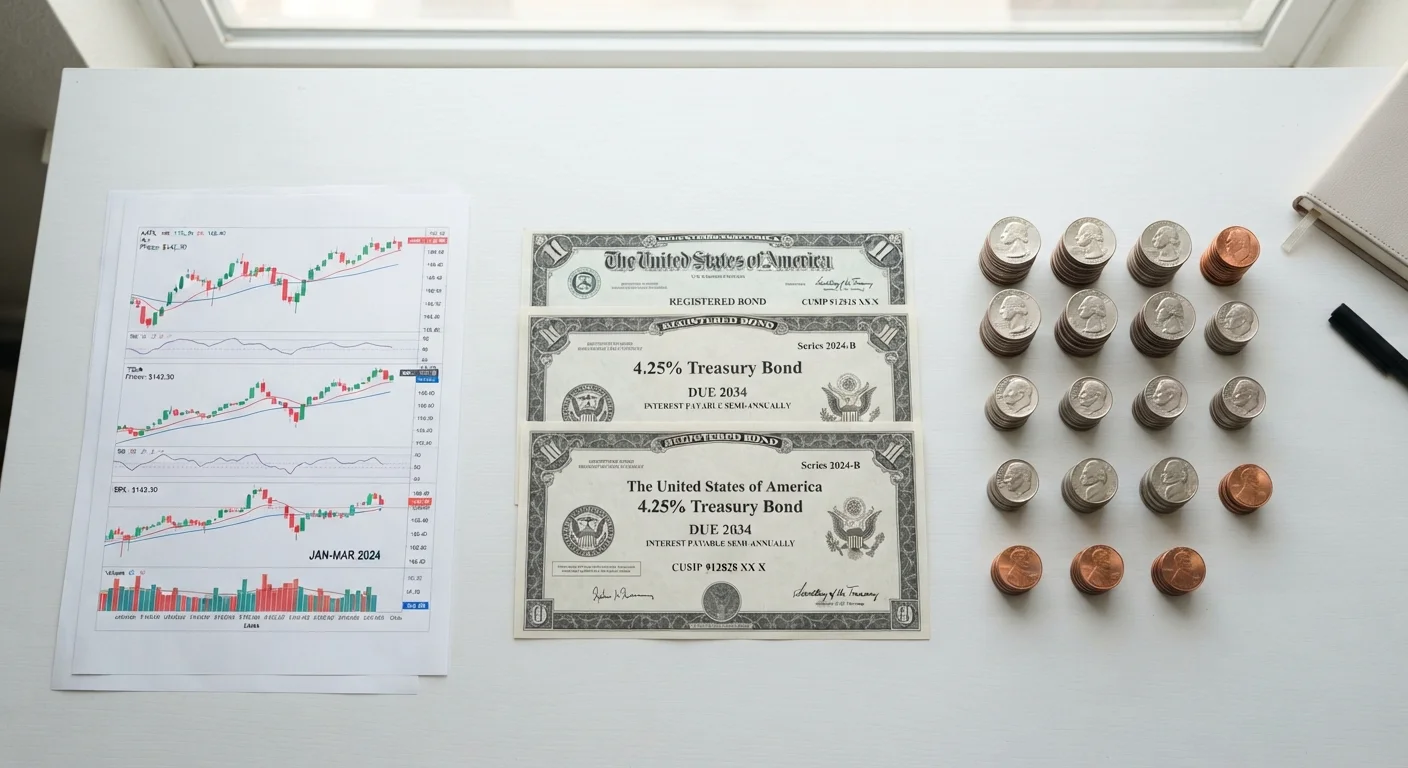
Why These Three Asset Classes Matter
Every investment portfolio — from a beginner's first brokerage account to a pension fund managing billions — is built from some combination of three foundational asset classes: stocks, bonds, and cash. Understanding what each one does, and why they behave differently, is the starting point for making sense of investing.
These aren't just abstract categories. They represent fundamentally different relationships between you and your money. When you buy a stock, you become a part-owner of a company. When you hold a bond, you're acting as a lender. When you keep cash or cash equivalents, you're prioritizing stability and accessibility over growth.
Most portfolios use all three because each asset class tends to perform differently depending on economic conditions. That mix is a core principle explored in diversification, and it's one of the most reliable ways investors manage risk over time. If you're just getting started, Investing from Scratch provides a broader foundation for understanding how these pieces fit together.
| Primary asset classes | Stocks, bonds, and cash |
| Stock return type | Price appreciation and/or dividends |
| Bond return type | Regular interest (coupon) payments |
| Cash return type | Interest; preserves principal |
| Relative risk level | Stocks > Bonds > Cash (generally) (Risk levels vary by specific security and issuer) |
| Typical long-term growth driver | Stocks |
| Typical stability anchor | Bonds and cash |
Stocks: Ownership and Growth Potential
A stock (also called a share or equity) represents fractional ownership of a company. When a company issues stock to the public, it's raising capital in exchange for giving investors a stake in its future performance.
Stocks offer two potential sources of return: price appreciation (the share price rises over time) and dividends (periodic cash payments some companies distribute to shareholders). Historically, stocks have provided higher long-term returns than bonds or cash — but that comes with higher short-term volatility. Stock prices can fall sharply during recessions, market corrections, or periods of uncertainty.
Because of this growth potential paired with volatility, stocks are generally considered more appropriate for longer time horizons. The longer you have before you need the money, the more time you have to ride out downturns. Understanding how growth compounds over time is central to this logic — see how compound interest builds long-term wealth for a closer look.
Asset Class
A broad category of investments that share similar characteristics and behave similarly in the market. Stocks, bonds, and cash are the three primary asset classes.
Equity (Stock)
A security representing partial ownership in a company. Equity holders may benefit from price appreciation and dividends, but bear the risk of losses if the company underperforms.
Bond
A fixed-income debt instrument in which an investor lends money to an issuer for a set period in exchange for interest payments and return of principal at maturity.
Coupon Rate
The annual interest rate paid by a bond issuer to the bondholder, expressed as a percentage of the bond's face value.
Cash Equivalent
A short-term, highly liquid investment that can be quickly converted to cash with minimal risk of loss, such as a money market fund or Treasury bill.
Volatility
The degree to which an investment's price fluctuates over time. Higher volatility means larger potential swings — both up and down — in value.
Purchasing Power Risk
The risk that inflation will erode the real value of cash or low-return investments over time, reducing what your money can actually buy.
Maturity
The date on which a bond's principal is due to be repaid to the bondholder. Bond terms can range from a few months to thirty or more years.
Bonds: Lending and Income
A bond is a debt instrument. When you buy a bond, you're lending money to an issuer — a corporation, a municipality, or the federal government — in exchange for regular interest payments (called the coupon) and the return of your principal at maturity.
Bonds are generally considered lower-risk than stocks because the repayment terms are contractually defined. However, they're not risk-free. Credit risk means the issuer could default; interest rate risk means bond prices typically fall when interest rates rise. Bonds issued by the U.S. government are widely considered among the lowest-risk bonds available, while corporate bonds carry more risk in exchange for potentially higher yields.
Because bonds tend to be more stable than stocks, they're often used to reduce overall portfolio volatility — particularly as investors approach a goal or retirement. How much of your portfolio belongs in bonds is closely tied to your time horizon, a concept covered in Time Horizon and Asset Allocation.
3 Classes
Core building blocks of nearly every portfolio
Stocks, bonds, and cash form the foundational categories that institutional and individual investors alike use to construct diversified portfolios.
Inverse
Common relationship between bond prices and interest rates
When prevailing interest rates rise, existing bond prices generally fall — a key dynamic for bond investors to understand before buying.
Varies
Ideal stock-to-bond ratio by investor
There is no universal allocation formula; the right mix depends on your time horizon, risk tolerance, and financial goals — factors best reviewed with a financial adviser.
Cash: Stability and Accessibility
In an investment context, cash refers not just to physical currency but to cash equivalents — instruments like money market funds, Treasury bills, and high-yield savings accounts that preserve your principal and remain easily accessible.
Cash earns a modest return (typically through interest), doesn't fluctuate in value the way stocks and bonds do, and can be converted to other investments quickly. Its primary role in a portfolio is stability: it cushions against losses in volatile markets and keeps funds readily available for near-term needs or opportunities.
The tradeoff is purchasing power risk. Over time, inflation can erode the real value of cash holdings, which is why most long-term investors don't hold large amounts indefinitely. Keeping an appropriate cash reserve, however, is a foundational habit — one that connects directly to building solid savings habits before or alongside investing. If your budget feels limited right now, Getting Started with Investing When You Have Limited Savings offers a realistic roadmap.
This article is for general informational and educational purposes only and does not constitute personalized financial, investment, or tax advice. Consult a licensed financial professional before making investment decisions based on your individual circumstances.