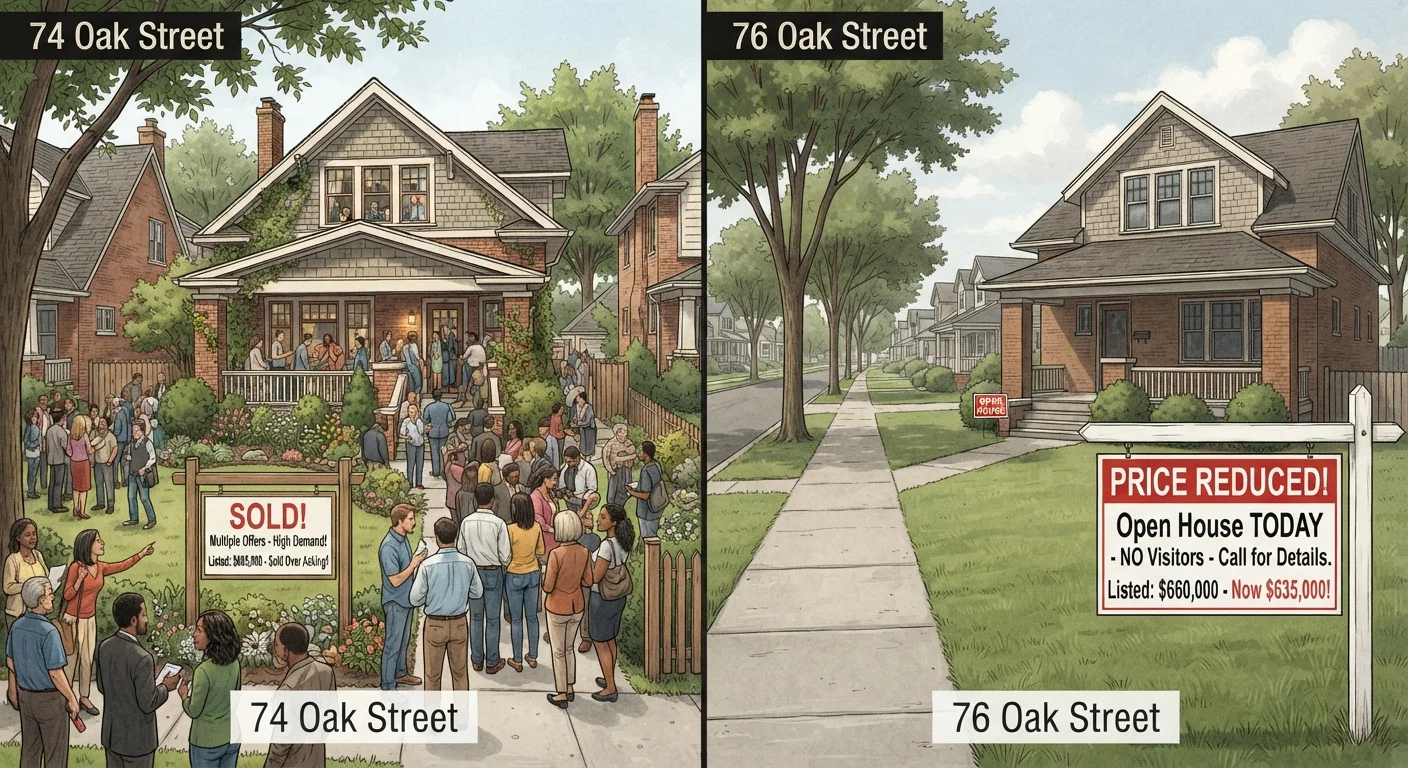
The Core Difference: Supply, Demand, and Who Has the Power
Real estate markets are fundamentally driven by supply and demand. A buyer's market exists when the number of homes for sale exceeds the number of active buyers. A seller's market is the reverse — more buyers competing for fewer homes. That imbalance determines who negotiates from a position of strength.
The standard industry benchmark is months of supply, which measures how long it would take to sell all current listings at the current pace of sales. Roughly six months of supply is considered a balanced market. Below that signals a seller's market; above it points to a buyer's market. Local associations of Realtors and the National Association of Realtors (NAR) publish this data regularly, making it one of the most accessible market indicators available.
Other signals reinforce the picture: days on market (how long homes sit before going under contract), the sale-to-list price ratio (whether homes sell above or below asking), and the frequency of price reductions all help confirm which environment you're navigating. To learn how to gather and interpret these indicators for a specific area, see sizing up a local housing market.
| Criterion | Buyer's Market | Seller's Market |
|---|---|---|
| Months of supply | Above 6 months | Below 6 months |
| Days on market | Longer — weeks to months | Short — often days |
| Sale-to-list price ratio | Below asking price common | At or above asking price common |
| Buyer negotiating power | Strong — concessions feasible | Weak — sellers set terms |
| Contingencies | Standard contingencies expected | Buyers may limit contingencies |
| Price reductions | Frequent | Rare |
| Competition among buyers | Low | High — multiple offers common |
What Each Market Actually Means in Practice
The difference between these two market types isn't just academic — it shapes every tactical decision a buyer or seller makes.
In a buyer's market:
- Sellers are more willing to negotiate on price, closing costs, and repair requests.
- Buyers can include contingencies — inspections, financing, appraisal — without losing competitive ground.
- Homes sit on the market longer, giving buyers time to compare options and avoid rushed decisions.
- List prices may already reflect downward pressure, but further negotiation is reasonable.
In a seller's market:
- Multiple-offer situations are common, often driving sale prices above the asking price.
- Buyers may waive certain contingencies to make offers more attractive — a decision that carries real risk and should be made carefully with professional guidance.
- Sellers can be selective about terms, closing timelines, and buyer qualifications.
- Homes often go under contract within days, leaving little room for deliberation.
6 months
Supply level indicating a balanced market
The National Association of Realtors uses six months of housing supply as the benchmark for a market in equilibrium between buyers and sellers.
~30 days
Median days on market in a competitive seller's market
In high-demand periods tracked by NAR, the national median time on market has fallen well below historical averages, reflecting intense buyer competition.
Neither market type is inherently good or bad — it depends entirely on which side of the transaction you're on. A seller's market that feels frustrating to a buyer is ideal for the homeowner listing down the street.
Why Market Conditions Aren't One-Size-Fits-All
National headlines about housing markets can be misleading. Real estate is hyper-local: a metro area experiencing a seller's market overall can contain specific zip codes, price ranges, or property types that behave very differently. A luxury condo market and an entry-level single-family market in the same city may not share the same dynamics at all.
Supply also comes in more than one form. Builder activity and new construction inventory interact with resale supply in ways that can shift conditions even when broader trends appear stable. New construction vs. existing homes explores how those supply types signal different things about where a market may be heading.
Before acting on any trend headline — whether it suggests a buying opportunity or a seller's windfall — it's worth pressure-testing what the data actually says about your specific situation. A housing market checkup offers a practical framework for doing exactly that.
Market Conditions Change — Sometimes Quickly
Interest rate shifts, local employment changes, and broader economic cycles can move a market from one condition to the other within months. A neighborhood that was a seller's market during a low-rate environment may cool significantly when borrowing costs rise and affordability tightens. Always verify current local data rather than assuming conditions described in older reports still apply.
Finally, market conditions interact directly with the rent-vs-buy calculation. A favorable buyer's market doesn't automatically make purchasing the right move — your financial stability, timeline, and local price-to-rent ratios all matter. Renting vs. owning in a shifting market provides a framework for working through that trade-off honestly. For a broader overview of the purchase process, the buying a home hub is a useful starting point.