Portugal Is Much Larger Than Its Capital
Lisbon earns its acclaim — it's a genuinely remarkable city. But travelers who return home having seen only the capital often feel they've glimpsed Portugal through a keyhole. The country's regions vary so dramatically in landscape, food culture, pace, and character that they can feel like separate countries stitched together by a common language and Atlantic coastline.
What follows is a realistic, region-by-region overview designed to help you set accurate expectations — not to oversell any single destination, but to match your interests and travel style to the place most likely to reward them. If the idea of spending longer in fewer places appeals to you, our guide to slow travel planning explores why that approach tends to produce richer experiences.
The Alentejo: Cork Forests, Slow Lunches, and Walled Hill Towns
Stretching across roughly a third of Portugal's landmass, the Alentejo is one of Western Europe's least densely populated regions — and that's a significant part of its appeal. The landscape alternates between cork oak forests, vast wheat plains, and ancient hilltop towns like Monsaraz and Marvão, where medieval walls ring whitewashed villages with virtually no traffic noise.
The regional food culture is distinct and deeply local: thick bread soups (açordas), slow-braised pork, and bold, often tannic red wines produced from indigenous grape varieties. Meals here are an event, not a transaction. Expect long lunches at family-run restaurants where the menu may be dictated verbally and changes daily.
Practical note: the Alentejo is largely a driving destination. Public transit connects the larger towns (Évora has good rail links from Lisbon), but reaching the smaller fortified villages requires a rental car. Summer temperatures regularly exceed 40°C (104°F), so spring and autumn are generally the most comfortable seasons for exploration.
The Alentejo's cork forests, hilltop villages, and long lunches reward travelers who genuinely enjoy unhurried days.
The Douro Valley: Europe's Oldest Demarcated Wine Region
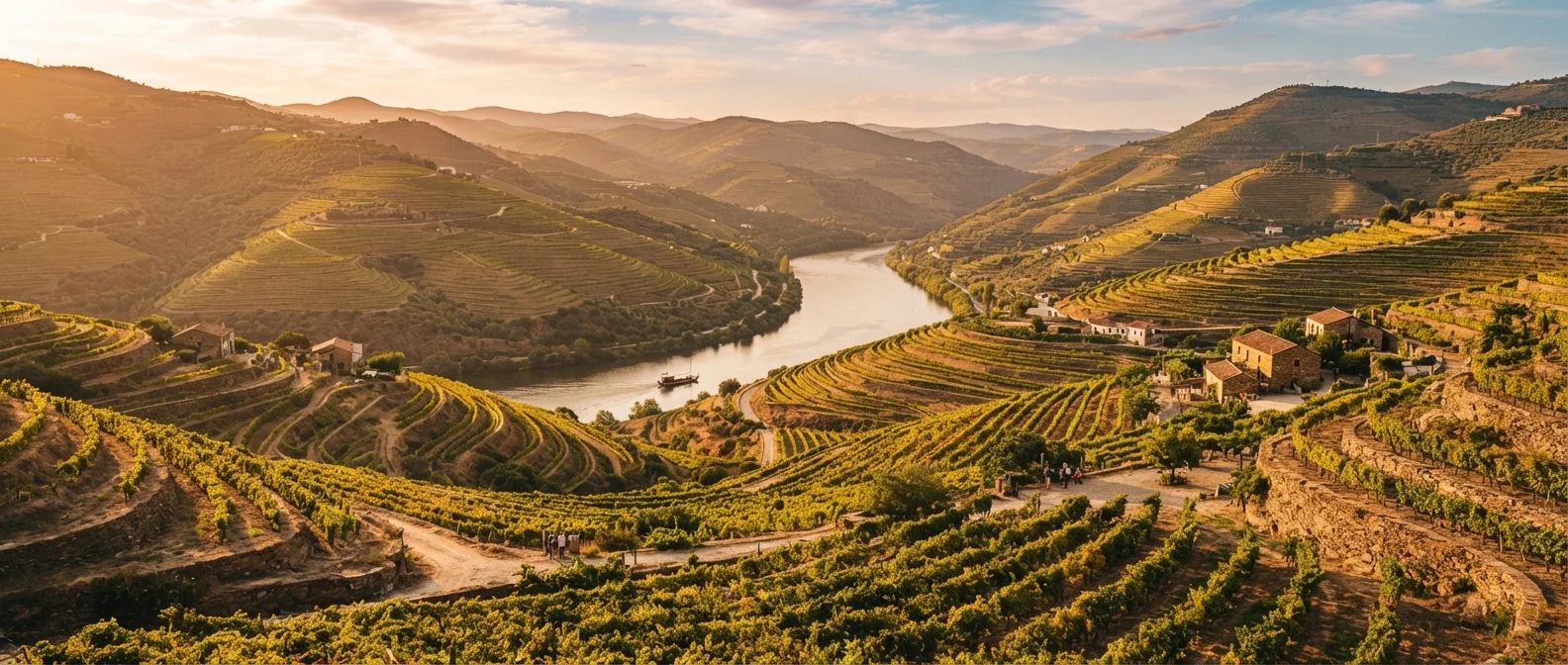
The Douro Valley — recognized in 1756 as the world's first legally demarcated wine region — is one of Portugal's most visually dramatic landscapes. The river carves through steeply terraced schist hillsides, many of which have been cultivated for centuries. The village of Pinhão sits at the heart of the region and serves as a practical base.
Beyond wine tourism, the Douro offers excellent hiking on the Douro Vinhateiro trail network, scenic train journeys from Porto to Pocinho, and small quintas (wine estates) where visitors can often arrange tastings and accommodation directly. It's a working agricultural valley, not a theme park — harvests happen in September and early October, when the region is at its most animated.
Access from Porto by train is straightforward and highly scenic, taking roughly two to three hours. The valley's narrow roads can be challenging to navigate by car, particularly after dark, so plan daylight driving if possible.
The Douro's terraced vineyards and scenic train journey from Porto make it one of Portugal's most rewarding day trips or overnight stays.
The Azores: Nine Islands, One Archipelago, Countless Landscapes
Located roughly 1,500 kilometers off Portugal's Atlantic coast, the Azores archipelago is technically part of Portugal but feels like its own world. The nine islands vary considerably: São Miguel offers volcanic crater lakes, geothermal hot springs, and lush green highlands; Faial and Pico appeal to sailors, whale-watching enthusiasts, and hikers tackling Portugal's highest peak; Flores is remote even by Azorean standards, with waterfalls and near-total tranquility.
Travelers should enter the Azores with weather flexibility built into their plans. The archipelago's Atlantic position means conditions can shift rapidly, and inter-island flights are sometimes delayed or cancelled. This isn't a destination for rigid itineraries — it rewards the traveler who can adapt. For entry and any current travel requirements, always verify with official Portuguese and your home country's government sources before travel, as requirements can change.
The Azores tend to attract nature-focused travelers, divers, and those seeking genuine detachment from urban rhythms. If that sounds like you, few European destinations deliver it as completely.
The Azores reward flexible travelers — weather variability is real, but the volcanic landscapes and Atlantic solitude are unlike anywhere else in Europe.
The Minho: Green Portugal Along the Spanish Border
The Minho region in Portugal's northwest is sometimes called "Green Portugal" — a reference to its rainfall and the resulting lushness, which stands in stark contrast to the sun-baked Alentejo. The region borders Spain's Galicia along the Minho River and shares cultural and culinary overlap, including a love of fresh seafood, granite architecture, and vinho verde — the light, slightly effervescent white wine produced throughout the region.
Braga, one of Portugal's oldest cities, anchors the region with impressive religious architecture, a lively student population, and a restaurant scene that has developed considerably in recent years. The walled city of Viana do Castelo offers coastal access and a well-preserved historic center. For walkers, the Minho forms part of the Portuguese route of the Camino de Santiago.
Infrastructure here is solid — rail connections from Porto to Braga are fast and frequent — making the Minho one of the more accessible regions for travelers without a rental car.
The Minho's green landscapes and easy rail access from Porto make it one of Portugal's most underrated and accessible regions.
The Beira Interior: Schist Villages and Genuine Solitude
The Beira Interior, occupying the mountainous interior between Coimbra and the Spanish border, remains largely off the radar of international tourism — and that absence is both its challenge and its character. The region contains the Serra da Estrela, the highest mountain range on the Portuguese mainland, along with dozens of aldeias do xisto (schist villages) whose stone architecture blends so seamlessly with the surrounding landscape that they seem grown rather than built.
Visitors should arrive with realistic expectations: services are limited, English is less commonly spoken outside the larger towns, and some of the most rewarding villages involve navigating unmarked rural roads. Accommodations range from simple guesthouses to converted manor homes. The regional cheese — queijo Serra da Estrela — is considered among Portugal's finest and is reason enough for some travelers to make the trip.
This is a region for travelers comfortable with genuine remoteness, not manufactured rusticity. If that appeals, the Beira Interior offers something increasingly rare: a rural Portuguese landscape that functions entirely on its own terms.
The Beira Interior's schist villages and Serra da Estrela mountains offer genuine remoteness — rare and rewarding for travelers seeking it.
Choosing Your Portugal
None of these regions is universally "better" than another — they simply suit different travelers. The Alentejo rewards those who genuinely enjoy unhurried afternoons. The Douro demands some comfort with winding roads and limited public transit. The Azores require flexibility around weather. The Minho suits walkers and culture-seekers. The Beira Interior is genuinely off the tourist map, which is precisely its appeal for some and a dealbreaker for others.
Build in travel days between regions
Portugal's regions are closer together on a map than they feel when you're moving between them. Switching from the Douro to the Alentejo, for example, takes the better part of a day by car or requires an overnight in Lisbon. Build buffer days into your itinerary rather than treating connections as simple logistics. You'll arrive at each destination less tired and more ready to engage with it.
Whatever you choose, resist the temptation to cover too much ground. Portugal's regions are best absorbed slowly, not checked off a list.