Why the Southwest Rewards — and Humbles — Road Trippers
The American Southwest — Arizona, Utah, Nevada, and New Mexico at its core — holds some of the most dramatic scenery on earth. Slot canyons, towering mesas, ancient ruins, and skies unpolluted by light draw millions of visitors every year. But the region also has a way of exposing the gap between a traveler's expectations and the actual conditions on the ground.
This guide doesn't exist to discourage you. It exists so that the Southwest delivers what it promises — breathtaking, humbling, genuinely memorable travel — rather than a series of expensive surprises. The travelers who struggle here are almost always the ones who underestimated it. The ones who thrive are the ones who planned for what it actually is.
“The desert tells a different time. You have to slow down, or it will slow you down on its own terms.”
— Edward Abbey, Author and essayist, known for 'Desert Solitaire'
The Distance Problem: What the Map Doesn't Convey
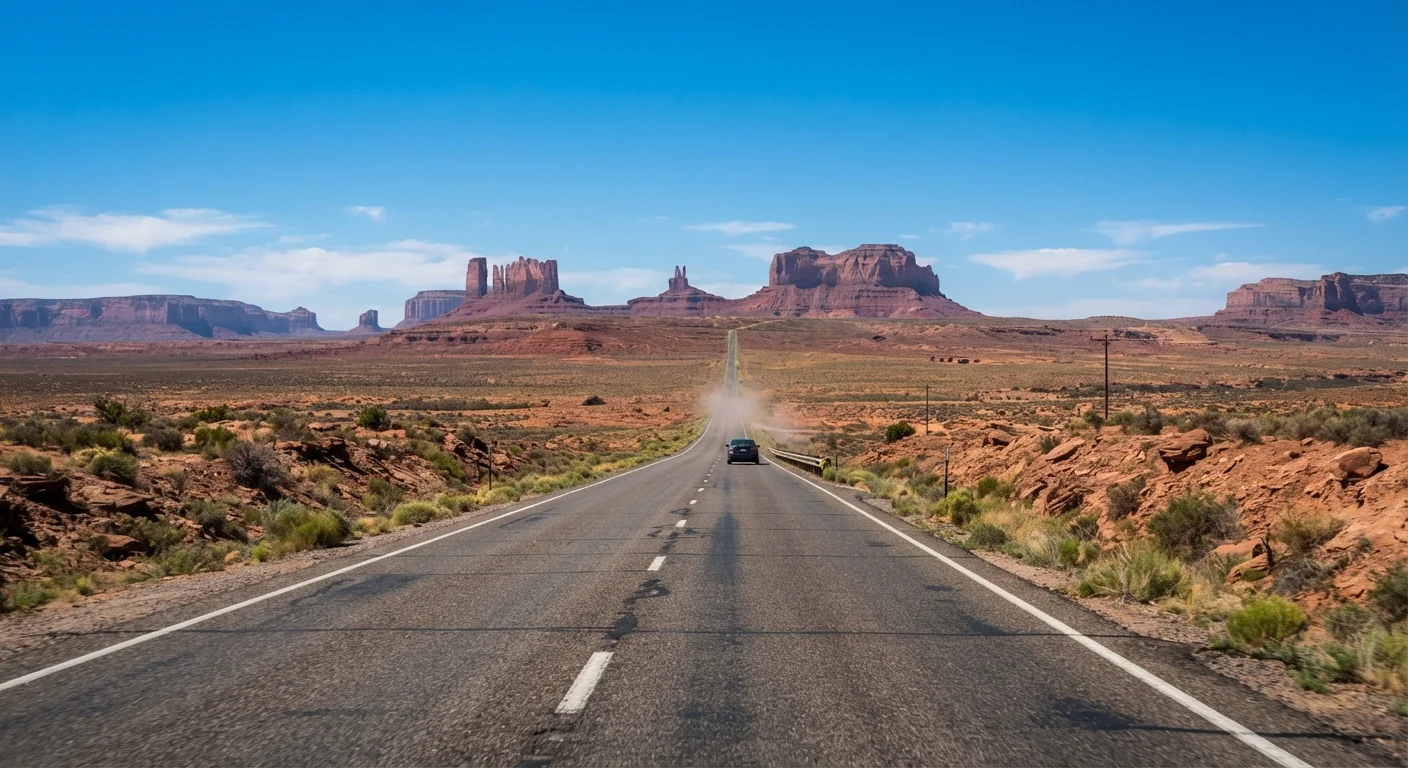
On a standard road atlas, the drive from Las Vegas to the North Rim of the Grand Canyon looks manageable — a few inches of highway. In practice, it's around 270 miles and takes well over four hours with no stops, much of it through empty plateau country where there is simply nothing. This pattern repeats across the region.
A common mistake is chaining too many landmarks into a single day: Monument Valley, Antelope Canyon, and Horseshoe Bend, say, followed by a drive to Moab. Each leg looks short until you're doing it in late afternoon sun with a car that's been running for hours.
Plan your driving day to end by early afternoon — not because of traffic, but because late-afternoon heat and fatigue in remote country is a real safety factor, and evening light over desert landscapes is worth stopping to experience.
Driving fatigued in areas with no services and limited cell coverage multiplies the consequences of a minor vehicle issue or wrong turn.
Before leaving any town, check your fuel gauge against the next confirmed gas station on your route, not just the next dot on a map — many map apps mark closed or seasonal stations as open.
Outdated mapping data has left travelers stranded in remote Southwest corridors where the next station was 80 or more miles beyond what the app indicated.
A realistic planning rule of thumb: assume 200–250 miles as a comfortable daily driving ceiling, not 400. If you're also hiking, that ceiling drops further. For a deeper look at structuring multi-destination itineraries, see the anatomy of a well-planned trip.
270+ miles
Las Vegas to Grand Canyon North Rim
A common Southwest pairing that catches road trippers off guard — over four hours of drive time before any stops.
110°F+
Peak summer temperatures in low desert areas
Temperatures regularly recorded in Phoenix, AZ, and Moab valley floors during June–August, per National Weather Service historical data.
6,800 ft
Elevation of the Grand Canyon South Rim
Altitude effects — reduced stamina, headaches — are commonly reported by visitors arriving from low-elevation cities.
Heat, Altitude, and Weather That Changes Fast
Summer temperatures in the lower desert — Phoenix, Moab valley floors, parts of Nevada — regularly exceed 110°F (43°C). At those temperatures, hiking after 9 a.m. carries real risk. Heat exhaustion can develop faster than most people expect, especially at elevation, where lower humidity creates a false sense of comfort while UV exposure remains intense.
Altitude is a separate factor. Flagstaff sits at roughly 7,000 feet, the South Rim of the Grand Canyon at about 6,800 feet. Visitors arriving from sea-level cities frequently underestimate how much this affects exertion — headaches, shortness of breath, and reduced stamina are common in the first day or two.
Flash Flooding Is a Year-Round Risk in Canyon Country
Slot canyons and narrow desert washes can flood explosively with no warning and no local rain — a storm miles away is enough. Never enter a canyon if storms are in the forecast for the broader region. Always check conditions with the local ranger station or land management agency the morning of your visit, and follow any closure or evacuation guidance without delay.
Weather also shifts dramatically by season and by elevation. Monsoon season (roughly July through September) brings sudden, intense afternoon thunderstorms across much of Arizona and New Mexico. Flash flooding in canyon country can occur with no local rain — a storm miles upstream sends water rushing through narrow slots. Always check conditions with the relevant land management agency before entering canyon terrain.
Services, Cell Coverage, and Self-Sufficiency
Between Page, Arizona, and the Utah state line, there is one gas station. Between Moab and Monticello, there are effectively no services. These gaps are the norm, not the exception, across most of the rural Southwest. Running low on fuel here is not a minor inconvenience — it can be genuinely dangerous, particularly in summer heat.
Cell service drops out across enormous stretches of Utah, Arizona, and New Mexico. Downloaded offline maps (not just cached tiles) are essential. So is a written or printed version of your route and accommodation confirmations — assuming your phone will work when you need it is a planning error.
Stock Your Vehicle Before Leaving Town
Fill your tank at every opportunity when you're below half — don't wait for the low-fuel warning in a region where the next station may be 60 miles away. Keep at minimum two gallons of water per person in the vehicle, plus emergency snacks, a basic toolkit, and a paper map. These aren't overcautions; they're standard practice for anyone who drives Southwest back roads regularly.
Carry more water than you think you need. The National Park Service recommends at least one liter per hour of hiking in hot conditions. A vehicle breakdown kit, a physical first-aid kit, and enough food to last an unplanned overnight are minimum standards for remote Southwest driving.
If you're new to independent trip planning, this beginner's guide to independent travel planning covers logistics that are especially relevant to remote destinations.
Budgeting Realistically for a Southwest Road Trip
The Southwest looks like budget-friendly territory — camping is cheap, scenery is free — until you price out the actual trip. Gas costs are significant given the distances involved. Entrance fees at national parks, state parks, and tribal lands add up quickly. The America the Beautiful annual pass (available from the National Park Service) can offer meaningful value if you're visiting multiple federal sites, but it doesn't cover tribal-managed sites like Antelope Canyon, which charge their own fees and require guided tours.
Lodging near the most popular parks — Zion, Bryce Canyon, Arches — carries a substantial premium, particularly in peak season. Gateway towns like Springdale, Utah, and Moab can surprise travelers who expect rural pricing. For approaches to keeping multi-state driving trips financially manageable, see strategies for stretching a road trip budget.
Permits, Crowds, and Timing Your Visit
The era of showing up and figuring it out is largely over in the most popular Southwest corridors. Zion's iconic Narrows requires planning around flow rates and flash flood forecasts. The Wave in the Vermilion Cliffs requires a lottery permit, with demand far exceeding supply. Antelope Canyon requires advance booking through authorized Navajo Nation tour operators. Coyote Gulch and many other Utah canyon routes now have daily visitor caps.
Spring (late March through May) and fall (September through October) are widely considered the most workable seasons — manageable temperatures, longer daylight hours, and lower risk of monsoon flooding compared to summer. Winter offers genuine solitude at most sites and stunning snow-dusted red rock scenery, but some roads and facilities close, and conditions require appropriate vehicle capability and preparation.
The scale of planning the Southwest demands compares in some ways to the preparation required for remote destinations like Alaska — see how travelers consistently underestimate Alaska's distances for a perspective on what serious remote-region planning looks like.
Building a Trip That Actually Works
The most successful Southwest road trips share a common structure: fewer destinations, more time at each, and deliberate buffer built into the schedule. A week is enough to do one or two parks justice. Two weeks allows a broader circuit without the feeling of being perpetually behind.
Anchor your itinerary around two or three must-do experiences, then build the route to support them rather than trying to collect landmarks. Accept that the driving itself — through country that looks like another planet — is part of the experience, not lost time between stops.
For a comprehensive framework to build any trip from the ground up, this end-to-end resource on budget travel planning offers structured guidance from initial budgeting through to post-trip tracking.
The Southwest doesn't reward rushing. It rewards travelers who've done the honest work of preparing for what it actually is — vast, demanding, and entirely worth it.