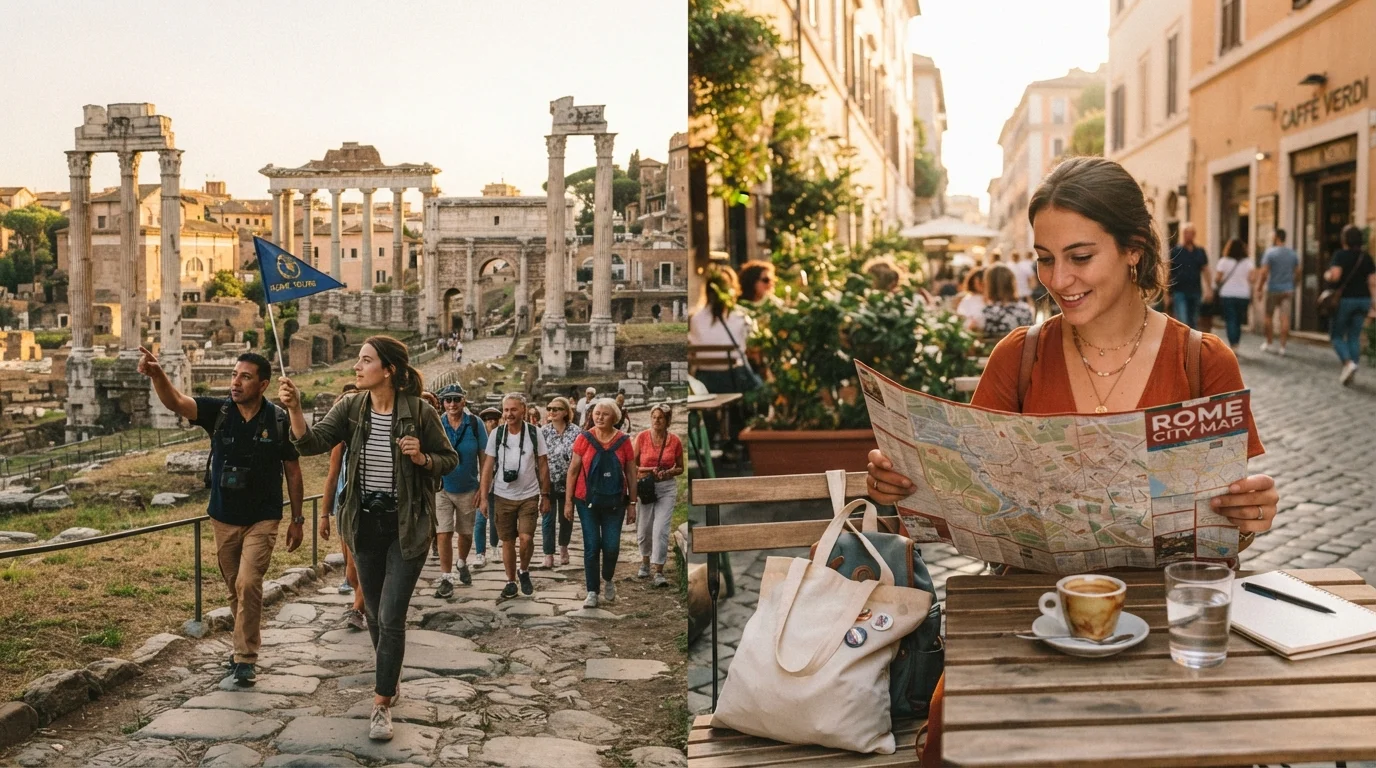
What Separates These Two Frameworks
At their core, guided tours and independent travel represent two different relationships with uncertainty. A guided tour — whether a multi-week itinerary managed by an operator or a single-site walking tour — hands the logistics to someone else. Transportation, accommodation, entry tickets, and pacing are largely predetermined. Independent travel means you own every decision, from which train to catch to where you eat lunch.
That distinction ripples into nearly every aspect of a trip. Understanding the practical differences, rather than treating one as inherently superior, is what allows you to build a framework that actually fits your trip. For a deeper look at how any trip comes together, see our guide to the anatomy of a well-planned trip.
| Criterion | Guided Tours | Independent Travel |
|---|---|---|
| Planning effort | Low — operator handles logistics | High — traveler manages all details |
| Flexibility | Limited — fixed schedule and itinerary | Full — change plans at any time |
| Cost predictability | High — bundled, upfront pricing | Variable — depends on choices made |
| Local expertise | Built-in via professional guide | Self-sourced through research |
| Social dynamic | Built-in group of fellow travelers | Entirely self-determined |
| Pacing | Set by operator or group | Fully personal |
| Ideal destination type | Complex, unfamiliar, or remote | Well-documented, accessible |
The Real Costs: Time, Money, and Mental Load
Cost comparisons between guided and independent travel are rarely straightforward. A guided tour bundles expenses — guide fees, group transport, sometimes meals and accommodation — into a single price that can appear higher but actually reflects real value when you account for what's included. Independent travelers often spend less overall, but only if they invest meaningful time in research and booking.
The less-discussed cost is mental load. Planning a two-week independent trip through multiple countries involves coordinating visas, transport connections, accommodation across different cities, and activity bookings — all before you leave home. For travelers who find that process energizing, it's part of the fun. For those who find it stressful, it can cast a shadow over the entire experience before the trip even starts.
~60%
Travelers who research trips independently online
Travel industry surveys consistently show the majority of leisure travelers use online research tools to plan at least part of their itinerary before booking.
8–12 hrs
Average planning time for a multi-destination independent trip
Travel planners and consumer surveys suggest independent travelers spend significant hours on logistics before departure, not counting on-the-ground decision-making.
Budget-conscious travelers will find that independent travel rewards effort with savings — but it's worth being honest about how much planning time you realistically have. Our travel on a budget hub covers approaches that work whether you're going guided or going solo.
Flexibility, Depth, and the Spontaneity Question
One of the most cited advantages of independent travel is flexibility — the freedom to stay an extra night in a town you love or skip a museum that doesn't interest you. That flexibility is real, but it requires a well-structured itinerary that doesn't leave you scrambling. Our article on building a travel itinerary without over-scheduling is a useful companion here.
Guided tours trade that spontaneity for depth. A knowledgeable local guide at an archaeological site, a national park, or a culturally layered city neighborhood can transform a surface-level visit into something genuinely memorable. Many travelers who pride themselves on independent exploration still book half-day guided experiences at specific destinations — and that hybrid model is worth considering seriously.
The Hybrid Model Is More Common Than You Think
Many experienced travelers don't commit exclusively to one framework — they build independent itineraries and layer in guided experiences at specific sites or cities. A private food tour in one city, a self-guided hiking day the next. This approach captures local expertise where it adds the most value while preserving overall freedom. It's worth budgeting for one or two guided experiences even if you're broadly planning an independent trip.
For travelers who are new to planning trips entirely on their own, the jump to full independence can feel steep. Our guide for first-time independent travelers walks through every stage of the process in plain, practical terms.
How to Decide: A Framework for Your Trip
Rather than choosing a side, think about your specific trip along three axes: destination complexity (how difficult is it to navigate independently?), experience level (how comfortable are you planning logistics from scratch?), and travel companions (are you coordinating with others whose preferences differ from yours?).
A first trip to rural Japan or a multi-country itinerary through Central Asia carries more logistical weight than a week in a single European city with good English signage. Complex destinations tend to favor guided frameworks — or at least guided components. Familiar or well-documented destinations are where independent travel really shines.
Traveling with a group adds another layer. When five people have different budgets, interests, and pacing preferences, independent group travel requires real coordination — our group trip planning guide covers those dynamics honestly. A guided tour can sidestep a lot of that friction by standardizing the experience.
If you're still weighing timing decisions alongside format decisions, the comparison of early planning vs. last-minute booking offers a useful parallel framework for thinking through trade-offs.