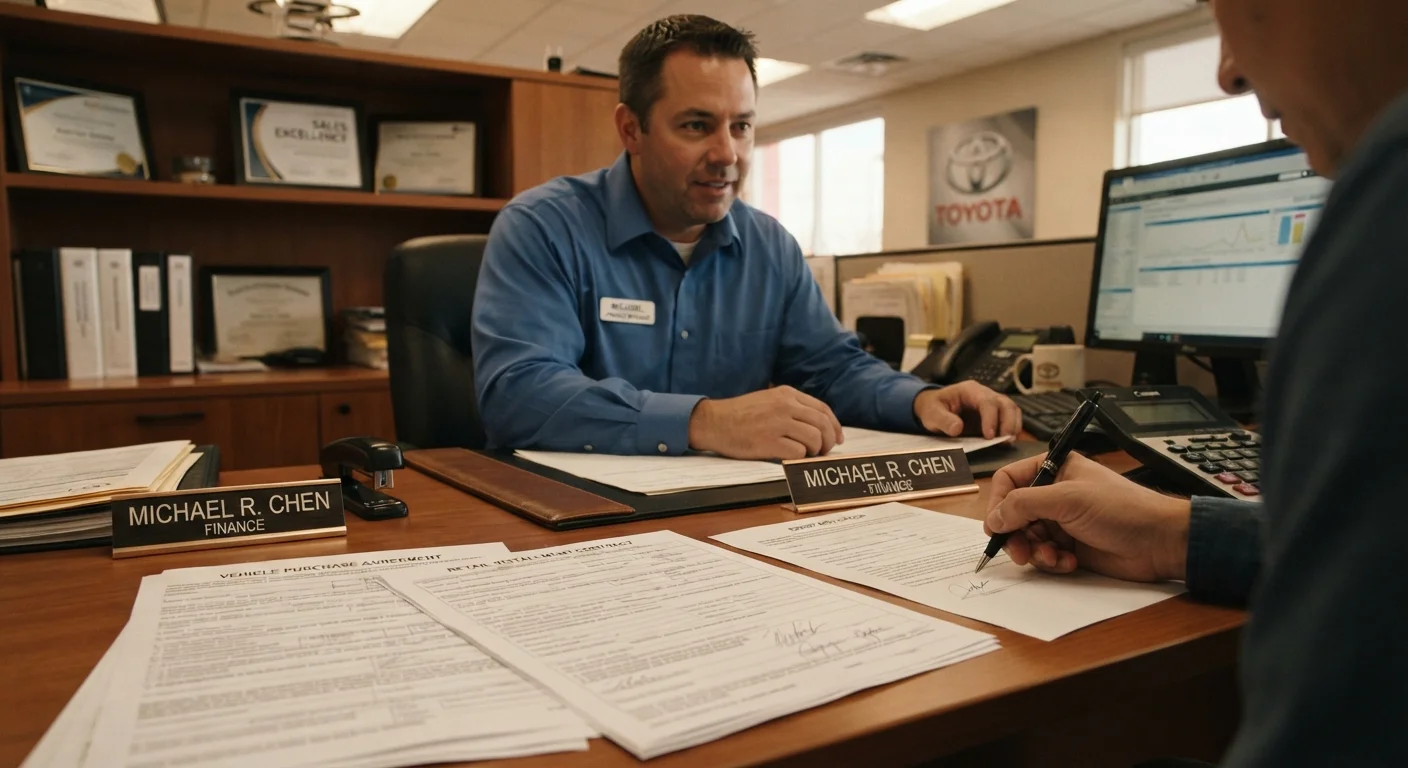
What Happens at the Finance Desk
After you agree on a vehicle price, you're typically handed off to the finance and insurance (F&I) manager - a dealership staff member whose role is to finalize your loan paperwork and present additional products for purchase. This stage of the transaction is often where buyers feel the most pressure and have the least preparation.
Common products presented at the F&I desk include extended service contracts (often called extended warranties), GAP insurance, tire and wheel protection, paint or fabric protection packages, credit life insurance, and key replacement programs. These are bundled into your loan if you accept them, meaning their cost quietly inflates your monthly payment rather than appearing as a separate out-of-pocket expense.
Understanding the full financial picture of owning a vehicle before you walk into the dealership helps you approach the F&I office with clearer expectations.
You Can Say No to Any Add-On
Dealership finance products are optional purchases, not loan conditions. A lender cannot require you to purchase an extended warranty or paint protection in order to approve your loan. If a finance manager implies otherwise, ask them to put the requirement in writing - most will clarify that the products are indeed optional. Taking time to review each item is not only reasonable, it's advisable.
Breaking Down the Most Common Add-Ons
Extended Service Contracts
Often marketed as "extended warranties," these are technically service contracts that take effect after the factory warranty expires. They can cover powertrain, mechanical, or electrical components - but coverage terms vary significantly. Read what is explicitly excluded before deciding.
GAP Insurance
Guaranteed Asset Protection (GAP) insurance covers the difference between what you owe on your loan and what the vehicle is worth if it's totaled or stolen. This is most relevant in the early months of a loan when depreciation can leave you "underwater" - owing more than the car's market value. Your regular auto insurer may offer GAP at a lower premium than the dealership.
Tire and Wheel Protection
This covers repair or replacement of tires and wheels damaged by road hazards. It can be useful if you drive in an area with poor road conditions, but check whether your standard auto policy already covers this.
Appearance Packages
Paint sealants, fabric protection, and rustproofing are frequently presented as high-value treatments. In practice, many vehicles already receive adequate factory-applied protection, and the markup on dealership-applied treatments is typically substantial.
If you're purchasing a certified pre-owned vehicle, check what protections already come included before agreeing to duplicate coverage.
Pros and Cons of Accepting Finance Office Products
As with any financial decision, the value of these products depends heavily on your individual circumstances - your vehicle, your loan terms, your driving habits, and your personal risk tolerance. Here is a balanced look at the core tradeoffs.
Can reduce out-of-pocket repair costs after factory warranty
Extended service contracts may provide financial predictability for repairs on vehicles prone to expensive mechanical issues, particularly if you plan to keep the car long-term.
GAP insurance protects against negative equity
If your car is totaled early in the loan, GAP coverage prevents you from paying off a vehicle you no longer own - a real risk when putting little money down.
Convenient single point of purchase
Bundling products into your loan at the dealership is administratively simple, avoiding the need to research and purchase coverage through separate channels.
Tire and wheel plans can cover costly road hazard damage
In areas with significant pothole or road debris issues, a tire and wheel plan may offset repair costs that standard auto insurance doesn't cover.
Significant markup over actual cost of coverage
Dealership F&I products typically carry substantial profit margins. The same or equivalent coverage is often available through insurers or third-party providers at a meaningfully lower price.
Costs are rolled into the loan, accruing interest
When add-ons are financed rather than paid upfront, you pay interest on them over the life of the loan, increasing the total cost beyond the listed price.
Overlap with existing coverage is common
Buyers may unknowingly purchase protections that duplicate their existing auto insurance policy, manufacturer warranty, or credit card travel benefits.
Contract terms can limit real-world usefulness
Extended service contracts often contain exclusions, deductibles, and maintenance record requirements that can complicate or deny claims when you need coverage most.
Appearance packages rarely deliver proportional value
Paint sealants and fabric treatments are among the highest-margin products in the F&I office and offer protections that often duplicate factory-applied coatings or are available at retail for a fraction of the price.
Before finalizing anything, ask the F&I manager to provide a full itemized list of all add-ons with their individual prices. You are entitled to decline any product without affecting your loan approval.
How to Evaluate Each Product Before You Sign
The most effective approach is to treat each add-on as a standalone purchase decision, separate from the vehicle itself. Ask these questions for each product offered:
- What exactly does this cover? Request the full contract terms, not just a verbal summary.
- Can I buy this elsewhere? GAP insurance, extended service contracts, and some coverage plans can be purchased through your insurer or a third-party provider - often at a lower cost.
- What's the cancellation policy? Many products are cancellable within a set period if you change your mind, and the refund is typically applied to your loan balance.
- Does the factory warranty or an existing policy already cover this? Overlapping coverage rarely pays off.
The negotiation doesn't end at the vehicle price. Understanding how dealership negotiations work can help you stay grounded when the conversation shifts to add-ons.
$1,000-$3,000+
Typical extended warranty markup range
Consumer advocacy organizations have noted that dealership-sold extended service contracts are commonly marked up well above the provider's cost, with margins varying by dealership and contract type.
~20%
Vehicles totaled before loan payoff
Industry data suggests a meaningful share of financed vehicles are involved in total-loss events during the loan term, making GAP insurance a relevant consideration for undercollateralized loans.
This article is for general informational purposes only. Coverage terms, pricing, and availability vary by dealership, provider, and region. Consult your insurance agent or a licensed financial professional before making decisions about loan-related products.