What Each Training Style Actually Involves
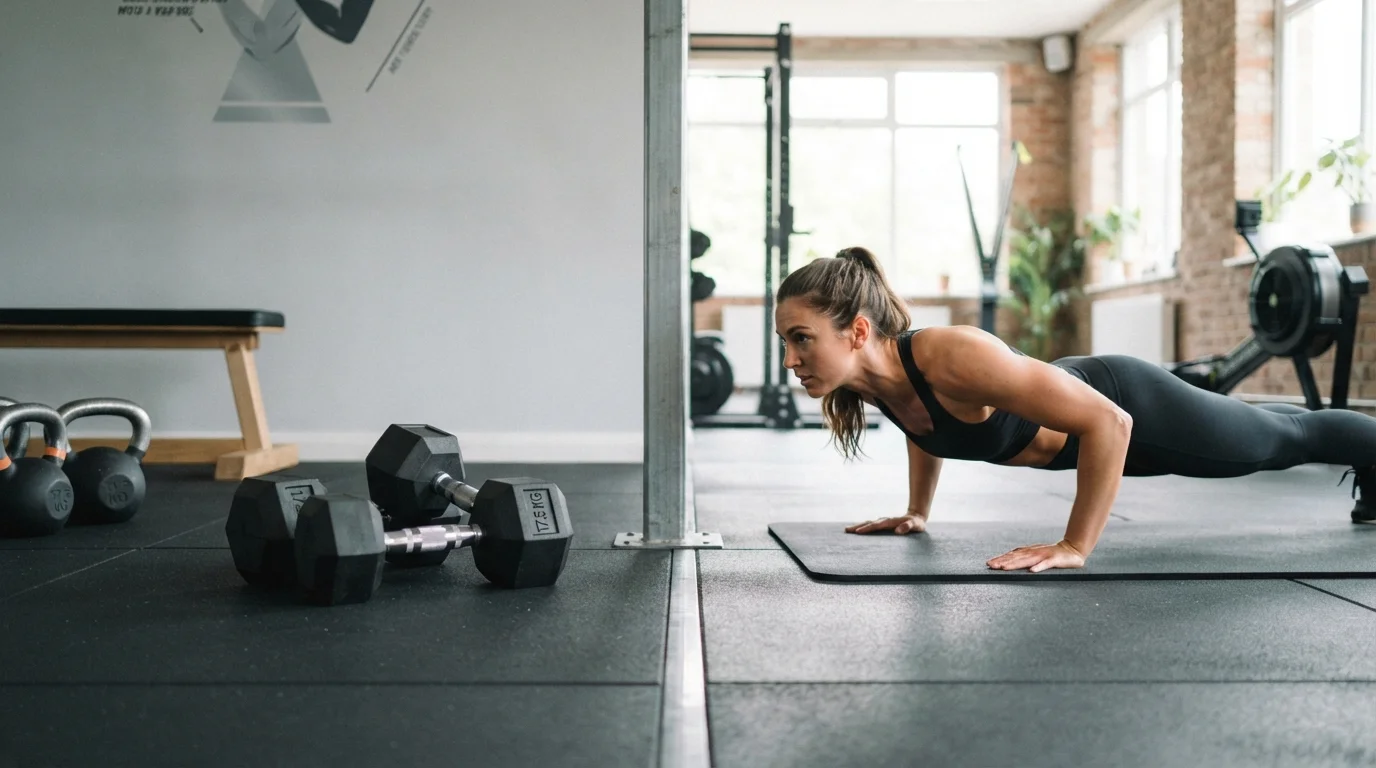
Bodyweight training uses your own mass as resistance - think push-ups, squats, lunges, pull-ups, and planks. It demands no external equipment and can be performed virtually anywhere. Because your body is the weight, the challenge is modulated by changing leverage, angle, or movement complexity rather than adding plates.
Free weight training uses dumbbells, barbells, or kettlebells to apply external load to movements. This includes exercises like the dumbbell row, barbell squat, or kettlebell deadlift. The defining feature is that you can increase resistance in small, measurable increments over time - a cornerstone of structured strength programming.
Before committing to either approach, it's worth doing some honest groundwork. Our self-assessment checklist for building a new fitness routine can help you identify your starting point and realistic goals.
| Criterion | Bodyweight Training | Free Weight Training |
|---|---|---|
| Equipment needed | None | Dumbbells, barbells, or kettlebells |
| Cost | Free | Low to moderate upfront investment |
| Ease of progression | Requires creative variation | Straightforward incremental load increases |
| Best for beginners | Yes - low barrier to entry | Moderate - technique learning curve |
| Builds muscle hypertrophy | Yes, with sufficient volume/intensity | Yes, highly effective |
| Portability | Fully portable | Limited - requires equipment access |
| Joint control & balance | Strong emphasis | Depends on exercise selection |
| Scalability over years | Requires skill progression | Highly scalable via load |
Strengths and Limitations of Each Approach
Bodyweight training excels at developing relative strength - the ability to control and move your own body - alongside balance, coordination, and joint stability. These qualities translate directly into everyday movement. It is also highly accessible: no gym membership, no equipment cost, and no barrier to getting started today. The limitation is that progression can become less intuitive as you advance. Moving from a standard push-up to a pike push-up or an archer push-up requires creativity and practice rather than simply adding weight.
Free weights make progressive overload explicit and measurable. You add 5 lb to a dumbbell curl and you've quantified your progression. Research consistently supports progressive overload as a primary driver of strength and muscle development. The trade-offs are real, though: equipment costs money, correct technique carries a learning curve, and some exercises warrant supervision, particularly for those new to lifting. For context on how to think about setting up a home training environment with free weights, see our guide on what you actually need for a home workout.
~2x/week
Minimum resistance training frequency for strength gains
The American College of Sports Medicine recommends training each major muscle group at least twice per week for general strength development.
No significant difference
Muscle growth: bodyweight vs. free weights at matched intensity
A 2017 review in the Journal of Human Kinetics found comparable hypertrophy outcomes between bodyweight and external-load resistance training when volume and effort are equated.
~50%
Adults who drop a new exercise routine within 6 months
Research consistently shows roughly half of people who begin a new exercise program discontinue within the first six months, underscoring the importance of choosing sustainable methods.
How to Decide - and Why You May Not Need to Choose
The most productive question isn't which method is objectively better - it's which method you will actually do, consistently, over time. Evidence across exercise science repeatedly points to adherence as the variable that matters most for long-term fitness outcomes. A bodyweight routine performed three times a week will deliver more benefit than a free weight program abandoned after two weeks. Our article on why consistency beats intensity for long-term fitness explores this principle in depth.
Many effective training programs combine both tools: bodyweight movements for warm-up, mobility work, and core stability, paired with free weights for primary strength work. Neither method needs to be exclusive. If you're weighing the broader picture of how resistance training fits alongside cardiovascular exercise, our strength training vs. cardio breakdown can help you map out a complete routine.
A Note on Special Populations
Older adults, pregnant individuals, and those managing chronic conditions such as osteoporosis or cardiovascular disease should seek guidance from a healthcare provider or certified professional before starting or significantly changing a resistance training program. Both bodyweight and free weight exercise can be adapted for a wide range of needs - but safe, individualized programming matters more than any general recommendation.
This article is for general informational and educational purposes only. It is not a substitute for professional medical or fitness advice. Consult a qualified healthcare provider or certified fitness professional before beginning any new exercise program, particularly if you have existing health conditions or injuries.