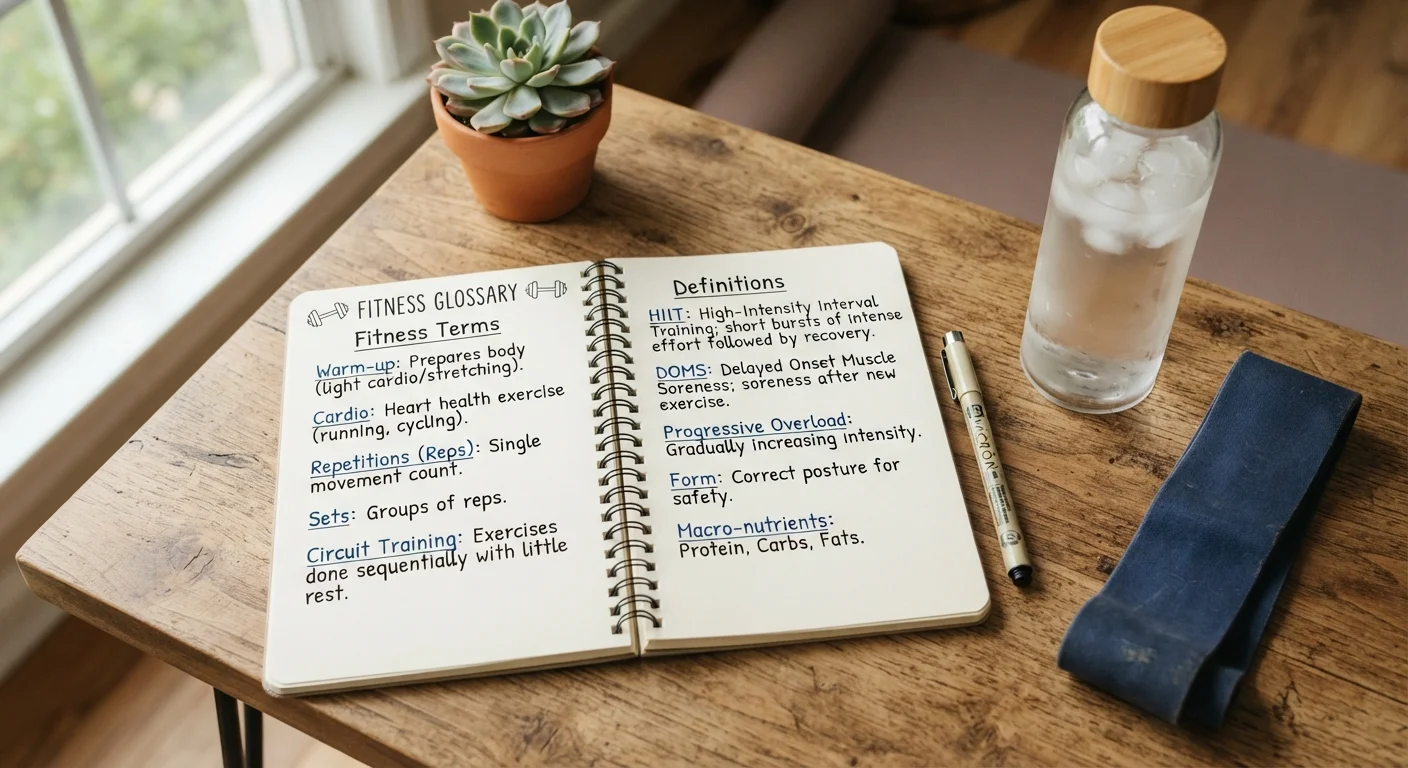
Why Fitness Vocabulary Matters
Walk into any gym or open a fitness app, and you'll encounter a wall of jargon — HIIT, supersets, periodization, RPE. For anyone new to structured movement, that language can feel like a barrier rather than a bridge. The good news: once you decode the vocabulary, the underlying concepts are straightforward and genuinely useful.
This reference covers the terms you're most likely to encounter across workout programs, fitness articles, and trainer conversations. Whether you're returning to exercise after a long break or simply trying to understand what a program is asking of you, these definitions are meant to make movement more approachable — not more intimidating.
For a broader look at how to build the habits that make these concepts work in real life, see our complete guide to building a lasting fitness habit.
| Reps in a typical beginner set | 8–12 per set (Common starting range in general fitness guidelines) |
| Rest between sets (general fitness) | 60–90 seconds (Standard recommendation for muscular endurance goals) |
| HIIT session duration | Often 20–30 minutes (Typical program length; varies by protocol) |
| VO2 max improvement | Possible at any age (Supported by general exercise science research) |
| Weekly activity recommendation | 150+ min moderate aerobic activity (U.S. Department of Health & Human Services Physical Activity Guidelines) |
Core Training Terms Explained
These are the foundational terms you'll encounter in almost any workout context, from beginner YouTube videos to structured gym programs.
Rep (Repetition)
One complete execution of an exercise movement — for example, lowering and raising a dumbbell once counts as one rep. Reps are the smallest unit of measurement in a strength or resistance workout.
Set
A group of consecutive reps performed without rest. A program might call for three sets of twelve reps, meaning you complete twelve reps, rest, then repeat that sequence two more times.
HIIT
High-Intensity Interval Training — a workout format alternating short bursts of intense effort with brief recovery periods. HIIT sessions are typically shorter than steady-state cardio and can be adapted to many fitness levels.
Progressive Overload
The principle of gradually increasing training demand over time so the body continues to adapt and improve. This can mean adding weight, doing more reps, reducing rest, or increasing range of motion.
Superset
Performing two different exercises back to back with little or no rest between them. Supersets are commonly used to save time or to work opposing muscle groups efficiently.
Compound Movement
An exercise that engages multiple muscle groups and joints simultaneously — such as a squat, deadlift, or push-up. Compound movements are highly efficient and form the foundation of most strength programs.
Isolation Exercise
An exercise that targets a single muscle group by minimizing involvement from others — a bicep curl is a classic example. Often used to complement compound movements.
VO2 Max
The maximum volume of oxygen your body can use during intense exercise. It is a widely used indicator of aerobic fitness capacity and can improve meaningfully with consistent cardiovascular training.
RPE (Rate of Perceived Exertion)
A subjective 1–10 scale used to describe how hard exercise feels at a given moment. An RPE of 5 feels moderate; an RPE of 9 feels very hard. It helps self-regulate intensity without needing specialized equipment.
Active Recovery
Low-intensity movement on rest days intended to support circulation and reduce muscle soreness. Examples include walking, light stretching, or easy cycling — activities that don't add significant training stress.
Periodization
A structured approach to organizing training over time into distinct phases — such as building volume, increasing intensity, and recovery — to promote ongoing adaptation and reduce injury risk.
Functional Movement
Exercise patterns that mirror everyday physical actions — squatting, hinging, pushing, pulling, and carrying. Training these movements builds strength that translates directly to daily life and general mobility.
Understanding how reps, sets, and rest interact is essential for reading any written program. When a plan says "3×10 at moderate effort," it means three sets of ten repetitions each, with adequate rest between sets — typically 60–90 seconds for general fitness goals. If you're curious how these concepts apply differently to strength versus cardio work, our strength training vs. cardio breakdown explains how training variables shift depending on your goal.
Effort, Intensity, and Recovery
Many fitness terms describe not what you do, but how hard you work and how your body responds. These concepts matter most when it comes to avoiding overtraining and making consistent progress.
150 min
Weekly moderate aerobic activity recommended for adults
According to the U.S. Department of Health & Human Services Physical Activity Guidelines for Americans.
2×/week
Minimum muscle-strengthening sessions recommended
The same federal guidelines recommend muscle-strengthening activity on at least two days per week for adults.
~48 hrs
Typical muscle recovery window after strength training
General exercise science guidance suggests 48 hours of rest between training sessions targeting the same muscle group.
Rate of Perceived Exertion (RPE) is a simple 1–10 scale used to gauge how hard an effort feels. A 6–7 RPE means you can still speak in short sentences; a 9 RPE means you're working very hard and speech is difficult. Many programs use RPE instead of fixed loads because it naturally accounts for day-to-day variation in your energy and readiness.
Progressive overload is one of the most important principles in fitness: gradually increasing the demand placed on your body over time — whether through more weight, more reps, shorter rest, or greater range of motion. Without it, the body adapts and progress plateaus. With it, fitness improvements continue steadily.
Active recovery refers to low-intensity movement on rest days — a walk, gentle stretching, or light cycling — rather than complete inactivity. It supports circulation and reduces muscle soreness without adding meaningful training stress. For ideas on incorporating this kind of movement into daily life, see movement throughout the day.
Listening to Your Body Is a Skill
Terms like RPE and active recovery are tools for self-regulation, not rigid rules. How your body responds to exercise varies day to day based on sleep, stress, and nutrition. Learning to read your own effort level honestly — rather than always pushing to maximum — is one of the most valuable fitness skills you can develop. If you're ever unsure whether symptoms during exercise are normal exertion or a warning sign, consult a qualified healthcare professional.
Advanced Terms Worth Knowing
These terms appear frequently in intermediate and advanced programs, but understanding them can benefit movers at any level.
VO2 max measures the maximum rate at which your body can consume oxygen during intense exercise. It's often cited as a marker of cardiovascular fitness. You don't need a lab test to improve it — consistent aerobic training raises VO2 max over time regardless of starting point.
Periodization is the practice of organizing training into structured phases — for example, alternating between blocks focused on building strength, increasing endurance, and recovery. Most well-designed programs use some form of periodization even if they don't label it explicitly.
Functional movement refers to exercises that mimic or support everyday actions — squatting, hinging, pushing, pulling, and carrying. These patterns build strength that transfers directly to daily life, not just athletic performance.
If you're setting up a home environment to practice these movements, our home workout setup guide separates what's genuinely useful from what's just marketing.
This article is for general informational purposes only and does not constitute medical or exercise-prescription advice. Consult a qualified healthcare or fitness professional before beginning any new exercise program, especially if you have a medical condition or injury history.