DSL: Widespread but Limited
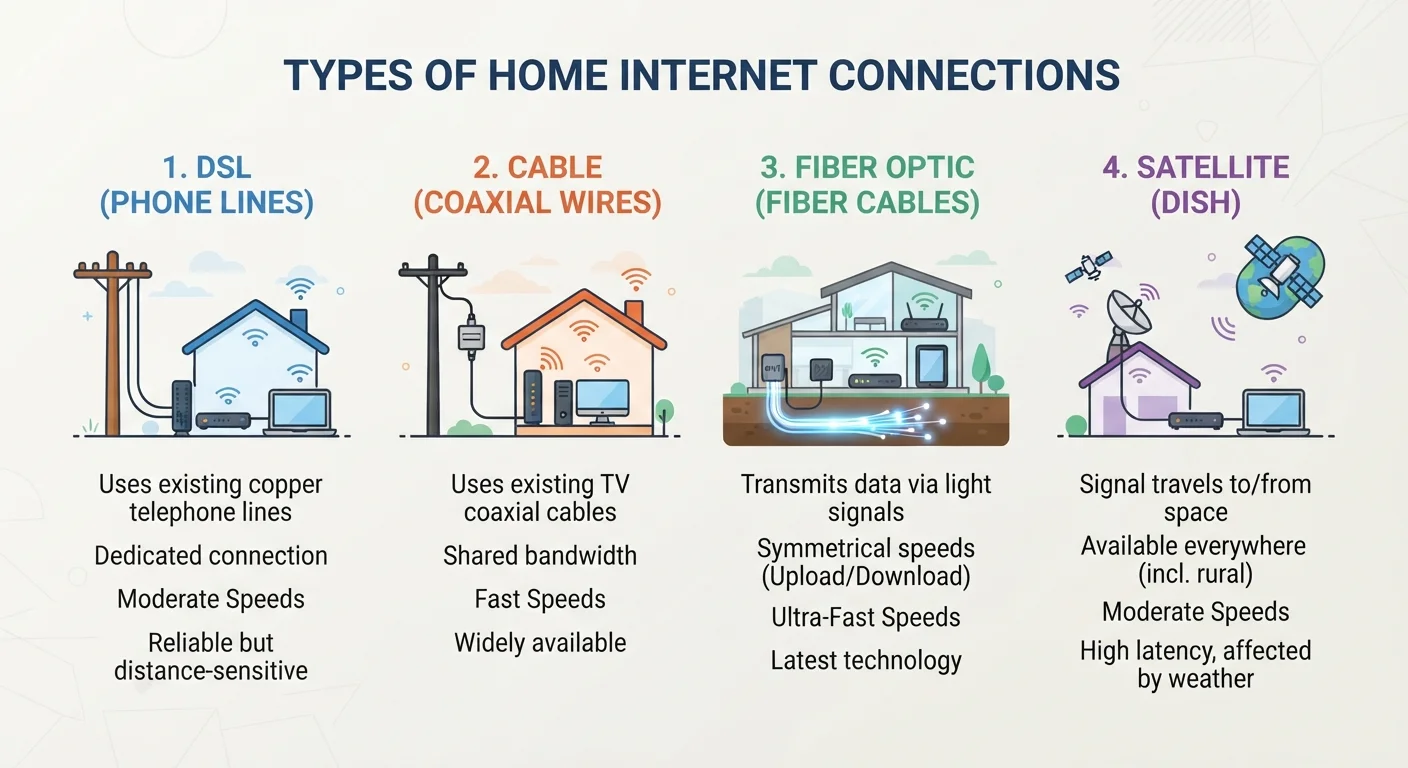
DSL (Digital Subscriber Line) delivers internet over the copper telephone lines already installed in most American homes. Because the infrastructure already exists, DSL is one of the most widely available connection types in the country, including in suburban and some rural areas.
The trade-off is speed. DSL performance degrades with distance — the farther your home is from the provider's local equipment, the slower your connection. Download speeds typically range from a few Mbps up to around 100 Mbps, though many older DSL connections fall well short of that ceiling. Upload speeds are usually significantly lower than download speeds.
DSL is a practical starting point for light internet use — email, basic browsing, and standard-definition streaming — but households with multiple users or heavy streaming and video conferencing needs may find it limiting. If you're unsure how much speed your household actually requires, our guide on calculating your household's bandwidth needs can help you work that out.
Cable: Fast Downloads, Shared Network
Cable internet runs over the same coaxial cable lines used for cable TV. It's available in most suburban and many urban areas across the US, and it delivers substantially faster speeds than most DSL connections — download speeds commonly range from 100 Mbps into the multiple hundreds of Mbps, with some providers offering gigabit-level service.
The main limitation is that cable is a shared-network technology. Your connection is pooled with other customers in your immediate area, which means speeds can dip noticeably during evenings and weekends when many people are online simultaneously. This is sometimes called network congestion.
Upload speeds on cable are also asymmetrical — often much slower than download speeds — which matters more now that video calls and cloud uploads are everyday activities for many households.
~88%
US households with access to cable broadband
According to FCC broadband deployment data, the vast majority of US homes are within reach of cable infrastructure, making it one of the most accessible connection types.
~43%
US households with access to fiber internet
FCC data indicates fiber availability has grown substantially but still reaches fewer than half of all US locations, with rural areas significantly underserved.
600+ ms
Typical latency for geostationary satellite
Traditional satellite internet services exhibit round-trip latency well above 500 milliseconds, compared to under 20 ms for most fiber connections.
Fiber: The High-Performance Option
Fiber optic internet transmits data as pulses of light through thin glass or plastic strands. It's the fastest and most consistent home internet technology in widespread residential use. Fiber connections are typically symmetrical — meaning upload and download speeds are equal — which is a significant advantage over cable and DSL for households that regularly upload large files, host video calls, or work remotely.
Fiber is also less affected by distance and network congestion than cable or DSL, making it more reliable during peak hours. Where it falls short is availability: fiber requires new infrastructure, and buildout has been slower in rural and lower-density areas.
If fiber is available at your address, it's generally the most future-proof option for a household with growing internet demands. Understanding the equipment involved can also help — see what a modem and router each actually do to get the full picture.
Check Your Address Before Assuming Availability
Fiber availability can vary block by block, even within the same neighborhood. Use the FCC's National Broadband Map or individual provider websites to search your specific address rather than relying on general area coverage claims. New fiber buildouts are ongoing in many regions, so it's worth rechecking if fiber wasn't available when you last looked.
Satellite: The Rural Option with Real Trade-Offs
Satellite internet beams data between your home dish and a satellite orbiting Earth. Its biggest advantage is reach — it can serve addresses where no cable, fiber, or DSL infrastructure exists, making it one of the few practical options for remote and rural households.
Traditional geostationary satellite internet has high latency — often 600 milliseconds or more — because signals travel roughly 22,000 miles to orbit and back. This makes real-time applications like video calls and online gaming frustrating. Newer low-Earth orbit (LEO) satellite services have reduced latency significantly, though they still tend to cost more and may have data thresholds that affect sustained performance.
Satellite service can also be affected by weather and physical obstructions like trees or buildings. For rural households weighing these factors carefully, our article on what rural households should realistically expect from satellite internet goes into much greater depth.
How to Think About Your Options
The right connection type depends on what's available at your address, how many people and devices share your connection, and what you primarily use the internet for. Availability is often the first filter — many households don't have all four types to choose from.
Once you know what's available, consider speed requirements, reliability during peak hours, and upload needs alongside download speed. Speed claims from providers reflect maximum potential under ideal conditions — actual experience can vary. Our article on common internet speed myths addresses some of the misunderstandings that make these comparisons tricky.
After choosing a connection type, your in-home setup still matters. Router placement, equipment quality, and network configuration all affect the experience you actually get day to day.
“Broadband infrastructure is the defining challenge of our digital era. The type of connection reaching your home shapes not just your streaming quality but your ability to participate in the modern economy.”
— FCC Broadband Progress Report, Federal Communications Commission policy document