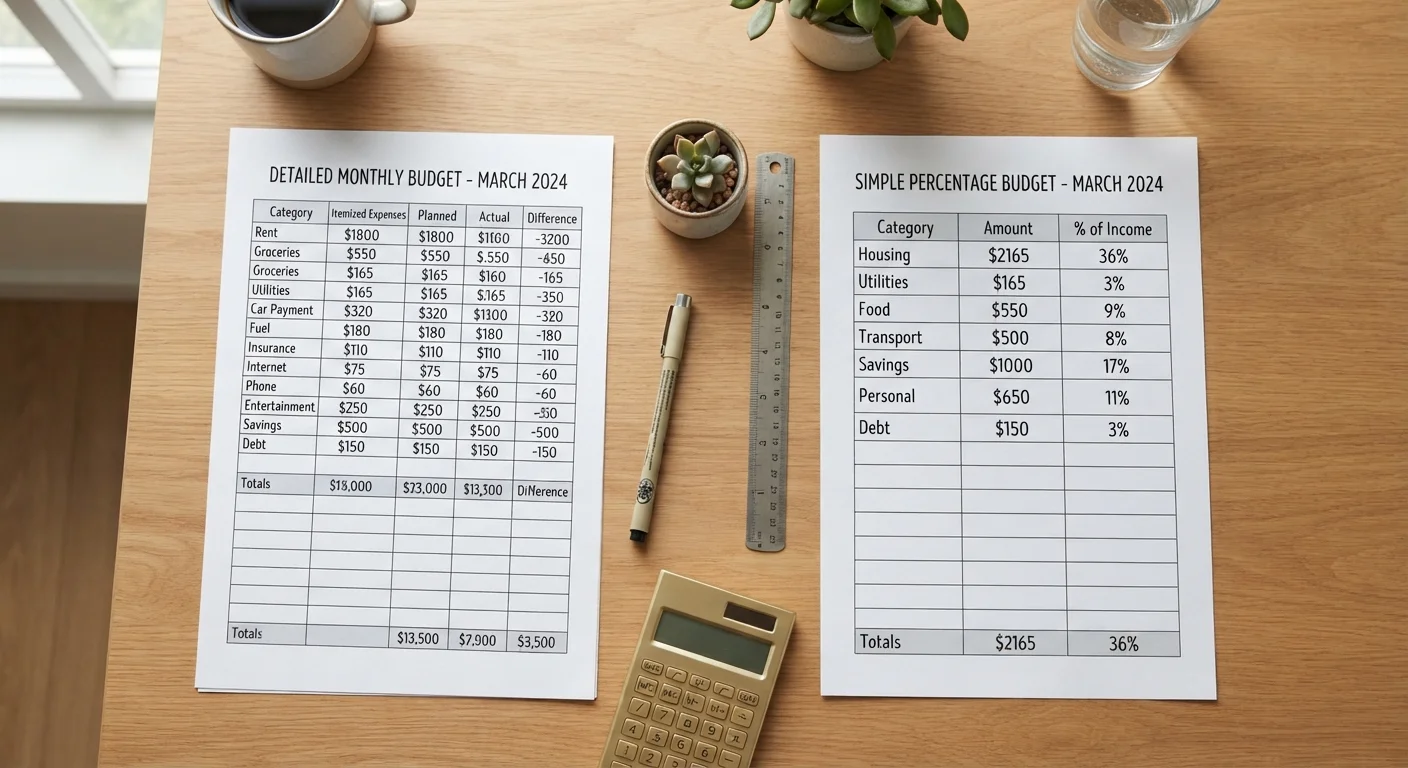
How Each Method Works
Understanding the mechanics of each approach is the fastest way to decide which one fits your life. Both methods start with the same raw material — your monthly income — but they carve it up very differently.
Zero-based budgeting (ZBB) asks you to account for every single dollar. You start with your take-home income and assign amounts to each category — rent, groceries, utilities, savings, debt payments, entertainment — until the remaining balance equals zero. Nothing is left unassigned. This does not mean spending everything; it means giving every dollar a job, including dollars earmarked for savings or an emergency fund.
Percentage-based budgeting skips the line-by-line detail and instead divides income into broad buckets using preset ratios. The widely referenced 50/30/20 framework, for example, allocates roughly 50% to needs, 30% to wants, and 20% to savings and debt repayment. Other percentage splits exist, and you can adjust the ratios to fit your priorities — but the core idea is simplicity through fixed proportions.
| Criterion | Zero-Based Budgeting | Percentage-Based Budgeting |
|---|---|---|
| Core concept | Every dollar assigned to a category | Income split by fixed ratios |
| Monthly time investment | Higher — rebuilt each month | Lower — ratios stay constant |
| Best income type | Variable or irregular income | Stable, predictable income |
| Level of detail | Granular, line-by-line | Broad category buckets |
| Learning curve | Steeper for beginners | Gentle and easy to start |
| Spending visibility | Very high — pinpoints leaks | Moderate — broad categories only |
| Flexibility mid-month | Requires manual reallocation | Naturally accommodates shifts |
If you have never built a budget before, the seven-step first budget guide walks you through the foundational setup either method requires.
Real-Life Trade-Offs: Time, Flexibility, and Precision
Choosing a budgeting method is not just an intellectual exercise — it comes down to how each fits your actual habits and circumstances.
~30%
Americans with a detailed monthly budget
Gallup polling has consistently found that fewer than one-third of U.S. adults maintain a detailed household budget.
50/30/20
Most referenced percentage budgeting ratio
The 50/30/20 split — needs, wants, savings — is one of the most widely cited frameworks in mainstream personal finance education.
$0
Unassigned dollars in a zero-based budget
By design, zero-based budgeting ends each planning session with every dollar allocated, including amounts directed to savings or debt payoff.
Time commitment: Zero-based budgeting typically requires 30–60 minutes at the start of each month to rebuild the plan from scratch. Percentage-based budgeting may take that long to set up initially, but ongoing reviews can be brief check-ins rather than full rebuilds.
Handling variable income: Freelancers, gig workers, and anyone with irregular paychecks often find zero-based budgeting more responsive. Because you rebuild the plan around what you actually brought in, there is no risk of committing to a percentage allocation based on income that did not materialize.
Precision vs. flexibility: ZBB can expose spending leaks that percentage methods hide inside broad categories. If your "needs" bucket is consistently overfilled, a percentage plan does not tell you why. ZBB drills down to the source. On the other hand, rigid category tracking can feel punishing during months with unexpected expenses, which is where the flexibility of percentage buckets becomes an advantage.
Behavior and motivation: Some people find the specificity of zero-based budgeting motivating — seeing every dollar assigned reinforces intentional spending. Others find it tedious and abandon it within a few months. A budgeting method you stick with imperfectly is more useful than a perfect method you abandon. The common budgeting myths addresses why rigid systems sometimes backfire.
For context, the envelope method shares DNA with zero-based budgeting — both assign spending limits to specific categories — and is worth considering if tactile, category-by-category control appeals to you.
Either method can be woven into a long-term household budget as your financial life grows more complex. The key is choosing a starting point that matches your current capacity, then refining from there.
This article is for general informational and educational purposes only and does not constitute personalized financial advice. Consider consulting a qualified financial professional for guidance tailored to your individual circumstances.