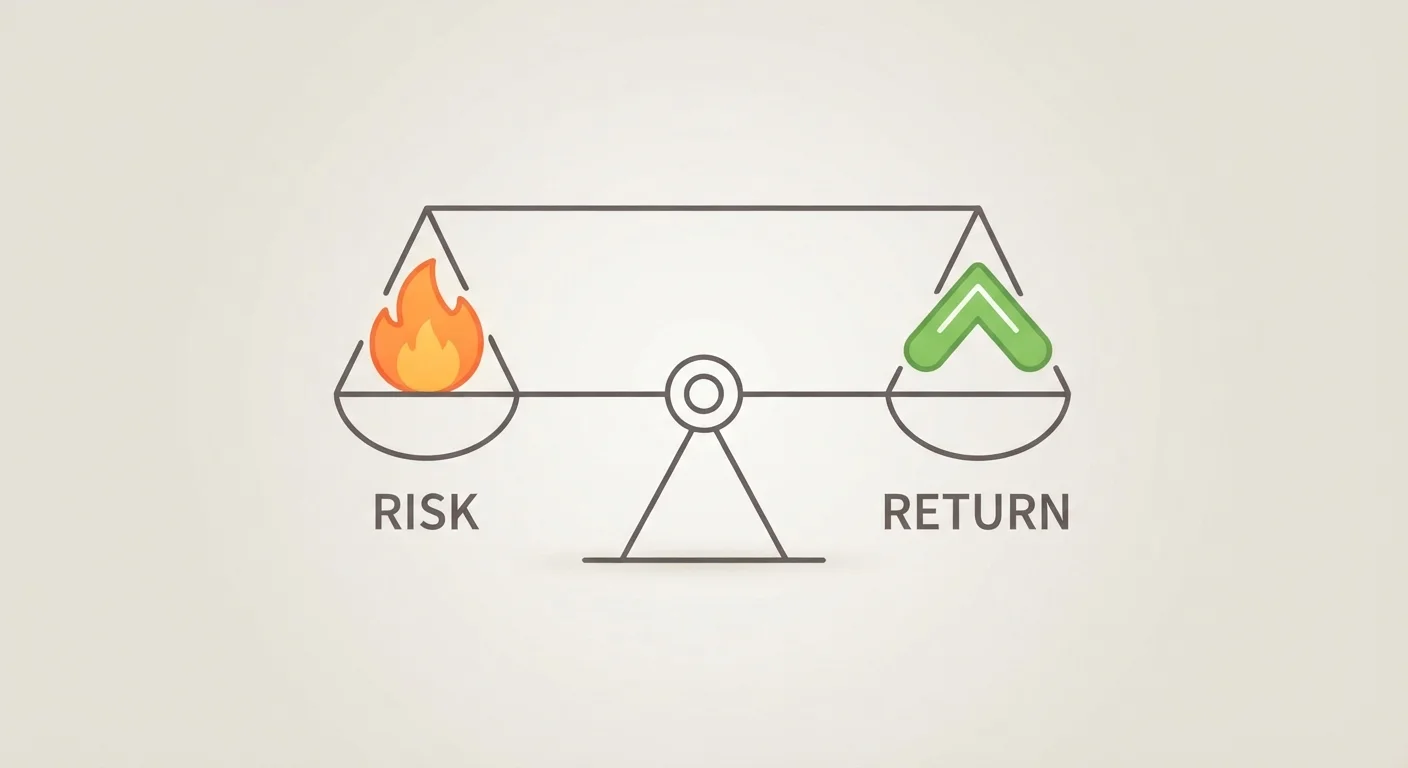
The Core Idea: You Can't Have One Without the Other
One of the most important ideas in investing is deceptively simple: to earn more, you have to risk more. This isn't a quirk of the financial system — it's a logical necessity. If a high-return investment carried no risk of loss, everyone would pour money into it, driving up prices until the return dropped. The market essentially prices risk into every investment.
Think of it as compensation. When you buy stock in a company, you're accepting uncertainty about whether that company will succeed. In exchange, you're offered the possibility of meaningful growth. When you put money into a savings account, the bank guarantees your principal won't disappear — but that safety comes at a cost: low interest rates that often barely keep pace with inflation.
Understanding this trade-off is the starting point for every sound investing decision. It's covered in more depth alongside the building blocks of investing in our guide to stocks, bonds, and cash.
“Risk comes from not knowing what you're doing.”
— Warren Buffett, Chairman and CEO, Berkshire Hathaway
What Different Risk Levels Look Like in Practice
Risk exists on a spectrum, and most common investments fall somewhere along it.
- Low risk: U.S. Treasury bills, federally insured savings accounts, and money market funds sit at the safer end. Returns are modest and relatively predictable. The main risk is inflation eroding your purchasing power over time.
- Moderate risk: Bonds issued by stable corporations or municipalities offer higher returns than savings accounts, but their value can fluctuate with interest rates, and there's some chance the issuer can't repay.
- Higher risk: Individual stocks, stock mutual funds, and index funds carry meaningful short-term volatility. Over long periods, U.S. stock markets have historically delivered stronger average returns than bonds or cash — but there's no guarantee that past performance will repeat.
- Speculative: Individual company stocks, cryptocurrencies, and certain alternative investments can swing dramatically in value. The potential upside is large; so is the potential to lose most or all of what you put in.
~10%
Historical average annual U.S. stock market return
The S&P 500 has delivered roughly 10% average annual returns over the long run before inflation, though individual years vary dramatically and past performance does not guarantee future results.
~4–5%
Typical U.S. Treasury bond yield range
U.S. government bonds have generally offered lower returns than equities in exchange for greater stability, reflecting the risk-return trade-off in practice.
Most investors don't sit entirely at one point on this spectrum. Mixing asset types — called diversification — is one of the most practical tools for managing risk. You can read more about how that works in our article on diversification explained.
How to Think About Your Own Risk Tolerance
Risk tolerance isn't just about personality — it's shaped by your financial reality. Two questions matter most:
- When do you need this money? A longer time horizon generally means you can absorb short-term losses and wait for recovery. If you're saving for retirement 25 years away, a market dip matters far less than if you need the funds in 18 months. This concept — matching investments to your timeline — is explored in our guide on time horizon and asset allocation.
- How would you react to a significant loss? If seeing your account drop 20% would cause you to sell everything immediately, taking on extreme risk is likely to hurt you — regardless of what the math says about long-term averages. Staying invested through downturns is often what captures the recovery, but that's only possible if you can emotionally and financially withstand the drop.
Start by Separating Your Goals
Before thinking about risk tolerance in the abstract, identify what each pool of money is for. Money you'll need within one to two years belongs in low-risk, liquid accounts. Money you won't touch for a decade or more can generally absorb more volatility. Mixing goals into a single risk level often leads to misaligned decisions.
For first-time investors still figuring out their starting point, our guide on getting started with limited savings offers a practical walkthrough.
This article is for general educational purposes only and does not constitute personalized financial or investment advice. Please consult a qualified financial professional before making decisions based on your individual circumstances.