How Investment Fees Work
Every investment fund — whether a mutual fund or an exchange-traded fund (ETF) — incurs costs to operate: portfolio management, administrative expenses, legal and accounting fees, and more. Those costs are passed to investors through the expense ratio, the single most important fee figure to understand.
The expense ratio is expressed as an annual percentage of your invested assets. If you have $10,000 invested in a fund with a 1% expense ratio, approximately $100 is deducted from the fund each year. That deduction happens automatically inside the fund — your statement won't show a separate fee line, but your balance reflects it. Most brokerage platforms display the expense ratio on the fund's information page, and it is always disclosed in the fund's prospectus (its official legal document).
Beyond expense ratios, some funds charge a sales load — a commission paid upfront (front-end load) or when you sell (back-end load). Some brokerages also charge transaction fees for certain trades or annual account maintenance fees. Reading the prospectus and your brokerage's own fee schedule is the only way to see the complete cost picture.
Fee Disclosures Are Required by Law
In the United States, the SEC requires mutual funds and ETFs to disclose their expense ratios and other material fees in their prospectus and in a standardized fee table. You can also look up fund fees using publicly available tools such as FINRA's Fund Analyzer. No fund can legally hide its expense ratio from investors.
Why Fees Compound Against You
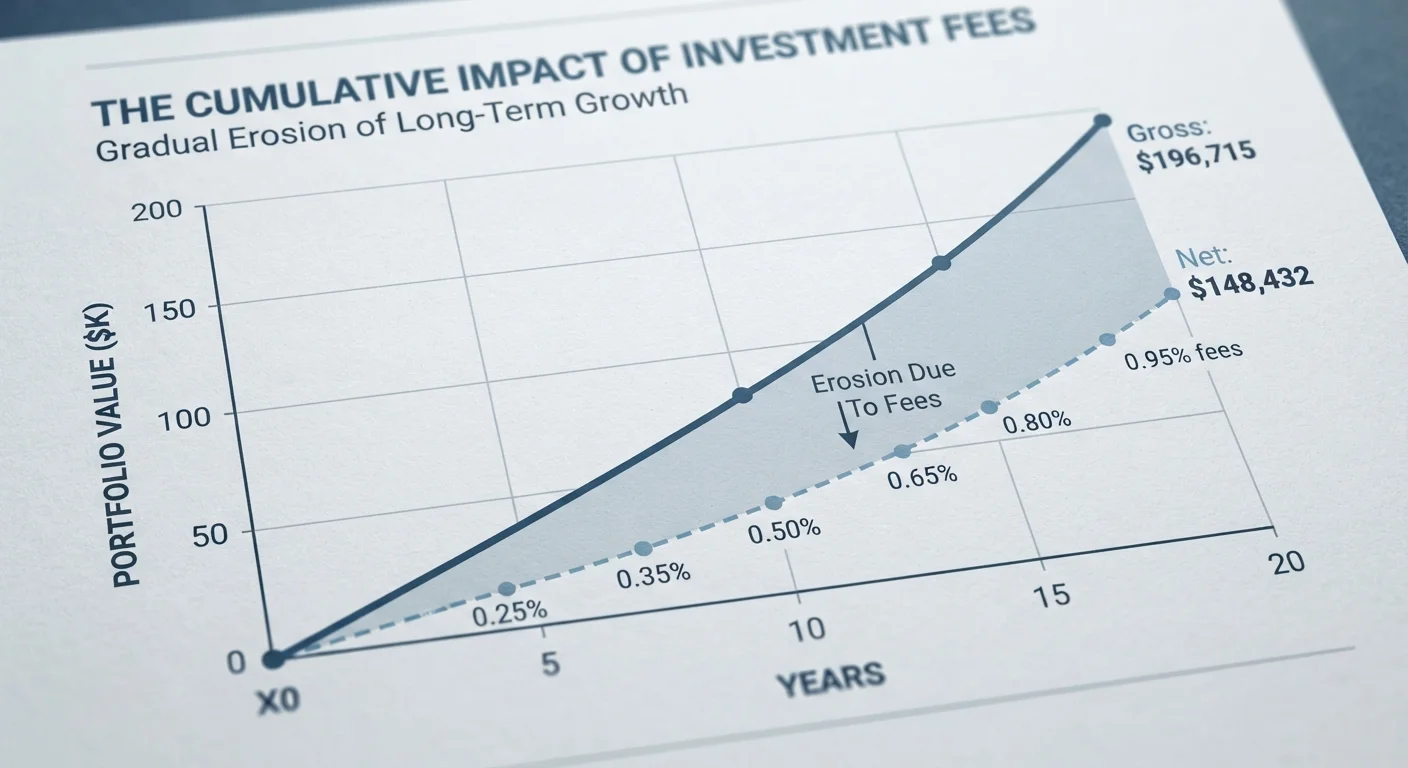
The insidious nature of investment fees is that they work exactly like compound interest — only in reverse. When a fee reduces your balance today, you lose not just that dollar amount but every dollar of future growth that money would have generated. Over 20 or 30 years, this effect becomes substantial.
Consider a simplified illustration: $50,000 invested for 30 years at a 7% gross annual return. With a 0.10% expense ratio, the ending value would be significantly higher than the same investment carrying a 1.10% expense ratio — the difference in wealth at the end can exceed $100,000, even though the annual fee gap was only 1 percentage point. That is compounding working against you.
0.03%–1.50%+
Typical expense ratio range across fund types
Broadly diversified index funds often charge as little as 0.03%, while some actively managed funds charge 1.00%–1.50% or more annually.
~$100,000
Potential wealth gap from a 1% fee difference
A 1 percentage point difference in annual fees on a $50,000 investment over 30 years at 7% gross return can result in a six-figure difference in ending wealth — illustrating how fees compound over time.
This is one reason the comparison between index funds and actively managed funds matters so much. As explained in our overview of index funds vs. actively managed funds, actively managed funds typically carry expense ratios several times higher than passive index funds. When a higher-cost fund also fails to outperform its benchmark — which research consistently shows is common over long periods — investors pay more and receive less.
For a deeper look at how compounding builds wealth, see our article on compound interest and long-term wealth.
Putting Fee Awareness Into Practice
Awareness of fees is one of the habits that separate successful long-term investors from those who struggle. Here are concrete steps to apply what you've learned:
- Compare expense ratios before investing. When evaluating two similar funds, the one with the lower expense ratio gives you more of the return you earn. This is one data point among several, but it's an objective, reliable one.
- Check for sales loads. Many funds today are sold without sales loads (called "no-load" funds), but some still carry them. A front-end load of 3–5% means a meaningful portion of your initial investment never earns a return.
- Account for brokerage fees. Some platforms charge per-trade commissions or account fees. These costs behave like spending leaks — small and easy to overlook until you add them up.
- Keep costs in context. Fees are one factor. Diversification, asset allocation, and consistent investing habits — such as those described in our guide on dollar-cost averaging — matter equally.
Make Fee Comparison a Routine Step
Before adding any new fund to your portfolio, look up its expense ratio and check whether any loads or transaction fees apply. Treat this as a standard checklist item alongside reviewing the fund's strategy and risk profile. Over a long investing horizon, even small differences in cost can make a meaningful difference in outcome.
This article is for general informational and educational purposes only and does not constitute personalized investment, financial, or tax advice. Consult a qualified, licensed financial adviser before making decisions based on your individual circumstances.