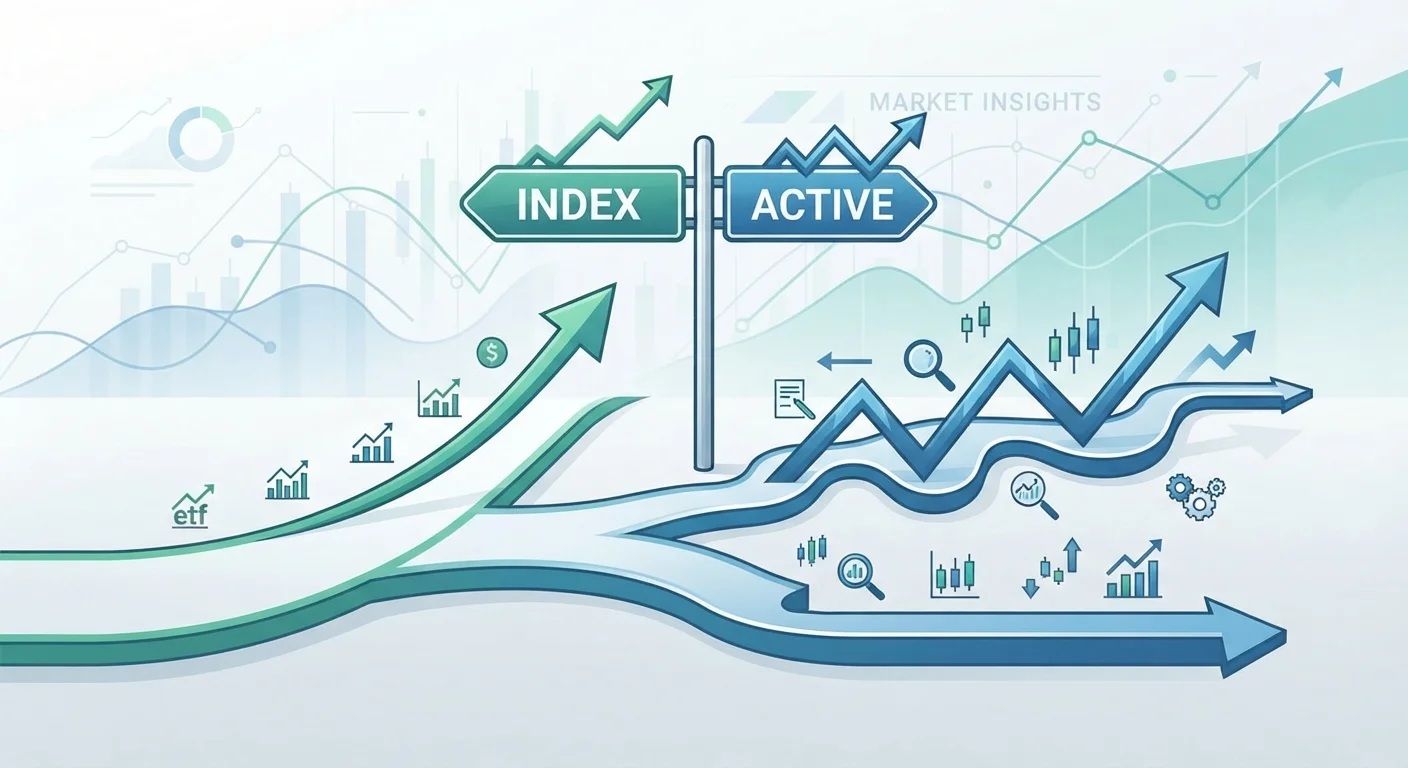
How Each Fund Type Works
Before comparing outcomes, it helps to understand the mechanics. An index fund is designed to mirror the holdings and performance of a specific market index — such as the S&P 500 or the total U.S. bond market. A computer algorithm rebalances the fund periodically to keep it aligned with the index. There is no team of analysts picking stocks; the fund simply owns what the index owns, in the same proportions.
An actively managed fund, by contrast, employs one or more portfolio managers who research securities and make deliberate decisions about what to buy, hold, or sell. The stated goal is to outperform a benchmark index, not merely match it. This human decision-making is what justifies the higher fees these funds charge.
Both fund types offer instant diversification — you own a slice of many different securities with a single purchase — which is one of their core advantages over buying individual stocks or bonds. To understand the underlying asset classes these funds hold, see our guide to stocks, bonds, and cash.
The Cost Difference — and Why It Matters
Fees are one of the most consequential differences between these two fund types. The annual cost of owning a fund is expressed as an expense ratio — the percentage of your investment deducted each year to cover management and operating costs.
| Criterion | Index Funds | Actively Managed Funds |
|---|---|---|
| Management style | Passive — tracks an index | Active — human manager decides |
| Typical expense ratio | 0.03%–0.20% | 0.50%–1.50% or higher |
| Goal | Match benchmark returns | Outperform benchmark |
| Portfolio turnover | Low | Often high |
| Tax efficiency | Generally higher | Generally lower |
| Long-run performance vs. benchmark | Closely tracks it | Most underperform after fees |
| Minimum research required | Low | Higher — evaluating managers matters |
Even a difference of 0.5% to 1% per year compounds significantly over decades. A $10,000 investment growing at 7% annually loses roughly $13,000 more to fees over 30 years at a 1% expense ratio versus a 0.05% one — a gap that grows the longer the money stays invested. Our article on how investment fees compound walks through the math in detail.
Actively managed funds also tend to trade more frequently, which can generate taxable capital gains distributions — an additional cost if the fund is held in a taxable account rather than a tax-advantaged one like an IRA or 401(k). You can explore account types in our 401(k) vs. IRA comparison.
Performance: What the Evidence Shows
The central promise of active management is outperformance — but the evidence is sobering. The S&P Indices Versus Active (SPIVA) reports, published by S&P Dow Jones Indices, consistently find that the majority of actively managed U.S. equity funds underperform their benchmark index over 10- and 15-year periods, after accounting for fees.
~85%
Active large-cap funds underperforming S&P 500
According to S&P Dow Jones Indices SPIVA reports, roughly 85% of actively managed large-cap U.S. equity funds underperformed the S&P 500 over a 15-year period.
0.05%
Typical index fund expense ratio
Many broad-market index funds charge annual expense ratios well below 0.10%, compared to industry averages for active funds that often exceed 0.60%.
1%
Fee difference that erodes decades of returns
A seemingly small 1% annual fee difference can reduce a portfolio's ending value by tens of thousands of dollars over a 30-year investment horizon, due to compounding.
This doesn't mean active management never wins. Some managers outperform over specific periods, and some fund categories — such as certain fixed-income markets — show more mixed results. However, identifying which active funds will outperform in advance is notoriously difficult, even for professional investors. Past outperformance has not proven to be a reliable predictor of future results.
Index funds, by design, will never beat the market — but they won't dramatically underperform it either (before fees, they match it almost exactly). For investors with long time horizons, that consistency has historically been difficult to beat on a cost-adjusted basis. See how your time horizon shapes the right asset mix for more context.
Choosing the Right Approach for You
For most beginning investors, index funds offer a straightforward, cost-effective starting point. A simple portfolio of broadly diversified index funds covering U.S. stocks, international stocks, and bonds can provide meaningful exposure to global markets at minimal cost. Pairing this with a disciplined contribution strategy — such as dollar-cost averaging — removes the pressure of trying to time the market.
Actively managed funds may still have a role in a portfolio, particularly in market segments where research suggests active management has a higher likelihood of adding value, or when an investor has a specific strategy in mind. The key is understanding what you're paying for and whether the potential benefits justify the additional cost and manager risk.
Both Fund Types Carry Investment Risk
Index funds and actively managed funds both lose value when markets decline — index funds simply fall in line with the overall market, while active funds may fall more or less depending on their holdings. Diversification across fund types and asset classes can help manage risk, but cannot eliminate it entirely. There is no guaranteed safe investment in public markets.
This article is for general educational purposes only and does not constitute personalized investment advice. All investing involves risk, including the possible loss of principal. Consult a licensed financial adviser before making investment decisions based on your individual circumstances.