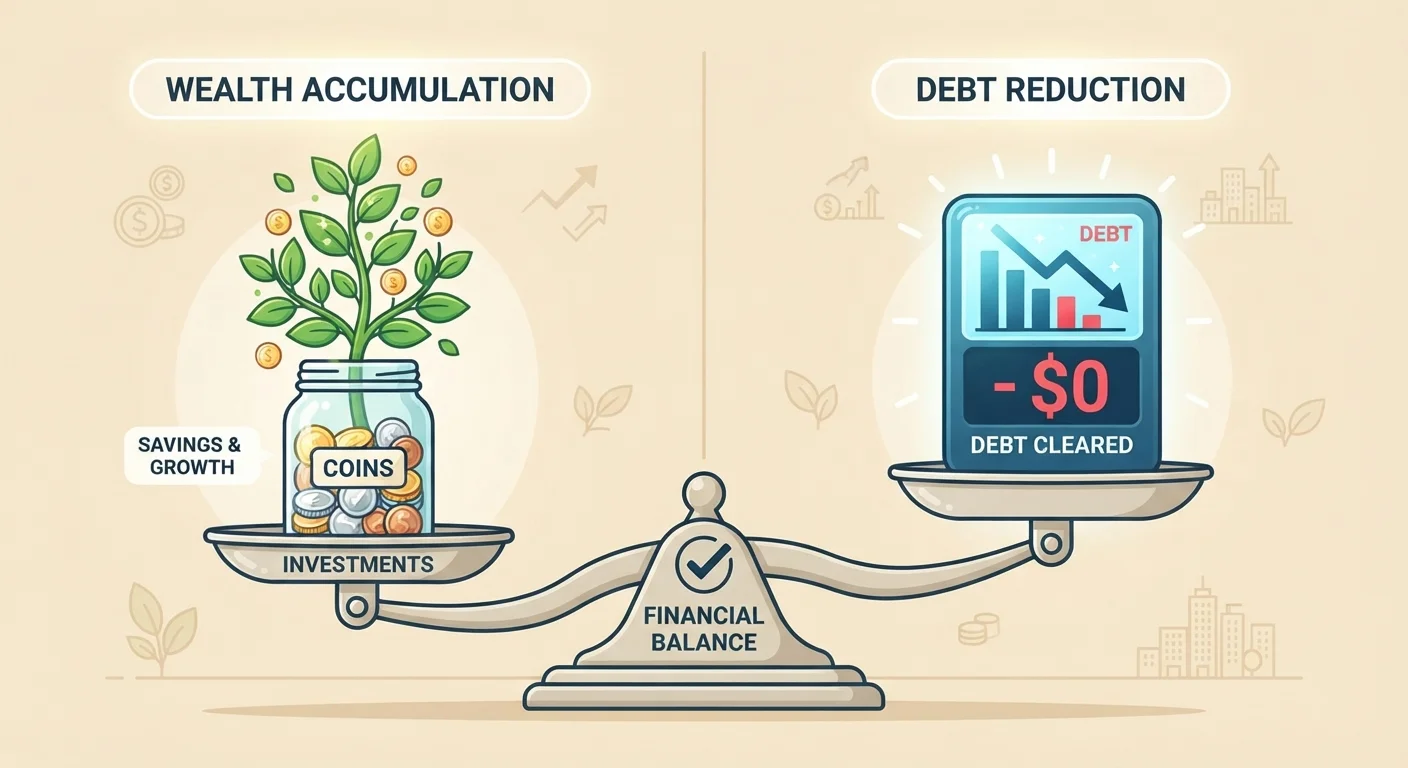
Why This Question Doesn't Have One Right Answer
The debate between investing early and paying down debt first is one of the most common financial crossroads Americans face — and one of the most mishandled. Too often, it's framed as a contest with a clear winner. In reality, the better answer depends on your specific interest rates, account types, income stability, and comfort level with uncertainty.
This article is general financial education, not personalized advice. For guidance specific to your situation, consult a licensed financial professional.
The core tension is straightforward: money spent aggressively repaying a loan is money not growing in the market, and vice versa. To navigate that tension thoughtfully, you need to understand what each path actually costs and returns — not in the abstract, but relative to your real numbers.
The Math: Interest Rates as the Starting Point
The most objective way to frame this decision is as a comparison of guaranteed return vs. expected return. Paying off a debt with a 20% annual percentage rate (APR) delivers a guaranteed 20% return on that money — no market risk involved. Investing in a diversified portfolio of stocks has historically produced average annual returns in the range of 7–10% over long periods, but those returns are never guaranteed and involve real volatility.
This means that, in purely mathematical terms:
- High-interest debt (roughly above 7–8% APR) usually warrants aggressive repayment before broad investing, because the guaranteed savings exceed probable investment gains.
- Low-interest debt (mortgages, subsidized student loans often below 4–5%) may be worth maintaining while investing, since expected market returns may exceed the interest cost over time.
- Mid-range debt (5–8% APR) sits in genuinely uncertain territory — reasonable people make different choices here.
| Invest Early | Pay Down Debt First | |
|---|---|---|
| Best suited for | Low-interest debt holders, long time horizons | High-interest debt holders, stress-sensitive individuals |
| Return profile | Variable; historically positive long-term | Guaranteed savings equal to interest rate |
| Risk level | Market risk; returns not guaranteed | No investment risk; debt obligation reduced |
| Compounding benefit | Maximizes time in market | Reduces compounding interest owed |
| Flexibility | Invested assets can be liquidated (with potential cost) | Debt reduction is permanent and irreversible |
| Behavioral impact | May increase net worth on paper | Often reduces financial stress and anxiety |
One major exception to the pure-math rule: employer 401(k) matching. If your employer matches a percentage of your contributions, that match is an immediate, guaranteed return on your dollars — often 50% or 100% on the matched portion. Passing that up to pay down even high-interest debt is typically a difficult trade to justify. Most financial educators suggest capturing the full employer match before directing extra funds elsewhere.
What the Math Misses: Risk, Behavior, and Uncertainty
Numbers alone don't decide what's right for you. Several real-world factors complicate the calculation:
Investment returns are not guaranteed
Historical stock market averages are backward-looking. A person who begins investing aggressively during a prolonged downturn early in their timeline may experience returns well below historical norms for years. That uncertainty is real and shouldn't be glossed over — see our common early investing pitfalls for more on how new investors sometimes undermine their own results.
Debt carries psychological weight
Research in behavioral economics consistently shows that people underestimate how much financial stress affects decision-making and overall well-being. If carrying debt creates chronic anxiety that disrupts your ability to stay employed, build an emergency fund, or maintain consistent habits, the human cost is real — and worth factoring in. Sustainable debt repayment approaches recognize this reality explicitly.
Compounding works in both directions
Early investing benefits from compound growth over time — small contributions at 25 can outpace larger ones at 40. But high-interest debt also compounds, often faster than investments grow. Delay on either front has real costs.
Start With Your Interest Rate List
Before making any allocation decision, write down every debt you carry along with its exact APR. Then note your investment options and any employer match rate. Seeing these side by side — rather than relying on intuition — often clarifies the decision more than any rule of thumb. You may find the answer is obvious for some debts and genuinely uncertain for others, which is useful information in itself.
A Practical Framework for Most Situations
Given the variables, a tiered approach is how many financial educators structure the decision:
- Build a minimal emergency fund first — even $500–$1,000 — so that unexpected expenses don't force new debt.
- Capture any employer 401(k) match in full. This is typically the highest-return move available.
- Pay down high-interest debt aggressively — credit cards, high-rate personal loans. See our practical roadmap for eliminating high-interest debt for a structured approach.
- Consider a hybrid strategy for mid-range debt — splitting extra dollars between debt repayment and investing. Paying off debt and saving simultaneously can make sense in specific circumstances.
- Invest more broadly once high-interest debt is cleared, taking advantage of tax-advantaged accounts (IRAs, HSAs, 401(k)s beyond the match) before taxable brokerage accounts.
This framework isn't a prescription — it's a starting structure. Your debt mix, income, job stability, and goals all matter. Working through the specifics with a qualified financial adviser is worthwhile before making major allocation decisions.
This article is for general informational and educational purposes only. It does not constitute personalized financial, investment, tax, or legal advice. Consult a licensed financial professional before making decisions about your specific situation.