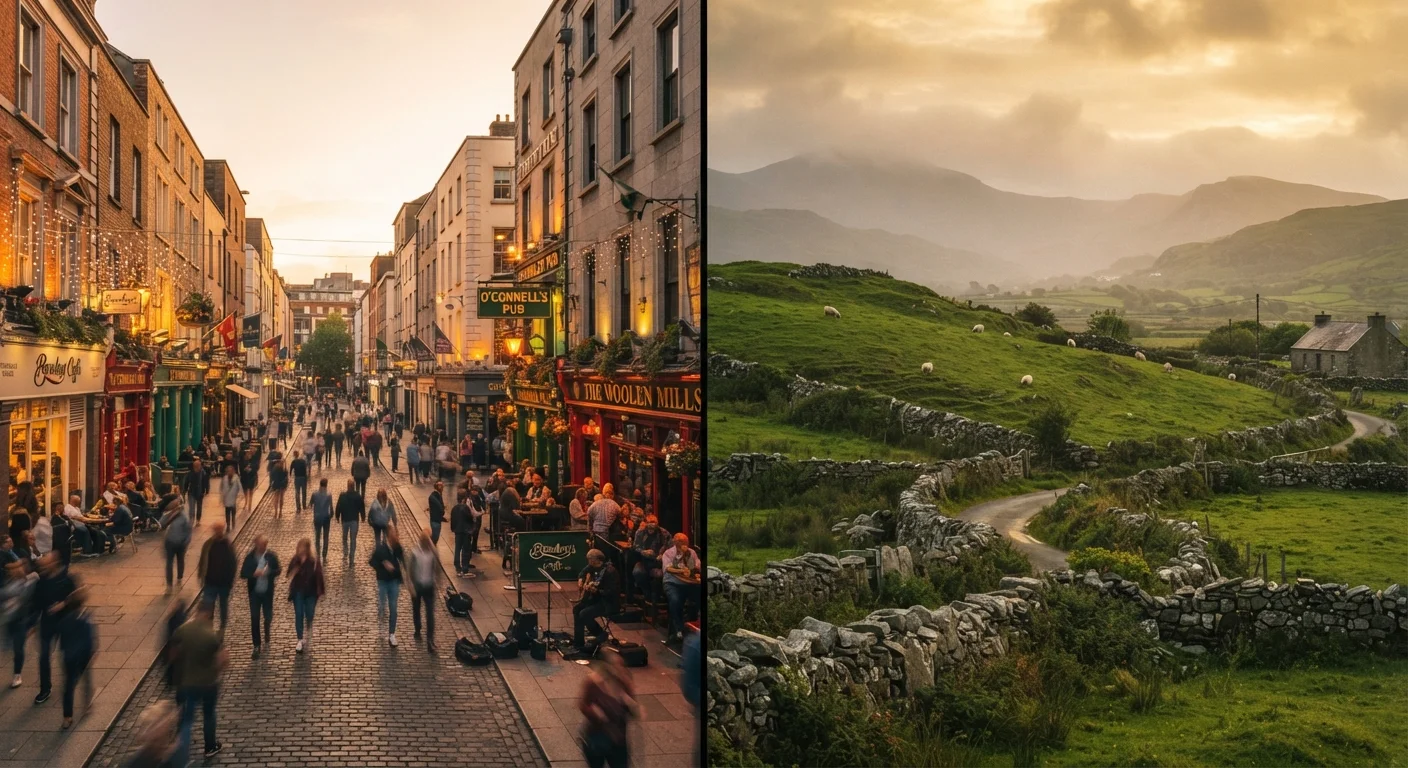
Two Irelands, One Island
Ask ten people who've visited Ireland what the country is like, and you'll likely get two entirely different answers. Some will rave about Temple Bar pints, the Chester Beatty Library, and a city that somehow feels both ancient and electrifyingly alive. Others will tell you about standing alone on a Connemara hillside in the rain, convinced they'd found the edge of the world. Both groups are right — and that's exactly the tension worth unpacking before you book.
The divide isn't just geographic. It reflects a fundamental split in what travelers want from a trip. Understanding that split honestly will save you from arriving with the wrong expectations.
The Case for Dublin
Dublin punches well above its weight for a city of just over one million people. The National Museum of Ireland, Trinity College's Long Room, and the Irish Film Institute all sit within walkable distance of each other. Neighborhoods like Portobello and Stoneybatter have developed genuinely interesting food and coffee scenes without becoming sanitized tourist corridors.
World-class museums within easy walking distance
Dublin's cultural institutions, including the National Museum and the Irish Modern Art collection, are free or low-cost and genuinely exceptional — a rare concentration for a small capital city.
No car required — public transit is reliable
The DART, Luas, and bus network covers the city and surrounding towns effectively, removing the stress of driving on unfamiliar left-hand roads while jet-lagged.
Vibrant pub and live music culture
Traditional Irish music sessions happen nightly in Dublin pubs throughout the year, providing an authentic cultural experience that doesn't require venturing outside the city.
Strong restaurant and café scene
Dublin's food culture has evolved considerably, with neighborhoods like Rathmines and Ranelagh offering genuinely diverse and high-quality dining options beyond tourist-focused spots.
Practically speaking, Dublin is easy. Direct flights from major U.S. cities land at Dublin Airport. The DART rail line, Luas trams, and buses cover the city reliably. You don't need a car, which matters enormously when jet lag is a factor. Day trips to Howth, Malahide, or Bray are straightforward on public transit.
The honest caveat: Dublin is expensive. Accommodation costs rank among the highest in Western Europe, and that reality hits harder if you're accustomed to U.S. mid-tier city pricing. The city can also feel crowded along the most-photographed routes, particularly in summer.
The Case for Rural Ireland
The landscapes that define Ireland's international image — the Cliffs of Moher, the Ring of Kerry, the Aran Islands, Connemara's blanket bogs — are none of them in Dublin. Getting to them requires either renting a car or booking organized tours, and that friction filters out the casual visitor. For those who make the effort, the payoff is substantial.
Narrow roads demand confident driving
Many rural routes, especially along the west coast, are single-track with passing places. Renting an automatic and allowing generous extra travel time reduces stress considerably.
Weather is genuinely unpredictable
The west coast averages over 50 inches of rainfall annually, and overcast or rainy days are the norm rather than the exception, particularly outside summer months.
Limited services in remote areas
ATMs, petrol stations, and restaurants can be sparse or closed outside typical hours in smaller villages — planning ahead for cash and food is genuinely necessary, not just advisable.
Iconic sites attract heavy crowds in peak season
The Cliffs of Moher and Ring of Kerry draw large tour bus volumes in July and August; early morning arrivals or shoulder-season travel significantly improve the experience.
Rural Ireland moves at its own pace, and that pace is slow. A 60-mile drive can take two hours on single-lane roads. Villages may have one pub and no ATM. Mobile coverage drops in the most dramatic areas. These aren't complaints — they're the features. But travelers who need constant stimulation, reliable WiFi, or accessible dining options will find the countryside genuinely challenging.
Weather compounds everything. The west of Ireland receives some of the highest rainfall in Europe. Iconic views can disappear entirely into fog for days. Experienced Ireland travelers tend to find this atmospheric rather than frustrating — but it requires an honest mindset adjustment, especially for shorter trips.
2,500 km
Length of the Wild Atlantic Way route
Ireland's Wild Atlantic Way is one of the world's longest defined coastal driving routes, stretching from Donegal in the north to Cork in the south.
Top 5
Dublin's European accommodation cost ranking
Dublin consistently ranks among the five most expensive cities in the European Union for overnight accommodation, according to Eurostat tourism data.
For travelers curious about similarly stark landscape-versus-city trade-offs, the honest-travel guide to Iceland's realities for first-time visitors covers comparable tensions between expectations and experience.
How to Think About Combining Both
The good news: you don't have to choose. Most transatlantic itineraries of ten days or more can realistically include two or three nights in Dublin plus a self-drive circuit through at least one rural region. The Wild Atlantic Way is well-signposted and covers everything from Donegal to Cork along the western seaboard — you can dip in and out of it depending on time.
Planning a Self-Drive Rural Circuit
When renting a car in Ireland, note that most rental fleet vehicles are manual transmission — automatic options exist but typically cost more and have limited availability, so booking well in advance is advisable. Additionally, all distances on Irish road signs are in kilometers, not miles, which catches some American travelers off guard on long rural drives.
The trap to avoid is over-scheduling. Trying to see the Cliffs of Moher, Killarney, Connemara, and Galway City in three days produces a highlight reel rather than a trip. Picking one rural region and spending real time there — including one genuinely bad-weather day where you're stuck reading in a pub — consistently produces stronger travel memories than racing between photo stops.