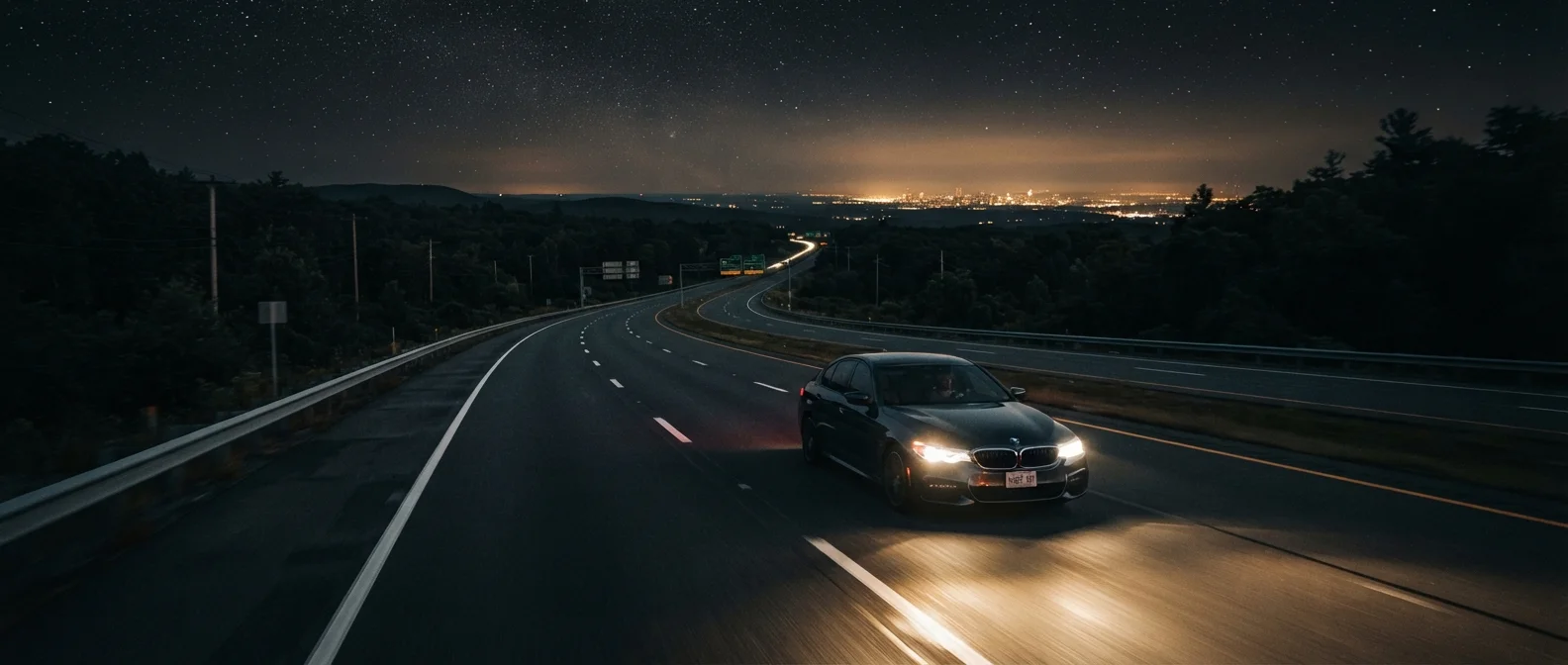
Why Night Driving Myths Are More Dangerous Than They Sound
After-dark driving accounts for roughly half of all traffic fatalities in the United States, according to data from the National Safety Council - despite the fact that significantly less driving happens at night overall. Yet many drivers approach nighttime roads with the same habits and assumptions they use in daylight. Some of those assumptions are not just wrong; they actively reduce safety.
Misconceptions about headlight range, high-beam etiquette, and how our eyes behave in the dark have circulated for so long that they feel like common sense. They are not. Understanding what actually happens to your vision and your vehicle after dark - and where the conventional wisdom falls short - is a meaningful step toward safer driving. See also our guide on risky habits experienced drivers overlook for a broader look at how familiarity breeds overconfidence behind the wheel.
Myth
Your headlights let you see far enough down the road to stop safely at highway speeds.
Fact
Standard low-beam headlights illuminate approximately 160 feet ahead - your stopping distance at 60 mph can exceed 300 feet.
This gap is sometimes called "overdriving your headlights" - traveling faster than your ability to stop within the range your lights reveal. At 60 mph, reaction time plus braking distance in a typical vehicle can require well over 300 feet. Yet low beams generally cover only 160 to 200 feet of road ahead. High beams extend that range to roughly 350-500 feet, which is why using them appropriately on open roads matters. Driving at night without accounting for this gap is one of the most underappreciated hazards on the road.
Myth
Keeping your high beams on is fine as long as you think you can see oncoming cars in time.
Fact
Failing to dim high beams for oncoming traffic is illegal in every U.S. state and can temporarily blind other drivers.
Most states require drivers to dim high beams when within 500 feet of an oncoming vehicle or within 200-300 feet of a vehicle ahead. Beyond the legal requirement, the practical risk is significant: high beams directed into a driver's eyes can cause temporary vision loss lasting several seconds - long enough to miss a curve, pedestrian, or road hazard. The correct habit is to dim proactively, before the other driver is close, not reactively once glare has already occurred.
Myth
Your eyes adjust to darkness almost instantly once bright lights are gone.
Fact
Full dark adaptation - particularly rod cell recovery - can take up to 30 minutes after bright light exposure.
Human vision uses two types of light-sensitive cells: cones for daylight color vision and rods for low-light detection. When bright light hits your eyes, rod cells are temporarily bleached and need time to regenerate the photosensitive pigment (rhodopsin) that enables night vision. After a car's high beams pass, basic vision may return in seconds, but optimal dark adaptation - especially after sustained bright light exposure - can take considerably longer. Drivers who frequently shift between well-lit environments and dark roads should not assume their night vision is fully functional immediately.
Myth
Turning on interior cabin lights while driving at night makes it harder to see outside.
Fact
At typical interior lighting levels, the effect on night vision is minimal for most drivers and situations.
This myth has a kernel of truth - very bright interior light can reduce contrast when looking through the windshield - but the practical impact of a dim map light or dashboard illumination is negligible for a driver whose eyes are focused on the road. The more meaningful concern at night is glare from improperly aimed rearview mirrors reflecting bright headlights from behind. Adjusting your mirrors correctly and using the night mode lever on your rearview mirror does more for visibility than worrying about a soft interior light.
Myth
Driving on a familiar road at night is essentially the same as driving it in daylight.
Fact
Familiarity does not compensate for reduced visibility - hazards like pedestrians, cyclists, and debris are still harder to detect.
Knowing a road's layout helps with anticipating curves and intersections, but it does nothing to improve your ability to spot a pedestrian in dark clothing, an animal crossing, or road debris that was not there on your last trip. Nighttime crash data consistently shows that familiar routes are not inherently safer after dark. Overconfidence on known roads is one of the patterns explored in research on driver complacency, and it is especially relevant after dark when sensory input is already reduced.
How to Adjust Your Habits Based on the Facts
Correcting these myths is useful only if you act on them. A few specific adjustments make a measurable difference:
- Increase following distance. Because your stopping distance often exceeds your visible range at night, adding extra space between your vehicle and the car ahead gives you more time to react to hazards that appear at the edge of your headlights.
- Use high beams deliberately. On unlit rural roads with no oncoming or preceding traffic, high beams dramatically improve your sight lines. Dim them as soon as another vehicle appears - not after they are already close.
- Allow time for eye adjustment. If you step outside from a brightly lit building into a dark parking lot before driving, give your eyes 10-15 minutes to adapt before assuming your vision is fully calibrated for the dark.
- Recognize fatigue early. Night driving compounds drowsiness. If you notice reduced alertness, pulling off and resting is always safer than pushing through. For a deeper look at how fatigue compares to other impairments, see distracted driving vs. drowsy driving.
Drowsiness Peaks in the Late Night Hours
The body's circadian rhythm creates natural dips in alertness between midnight and 6 a.m. - even if you do not feel tired. If you are driving during those hours, be especially vigilant for signs of fatigue such as lane drift, difficulty focusing, or frequent blinking. No amount of coffee or music reliably replaces the need for sleep.
Reduced visibility conditions like fog compound every one of the risks discussed here. Our article on driving in rain, fog, and snow covers how to adapt your approach when visibility drops further.