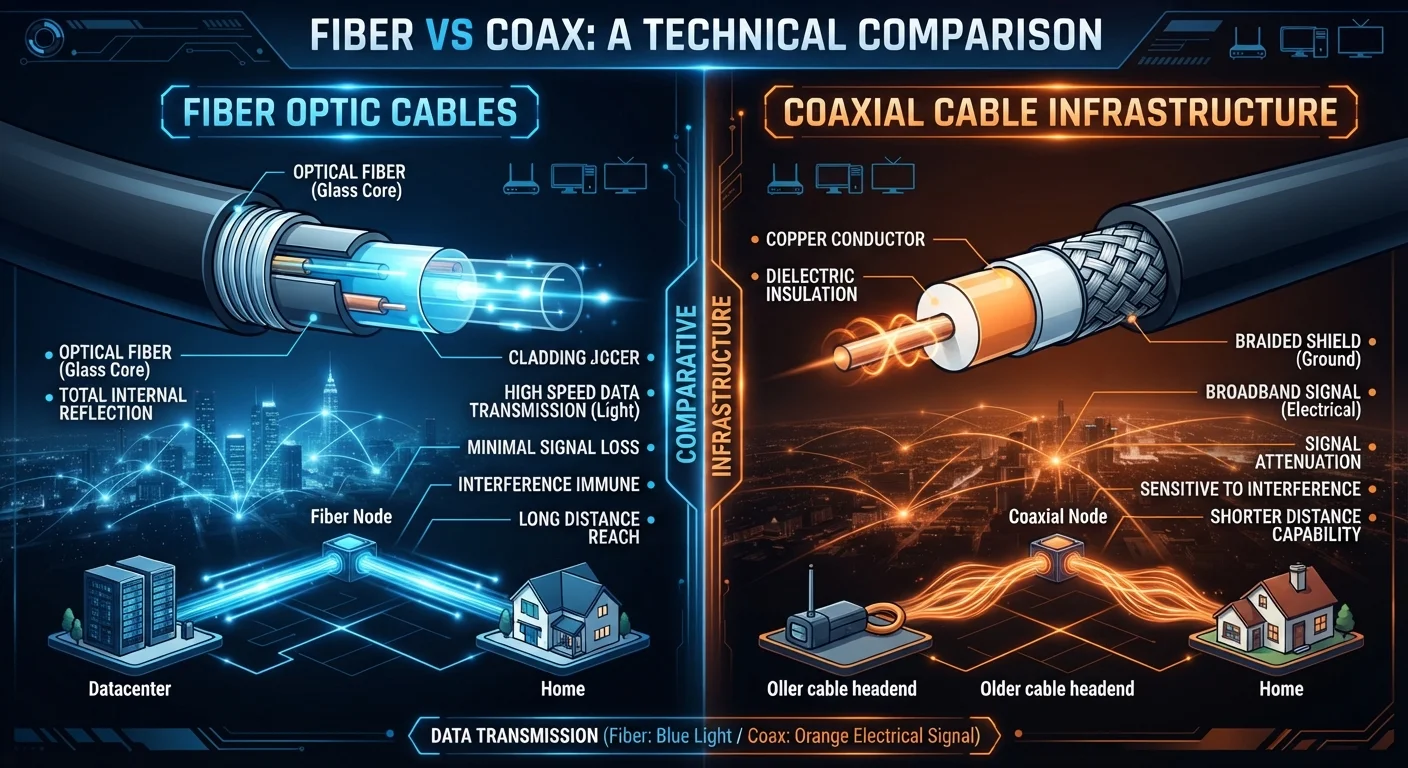
How Each Technology Actually Works
The core difference between fiber and cable internet isn't about speed tiers on a marketing brochure — it's about the physical medium carrying your data.
Fiber optic internet transmits data as pulses of light through thin strands of glass or plastic. Because light travels at, well, the speed of light, and because the signal doesn't degrade as quickly over distance, fiber connections are capable of extremely high speeds with low signal loss.
Cable internet uses the same coaxial copper cable infrastructure originally built for cable television. Data travels as electrical signals through that copper line. The technology powering modern cable internet — called DOCSIS — has improved significantly over the years, with the latest DOCSIS 3.1 standard capable of multi-gigabit speeds. However, cable still operates over a shared network architecture in most deployments.
Understanding these physical differences explains nearly every practical distinction that follows. For a broader look at how these fit alongside DSL and satellite options, see our overview of home internet connection types.
| Criterion | Fiber Internet | Cable Internet |
|---|---|---|
| Transmission medium | Light through glass/plastic strands | Electrical signal through coaxial copper |
| Typical speed symmetry | Upload ≈ Download (symmetrical) | Upload much slower than download |
| Network architecture | Dedicated line to each home | Shared neighborhood infrastructure |
| Peak-hour congestion impact | Minimal — dedicated line | Noticeable — shared bandwidth |
| Latency consistency | Low and stable | Generally acceptable; can spike |
| US availability | Growing, but still limited geographically | Widely available across the US |
| Infrastructure age | Newer, purpose-built for data | Adapted from existing TV cable networks |
Speed, Symmetry, and Congestion: The Practical Gaps
On paper, cable and fiber plans can advertise similar download speeds. The real differences show up in three areas most households notice day to day.
Upload vs. Download Speed
Cable plans are typically asymmetrical — download speeds are far higher than upload speeds. A plan advertising 500 Mbps download might offer only 20–50 Mbps upload. Fiber plans are more commonly symmetrical, meaning upload and download speeds are equal or close to equal. This matters most when you're video conferencing, uploading content, or using cloud storage heavily.
Network Congestion
Cable infrastructure in most neighborhoods runs on a shared network — nearby households share bandwidth on the same physical line. During peak evening hours, speeds can drop noticeably. Fiber connections typically use dedicated lines to each home, making them more resistant to neighborhood-level congestion. If you've noticed your cable internet slowing down around 7–9 p.m., this shared infrastructure is usually why.
Latency
Latency — the time it takes data to travel from your device to a server and back — tends to be lower and more consistent on fiber. This matters for online gaming, video calls, and any real-time application. Cable latency is generally acceptable for most users but can spike during congestion. For more context on how speed actually works in practice, see our article on common internet speed myths.
~43%
US households with fiber access
According to FCC broadband deployment data, fiber-to-the-home availability has grown steadily but still reaches a minority of US addresses.
~90%
US households with cable broadband access
Cable's existing coaxial infrastructure gives it substantially broader geographic reach than fiber across the United States.
10–30ms
Typical fiber latency range
Fiber connections commonly deliver latency in this range under normal conditions, compared to 15–40ms or higher on cable during peak hours.
Availability and What It Means for Your Choices
One of the biggest factors distinguishing fiber from cable isn't technical — it's geographic. Fiber requires entirely new infrastructure: new lines, new equipment, and significant installation investment. As a result, fiber availability in the US is still concentrated in denser urban and suburban areas, though that footprint has grown considerably in recent years.
Cable's coaxial infrastructure, by contrast, was already built out across a large portion of the country alongside cable TV networks. This gives cable a significant availability advantage, particularly in smaller cities, suburban areas, and some rural communities.
If you're moving to a new home and want to know what's available at your address, checking directly with local providers — or using your state's broadband availability resources — is the most reliable approach. Our guide on internet setup for first-time renters and buyers walks through exactly what questions to ask before you sign up.
Fiber Availability Is Expanding
Federal infrastructure programs have directed significant funding toward expanding fiber access in underserved communities. If fiber isn't available at your address today, it's worth checking again in a year or two — coverage maps are changing. Your state's broadband office or the FCC's broadband map can give you a current picture of what's available where you live.
When you do set up service, understanding your home network equipment matters too. Our explainer on the difference between a modem and a router can help you make sense of what equipment you'll need regardless of connection type.