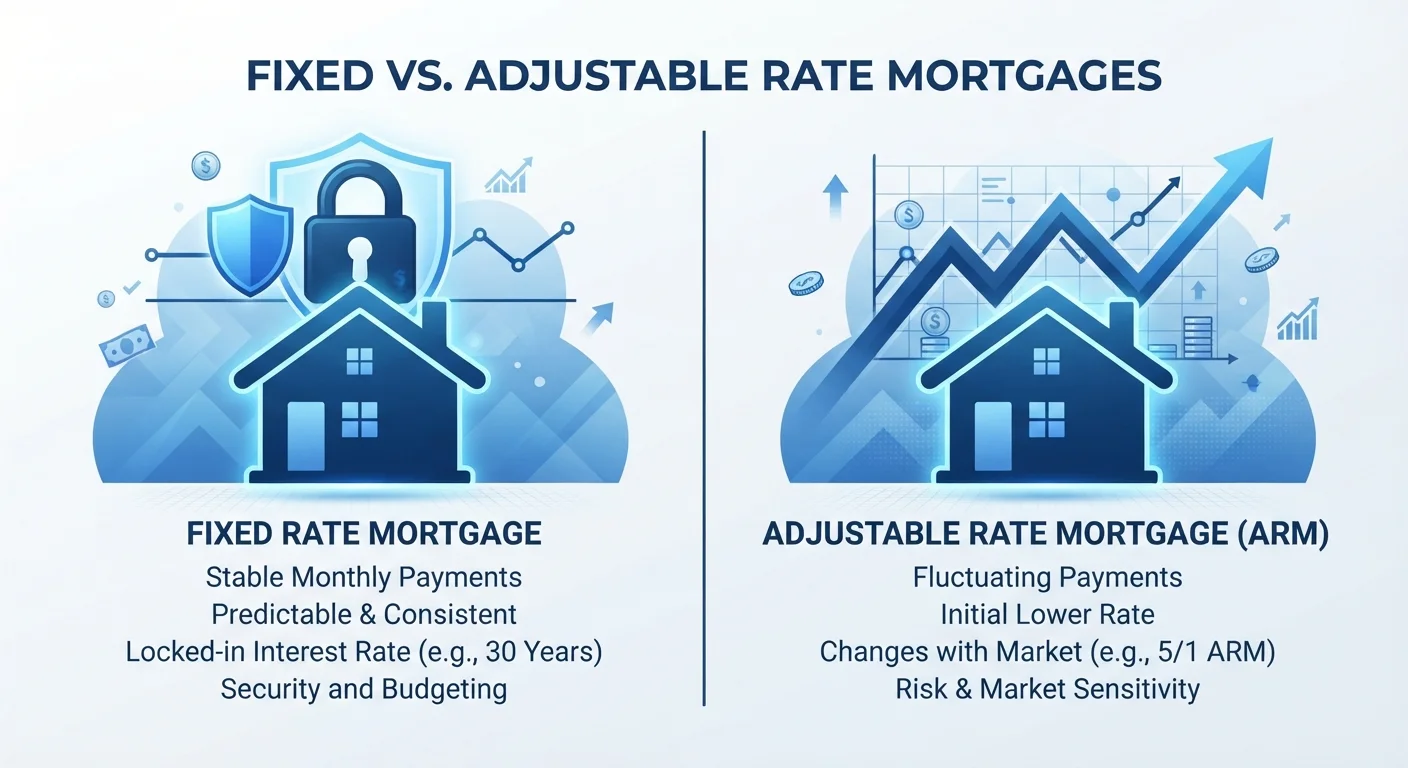
How Each Mortgage Type Works
A fixed-rate mortgage carries the same interest rate from the day you close until the day you make your final payment — whether that's 15, 20, or 30 years later. Your monthly principal and interest payment never changes. Taxes and insurance, which are often bundled into escrow payments, can fluctuate, but the core mortgage cost stays constant.
An adjustable-rate mortgage (ARM) works differently. It begins with a fixed introductory period — commonly 5, 7, or 10 years — during which the rate stays the same. After that period, the rate adjusts at set intervals (typically once per year) based on a financial index, such as the Secured Overnight Financing Rate (SOFR), plus a lender margin. That means your payment can rise or fall depending on broader interest rate conditions.
To understand why interest rates matter so much to the overall cost of borrowing, see our piece on how interest rates shape every savings and debt decision.
| Criterion | Fixed-Rate Mortgage | Adjustable-Rate Mortgage (ARM) |
|---|---|---|
| Interest Rate Over Time | Stays the same throughout loan term | Fixed initially, then adjusts periodically |
| Monthly Payment Stability | Fully predictable (P&I portion) | Can rise or fall after intro period |
| Initial Interest Rate | Typically higher than ARM intro rate | Usually lower for the introductory period |
| Rate Cap Protection | Not applicable — rate never adjusts | Caps limit per-adjustment and lifetime increases |
| Best Holding Period | Long-term (10+ years) | Short-to-medium term (under 7 years) |
| Risk Profile | Lower payment risk; higher rate lock-in risk | Higher payment uncertainty after adjustment |
| Refinancing Need | Less urgent — rate is already locked | May be necessary before first adjustment |
ARM Rate Caps: The Built-In Safety Net
One of the most misunderstood features of ARMs is the rate cap structure. Lenders are required to disclose three types of caps: the initial adjustment cap (how much the rate can move at the first adjustment), the periodic cap (how much it can move at each subsequent adjustment), and the lifetime cap (the maximum it can rise above your starting rate over the life of the loan).
For example, a 5/1 ARM with a 2/2/5 cap structure means the rate can rise no more than 2 percentage points at the first adjustment, 2 points at each subsequent adjustment, and no more than 5 points total above your initial rate. Knowing your caps helps you stress-test the worst-case scenario before you sign.
Understanding ARM Notation
ARM products are often labeled with two numbers separated by a slash — for example, 5/1 or 7/1. The first number is the length of the fixed introductory period in years. The second is how often the rate adjusts after that, also in years. A 7/1 ARM is fixed for seven years, then adjusts once per year. Always confirm the index, margin, and cap structure with your lender in writing before committing.
That said, even capped increases can meaningfully raise your monthly payment. Running the numbers on the maximum possible rate — not just the starting rate — before committing to an ARM is a sound practice.
When Each Option Tends to Make Sense
Time horizon is the single most decisive factor. If you're buying a home you intend to live in for the long haul — raising a family, building equity over decades — a fixed-rate loan removes a major financial variable from your life. You know exactly what your payment will be in year one and year twenty-nine.
If you're buying a starter home, relocating for work in a few years, or anticipate a significant income increase that would allow you to refinance, an ARM's lower initial rate can reduce your costs during the window you actually plan to hold the loan. The difference between a fixed rate and an ARM's introductory rate can amount to hundreds of dollars per month — real savings if you exit the loan before adjustments begin.
Market conditions also matter. When prevailing rates are elevated, ARMs can offer meaningful short-term relief. When rates are historically low, locking in a fixed rate is often the smarter long-term move. This connects directly to the broader relationship between mortgage rates and home prices, which rarely moves in a straight line.
30 years
Most common fixed mortgage term in the U.S.
The 30-year fixed-rate mortgage has long been the dominant home loan product for American buyers, according to Freddie Mac data.
5/1 ARM
Most widely used adjustable-rate structure
The 5/1 ARM — fixed for five years, then adjusting annually — is among the most common ARM configurations offered by U.S. lenders.
5 pts
Typical ARM lifetime rate cap above initial rate
Many ARM products carry a lifetime cap of 5 percentage points above the starting rate, though terms vary by lender and product.
Making the Decision: What to Assess
Before choosing, honestly answer these questions: How long do I realistically plan to stay in this home? How would my budget handle a payment increase of 2–5 percentage points? Is my income stable and predictable, or variable? Am I comfortable with financial uncertainty in exchange for a lower starting cost?
Also consider your broader housing context. If you're still weighing whether to buy at all, the renting vs. buying decision deserves a thorough look before you focus on mortgage structure. And for those navigating a shifting market, renting vs. owning in a shifting market offers a useful framework.
Finally, consult a licensed mortgage professional who can model both options against your actual financial profile. General information like this article can help you ask better questions — but your specific income, credit score, down payment, and goals will shape which loan structure fits best.
This article is for general informational purposes only and does not constitute personalized financial, mortgage, or legal advice. Consult a licensed mortgage lender or financial adviser for guidance suited to your individual circumstances.