The Intuitive Logic — and Its Limits
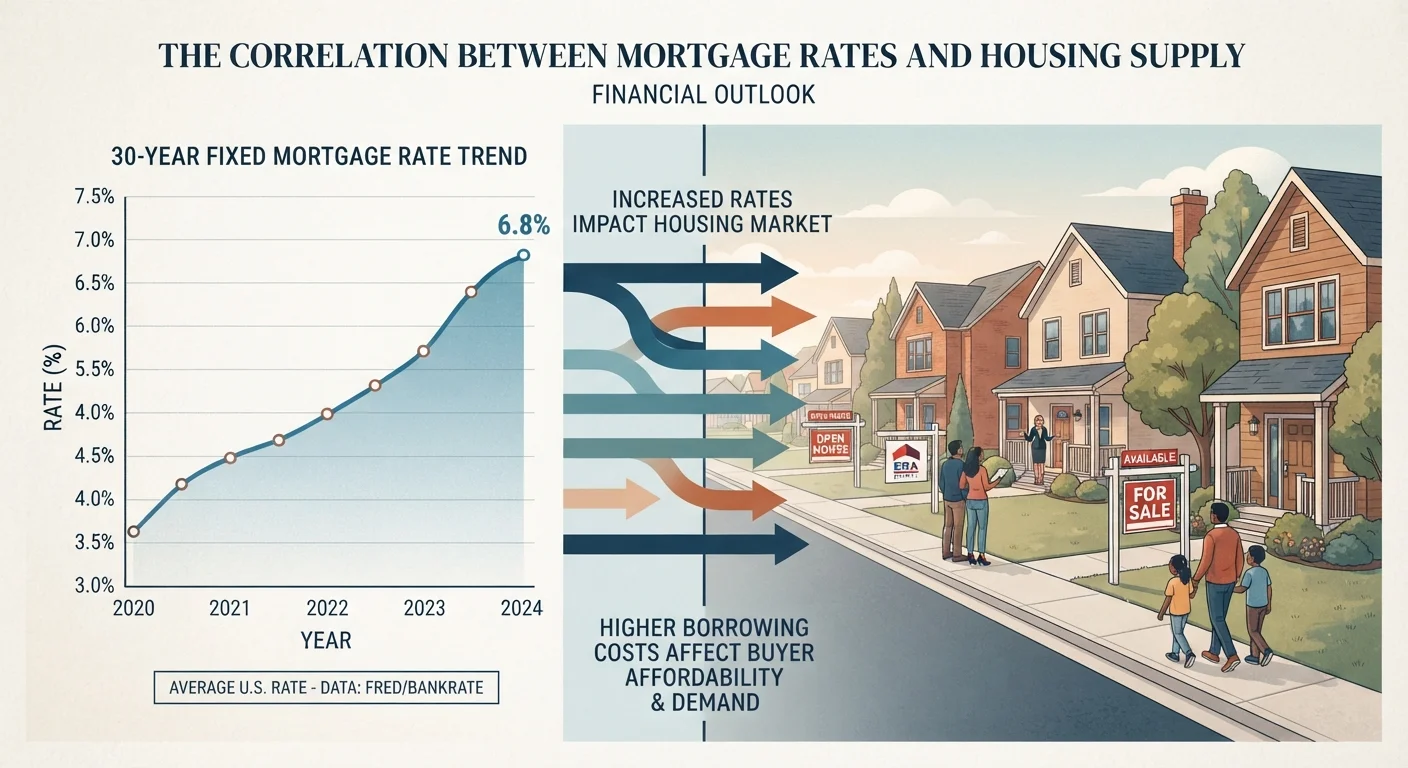
It seems straightforward: when mortgage rates rise, monthly payments get more expensive, fewer people can qualify or afford to buy, and sellers must lower prices to attract buyers. When rates fall, the reverse occurs. This logic is not wrong — but it is incomplete.
In practice, the housing market does not behave like a simple seesaw. Prices are influenced by supply, local employment, migration patterns, construction activity, and seller psychology — none of which are governed by interest rates alone. To understand why a rate hike in one cycle produced a price correction while a similar hike in another barely moved the needle, you need to look at the full picture.
For deeper context on the broader forces that move housing values over time, see our explanation of housing market cycles.
~$200+
Extra monthly cost per rate point increase
On a $350,000 loan, each one-percentage-point rate increase adds roughly $200 or more to the monthly payment, according to standard amortization calculations.
Low
Months of housing supply in constrained markets
The National Association of Realtors has historically characterized a balanced market as 5–6 months of supply; many U.S. markets have operated well below that threshold in recent years.
Millions
Homeowners potentially affected by lock-in effect
Research from institutions including the Federal Housing Finance Agency has estimated that a large share of outstanding mortgages carry rates significantly below current market levels, discouraging sales.
How Rates Actually Compress Demand
Mortgage rates affect buyers primarily through monthly payment math. When rates rise significantly, the same loan balance costs substantially more per month. This pushes some buyers out of their target price range entirely, and causes others to lower their maximum offer price. The result is a reduction in the pool of qualified buyers, which is real demand compression.
But demand compression does not translate directly into price cuts if supply is also low. A market with 10 homes for sale and 6 qualified buyers still functions as a competitive environment — sellers have leverage even if that pool of 6 shrank from 12. The economic signals that move the housing market — including employment data and wage growth — determine whether that buyer pool rebuilds quickly or stays diminished.
Run the Numbers at Today's Rate
Before assuming rates will fall and prices will follow, calculate what your target home costs at the current rate. Use that figure as your baseline for budgeting. If rates do improve, any savings become a bonus — but your plan stays sound regardless.
The Lock-In Effect: How Rising Rates Suppress Supply
One of the most counterintuitive consequences of rising mortgage rates is that they can actually keep prices elevated by reducing housing supply. When a homeowner is sitting on a 3% mortgage from a previous period of low rates, selling their home and buying another at 7% carries a steep cost — often hundreds of dollars more per month for a comparable property. Many choose not to sell at all.
This dynamic, widely called the lock-in effect, means that rate increases simultaneously reduce buyer demand and seller supply. With fewer homes available, the remaining inventory retains value better than simple demand-side analysis would predict. The net effect on prices depends on which force is stronger in a given local market.
This is one reason why appraisals sometimes come in below purchase price — agreed-upon prices in constrained markets can outpace comparable sales data.
What This Means for Buyers Navigating Today's Market
For buyers, the practical takeaway is that waiting for rates to fall is not a risk-free strategy. If rates decline, pent-up demand — from buyers who sat on the sidelines — can surge back into the market, intensifying competition and pushing prices upward. The affordability gain from lower rates may be partially or fully offset by higher purchase prices.
The most grounded approach is to understand your own purchasing power at current rates and assess local supply conditions honestly. A mortgage pre-approval gives you a concrete picture of what lenders will extend based on your income, credit, and current rates — not a hypothetical future scenario.
Buyers should also understand the loan structure they're choosing. In high-rate environments, some buyers consider adjustable-rate products. Our overview of fixed vs. adjustable-rate mortgages explains the trade-offs clearly. For comprehensive guidance on the full purchase process, the Buying a Home hub is a practical starting point.
“The relationship between interest rates and home prices is not mechanical. Supply constraints, local demand, and seller psychology all mediate the outcome in ways that aggregate rate data cannot predict.”
— Housing Economics Research Perspective, General principle reflected across academic and industry housing research
This article is for general informational and educational purposes only and does not constitute financial, investment, or legal advice. Please consult a qualified professional regarding your specific circumstances.