How Each Lease Type Actually Works
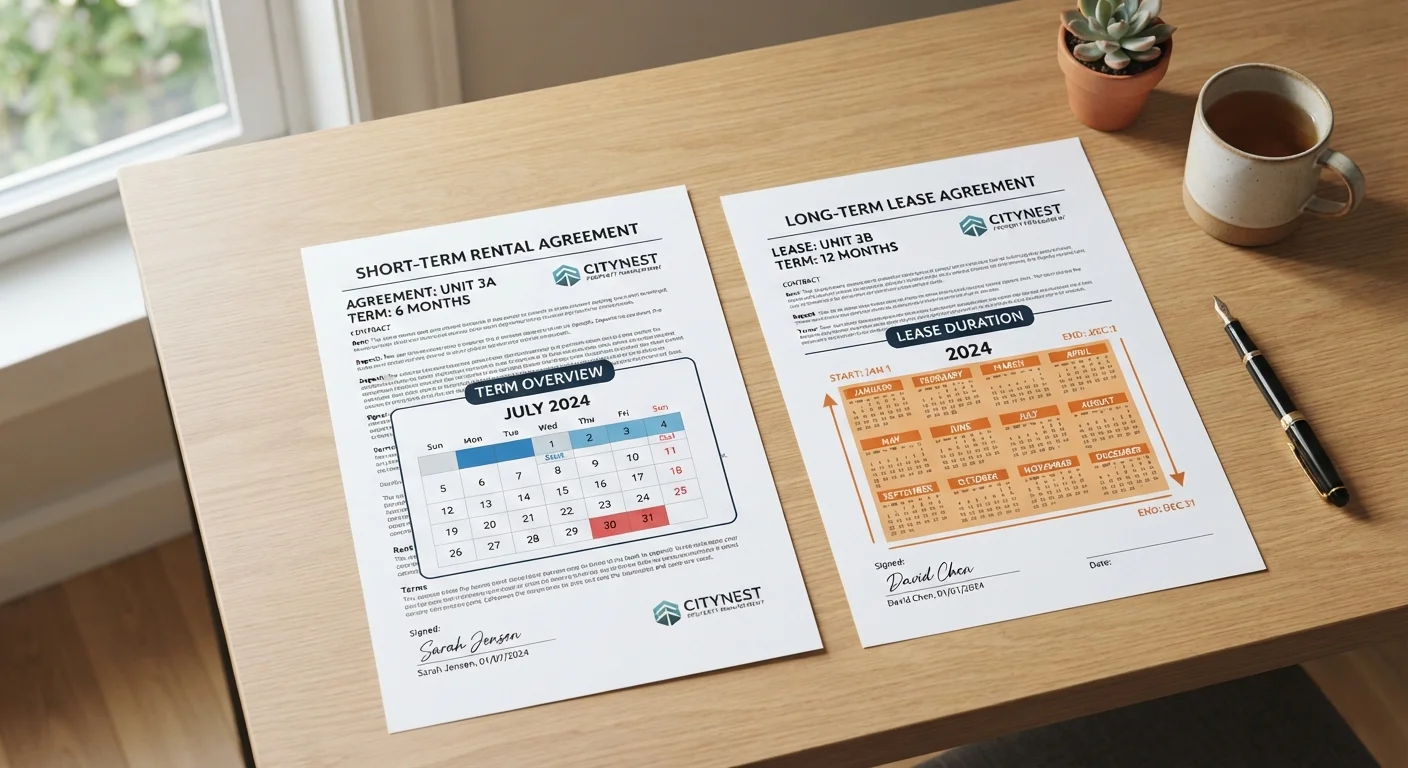
A fixed-term lease is a legally binding agreement that runs for a defined period — most commonly 12 months, though 6-month and 18-month terms exist. During that time, your rent is locked in, and your landlord generally cannot end the tenancy or change the terms without cause. At the end of the term, the lease typically either converts to a month-to-month arrangement, renews at the same or adjusted rate, or expires and you vacate.
A month-to-month lease (sometimes called a periodic tenancy) has no fixed end date. It automatically renews each month unless either party gives proper written notice — commonly 30 days, though requirements vary by state. Month-to-month status is also how many tenants end up after a fixed-term lease expires without a formal renewal.
For a full breakdown of what specific clauses in either agreement actually mean, see our plain-language lease decoder.
| Criterion | Month-to-Month Lease | Fixed-Term Lease |
|---|---|---|
| Lease Duration | Renews monthly, no end date | Set period (typically 12 months) |
| Rent Stability | Can change with each renewal period | Locked in for the full term |
| Tenant's Exit Notice | Typically 30 days written notice | Early exit triggers penalties |
| Landlord's Termination Rights | Can end with proper notice (varies by state) | Cannot terminate without cause during term |
| Monthly Rent Cost | Often 10–20% higher than fixed-term | Generally lower, reflects longer commitment |
| Protections Against Rent Increases | Minimal; subject to local rent laws | Protected until term end |
| Best Market Condition | Softening or uncertain rental markets | Rising or competitive rental markets |
The Real Cost of Flexibility
Month-to-month tenants often pay a premium for their freedom. Landlords frequently charge 10–20% more per month compared with a standard annual lease for the same unit, reflecting the higher turnover risk they absorb. Over a year, that premium can exceed one month's equivalent rent — a meaningful sum in most U.S. markets.
On the fixed-term side, the cost risk runs in the other direction: leaving early. Most fixed-term leases include an early termination clause that may require paying two to three months' rent as a penalty, forfeiting a security deposit, or continuing to pay rent until the unit is re-rented. Some states limit what landlords can collect, but you should always read your specific lease carefully before signing.
30–60 Days
Typical landlord notice to terminate month-to-month tenancy
Most U.S. states require at least 30 days' notice; several require 60 days for tenants who have occupied a unit for more than one year.
10–20%
Typical monthly rent premium for month-to-month flexibility
Landlords commonly charge above the standard annual-lease rate for month-to-month tenants to offset higher turnover risk.
2–3 Months
Common early termination penalty range in fixed-term leases
Many fixed-term leases require tenants who break the agreement early to pay two to three months' equivalent rent as a penalty, though state law may cap this.
Those weighing whether to rent or own at all will find useful context in our rent vs. buy decision framework.
Legal Protections and Notice Rules
The legal landscape differs significantly between lease types. Under a fixed-term lease, a landlord generally cannot terminate your tenancy before the end date unless you violate lease terms — such as non-payment, property damage, or illegal activity. This provides meaningful occupancy security that month-to-month tenants do not have.
With a month-to-month lease, most states allow a landlord to end the tenancy simply by providing adequate notice — typically 30 days, though some states (California, Oregon, and others) require 60 days if you've lived there over a year. In jurisdictions with just-cause eviction protections, landlords may need a specific legal reason to terminate even a month-to-month tenancy. Always verify the rules in your state and city.
Check Your Local Just-Cause Eviction Laws
A growing number of cities and states have enacted just-cause eviction ordinances that limit a landlord's ability to end a month-to-month tenancy without a specific legal reason. These protections vary widely — some apply only in rent-stabilized buildings, others citywide. Check with your local tenant rights organization or housing authority to understand exactly what protections apply where you live.
Rent increases follow similar rules: month-to-month tenants can receive notice of a rent hike at the start of any new month (subject to local rent stabilization laws), while fixed-term tenants are shielded from increases until their current term ends.
If you later need to exit a lease early through subletting or transferring it, those options carry their own legal nuances — see subletting vs. lease assignment explained.
Making the Decision That Fits Your Situation
No single lease type is universally better — the right choice depends on your specific circumstances. Ask yourself three core questions:
- How certain is my timeline? If a job transfer, family change, or home purchase is plausible within 12 months, the flexibility premium of month-to-month may be worth it. If you're settled, a fixed term almost always offers better value.
- What's happening in the local rental market? In a rising market, locking in today's rate with a fixed-term lease shields you from future increases. In a softening market, month-to-month keeps your options open to negotiate or move to a lower-priced unit. For broader market context, see our guide to renting vs. owning in a shifting market.
- What's my financial cushion? If breaking a fixed-term lease early would be a serious financial hardship, the flexibility of month-to-month may be the more conservative choice despite its higher monthly cost.
Both lease types are legitimate tools. Understanding exactly what each one commits you to — and what rights you retain — is the most important step before signing anything.
This article is for general informational purposes only and does not constitute legal or financial advice. Lease laws vary significantly by state and locality. Consult a qualified attorney or tenant rights organization for guidance specific to your situation.