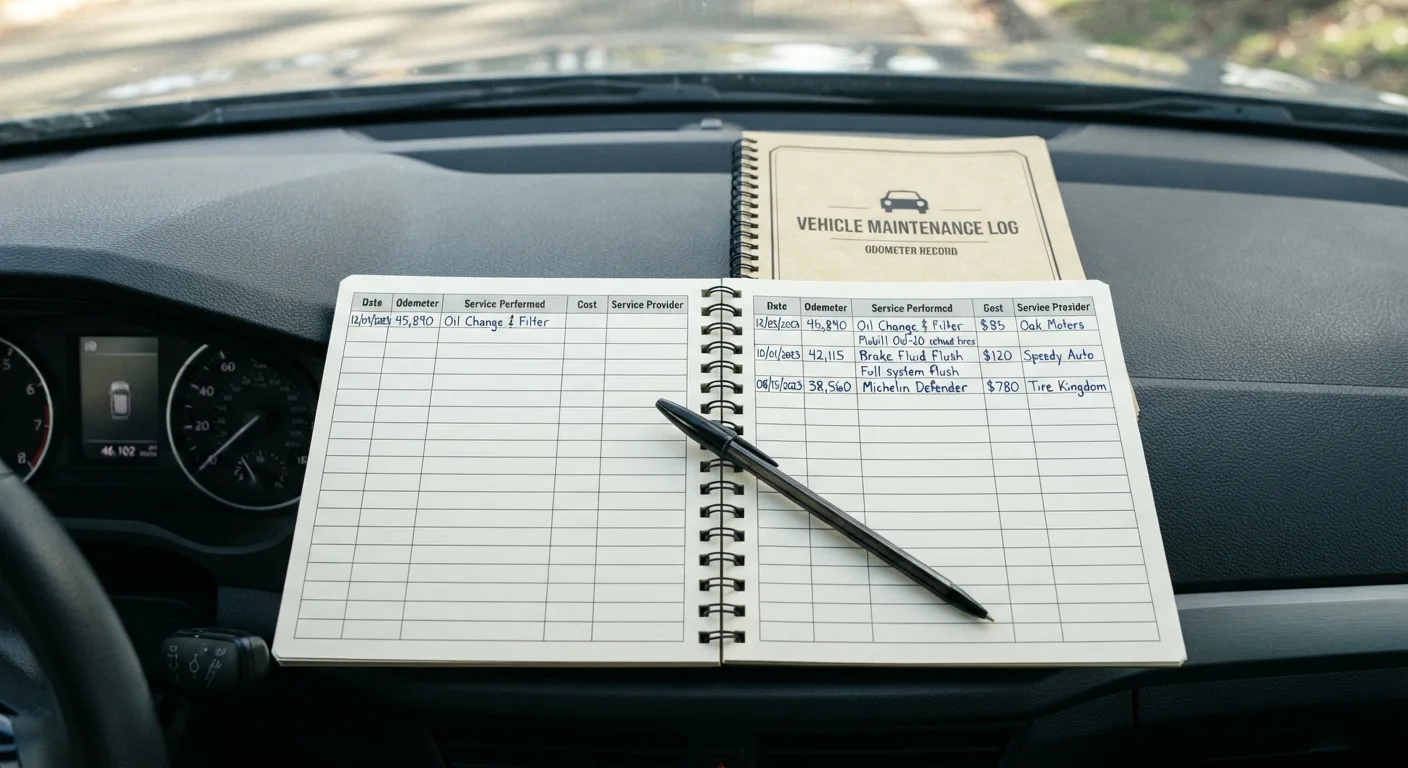
What a Maintenance Log Actually Is
A vehicle maintenance log is a running record of every service, inspection, and repair performed on your car. It can be as straightforward as a small notebook kept in the glove compartment, a dedicated logbook purchased at an auto parts store, or a digital spreadsheet synced to your phone. What it contains is more important than where it lives.
At minimum, a useful log captures the date and mileage of each service, what was done (oil change, tire rotation, brake inspection, fluid top-off), which parts or fluids were used, and who performed the work. Receipts from shops serve as supporting documentation - keeping them clipped together with your log or scanned into a digital folder adds a layer of verification that informal notes alone can't provide.
Think of it as a health record for your vehicle. Just as a doctor reviews your medical history before making a diagnosis, a mechanic benefits enormously from knowing what has already been addressed and when. For a practical starting point on what to inspect at each season, see our seasonal car maintenance checklist.
The Advantages of Keeping a Log
The case for consistent record-keeping is stronger than many drivers realize. These benefits compound quietly over time.
Supports stronger resale and trade-in value
A documented service history gives buyers and dealers confidence in the vehicle's condition, often translating to a higher offer than an equivalent car without records.
Speeds up mechanic diagnosis
A technician who can see exactly when the last brake service or fluid flush was done can narrow down causes faster, reducing diagnostic time and potentially lowering labor costs.
Helps you stay on top of service intervals
Recording the mileage at each oil change or tire rotation makes it easy to calculate when the next one is due - no guesswork, no relying on memory.
Reveals recurring problems over time
When the same issue reappears across multiple entries, the log turns anecdote into evidence - giving mechanics a clearer picture of what's really going on.
Provides warranty and insurance documentation
Some warranty claims and insurance situations require proof of proper maintenance. A detailed log, supported by receipts, can substantiate that care was taken.
~$1,200
Average cost of a major unplanned repair
Industry estimates from automotive service associations suggest unplanned breakdowns routinely cost drivers over $1,000, reinforcing the value of proactive maintenance tracking.
3-5%
Potential resale value improvement with service records
Consumer automotive research consistently finds that documented maintenance history can improve a private-sale vehicle's perceived value, often meaningfully above comparable cars without records.
Beyond the numbers, a log gives you negotiating clarity. When selling a vehicle privately or trading it in, documented service history is tangible evidence of responsible ownership - not just a verbal assurance. Buyers and dealers both respond to verifiable records.
The Drawbacks Worth Knowing
Honest assessment means acknowledging where a maintenance log falls short or creates friction.
Requires consistent effort to stay useful
A log with gaps is significantly less useful than a complete one. If entries are missed after shop visits or DIY tasks, the record loses its reliability as a reference.
Earlier records may be impossible to reconstruct
For used vehicles or cars owned for years without logging, the historical record is incomplete by definition - limiting one of the log's primary benefits.
Digital formats risk data loss without backups
A spreadsheet or app-based log is vulnerable to device loss, software changes, or account issues unless it's regularly backed up to a second location.
Paper logs can be lost or damaged
A notebook kept in the glovebox is exposed to heat, moisture, and the general disorder of daily vehicle use - physical copies should be photographed or photocopied periodically.
When a Log Isn't Enough on Its Own
A maintenance log records what was done, but it doesn't verify that work was done correctly. Entries made without supporting receipts - particularly for dealer or shop visits - are harder to substantiate if a warranty or dispute situation arises. For work performed at a professional shop, always request and retain itemized invoices as companion documentation alongside your log entries.
How Logs Help Catch Problems Earlier
One underappreciated benefit is pattern recognition. If you notice that you've replaced the same component twice in 18 months, or that coolant keeps running low between oil changes, those entries become diagnostic clues. A mechanic reviewing your log can quickly identify whether an issue is isolated or recurring - which changes both the diagnosis and the repair strategy.
This is especially relevant for vehicles approaching higher mileage. Skipping scheduled maintenance can cause cascading failures that are expensive to untangle - and a log helps ensure nothing slips through. Whether you handle some tasks yourself or rely entirely on a shop, our guide on DIY versus shop maintenance can help you decide where to draw that line.
Starting a Log: Practical Steps
The best time to start a log is now, even if your vehicle already has years of unrecorded history behind it. Begin with what you know: note the current mileage, list any recent services you can recall or verify with receipts, and commit to recording every service going forward.
Choose a format you'll actually use. If you're comfortable with a notes app or a shared cloud spreadsheet, use that. If a small spiral notebook works better, keep one in the car. The format is irrelevant - the habit is everything. A log that's updated after every service is infinitely more useful than a detailed system that's abandoned after two entries.
Homeowners who already maintain property records may find the transition natural. The logic is the same: a documented history makes future decisions easier and protects your investment. Our guide to keeping a home maintenance log covers similar principles if you'd like a parallel framework.
This article is for general informational purposes only. Always consult a qualified mechanic for guidance specific to your vehicle's condition and service needs.