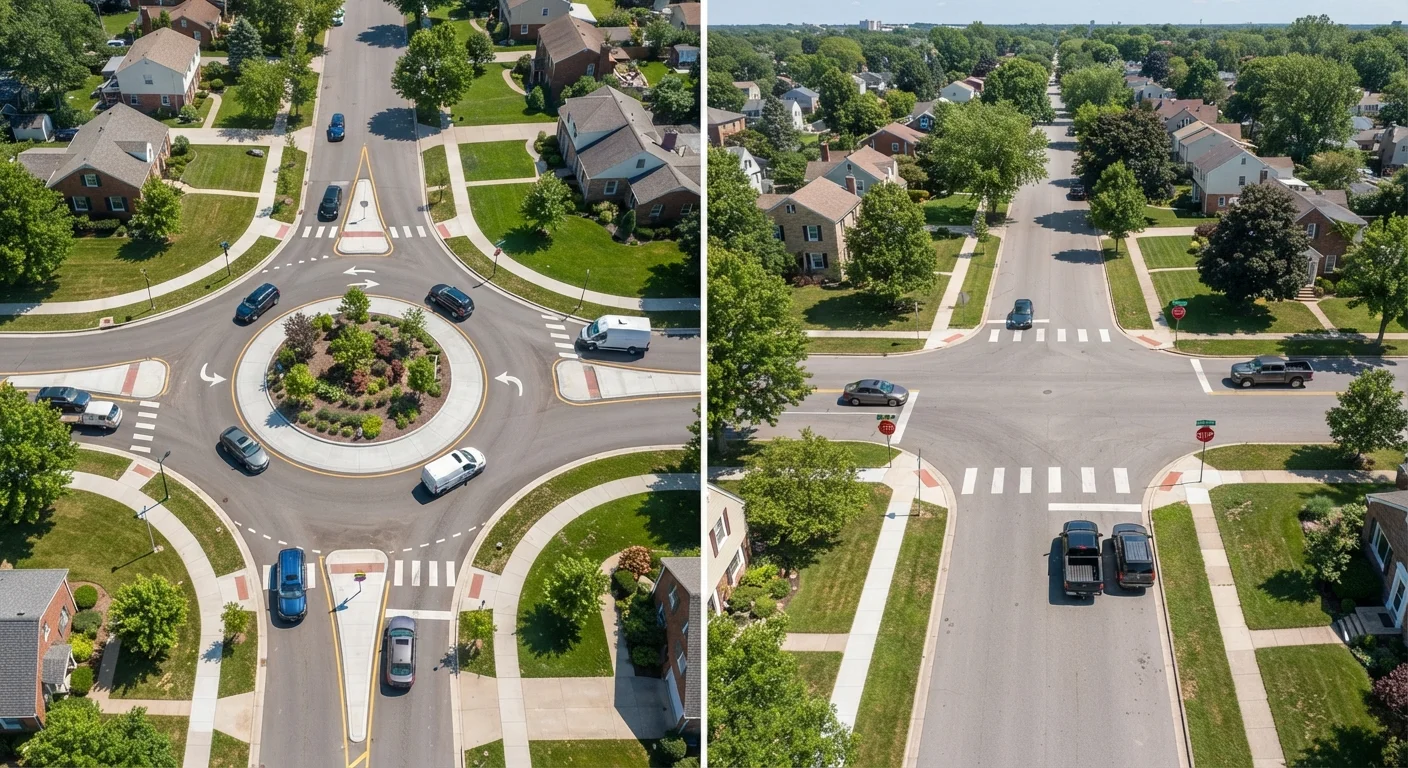
How Each Intersection Type Works
The fundamental difference between a roundabout and a four-way stop is when and whether you stop. At a four-way stop, every driver must come to a complete stop before proceeding - no exceptions. At a roundabout, drivers yield at entry and only stop if circulating traffic is present. If the roundabout is clear, you can enter without stopping at all.
Four-way stops operate on a strict first-come, first-served sequence. The driver who stops first proceeds first. When two or more vehicles stop at the same time, the one furthest to the right goes next. This sequential approach keeps things predictable, though it can create hesitation when drivers aren't sure who arrived first.
Roundabouts use a yield-at-entry model. Traffic already inside the circle has priority - you wait at the dashed yield line until there's a safe gap, then enter and travel counterclockwise to your exit. There are no traffic lights dictating turns, which is why roundabouts can handle steady traffic flow more efficiently during busy periods. For a broader look at managing complex urban road situations, see our complete guide to driving safely in urban traffic.
| Criterion | Roundabout | Four-Way Stop |
|---|---|---|
| Required action at entry | Yield to circulating traffic | Full stop always required |
| Right-of-way rule | Vehicles inside circle go first | First to stop, first to go |
| Traffic flow | Continuous, counterclockwise | Sequential, one direction at a time |
| Tie-breaking rule | No tie - yield to anyone inside | Yield to driver on your right |
| Fatal crash risk | Lower (fewer high-speed conflicts) | Higher risk if stop sign ignored |
| Pedestrian crossings | Set-back crosswalks at entry/exit | At corners; yield when pedestrian present |
| Lane complexity | Can be multi-lane; follow pavement markings | Standard lanes; direction-based |
Right-of-Way Rules in Detail
At a four-way stop, right-of-way follows this order: the first to stop, the first to go. When arrival times are too close to call, yield to the driver on your right. If two vehicles face each other - one going straight, one turning left - the straight-moving driver proceeds first. Two vehicles facing each other and both going straight may proceed simultaneously.
At a roundabout, the rule is simpler in principle: yield to anyone already circling. Once inside, you have the right of way over entering vehicles. Multi-lane roundabouts add a layer of complexity - generally, use the right lane for right-turn or straight exits and the left lane for exits that require passing more than halfway around. Check lane markings and pavement arrows, which are usually painted on the road surface.
Pedestrians operate under specific rules at both intersection types. At four-way stops, pedestrians in a marked or unmarked crosswalk generally have the right of way once a driver has stopped. At roundabouts, pedestrians use marked crosswalks set back from the yield line - drivers exiting or entering must yield to pedestrians at those crossings, but pedestrians should never attempt to cross mid-circle.
~37%
Reduction in overall crashes
The FHWA reports roundabouts reduce all crashes by roughly 37% compared to traditional intersections with stop or signal control.
~75%
Fewer injury crashes
IIHS data indicates roundabouts reduce injury crashes by approximately 75% versus signalized or stop-controlled intersections.
~90%
Reduction in fatal crashes
Fatal crashes drop by roughly 90% at locations converted from traditional intersections to roundabouts, according to FHWA research summaries.
Common Mistakes and How to Avoid Them
The most frequent roundabout error is failing to yield at entry - drivers accustomed to four-way stops sometimes treat the dashed line as a stop sign and roll in without checking for circulating vehicles. The opposite mistake also happens: stopping unnecessarily inside an empty roundabout, which can confuse drivers behind you.
At four-way stops, the most common problem is ambiguous arrival order. If you're unsure who stopped first, make brief eye contact or use a small hand gesture to communicate. Never assume the other driver knows who has priority - defensive awareness prevents most misunderstandings.
Forgetting to signal is another widespread issue at roundabouts. While not always legally required in every state, signaling your intended exit (right turn signal as you approach your exit) gives pedestrians and waiting drivers critical information. Think of it as courtesy that functions like a safety device.
For situations beyond standard intersections - such as school zones or active construction - right-of-way rules can shift in ways that catch drivers off guard. Our guide on school zones, construction zones, and emergency vehicles covers those scenarios in detail.
Multi-Lane Roundabouts: A Special Note
Multi-lane roundabouts follow the same core yield-at-entry rule, but lane selection matters more. Drivers planning to exit within the first half of the circle typically use the right lane; those traveling farther around use the left lane. Always obey painted pavement arrows and lane markings specific to each roundabout, as configurations can vary. If you accidentally miss your exit, simply continue around and try again - do not reverse or stop inside the circle.
Which Intersection Is Safer?
Research from the Insurance Institute for Highway Safety (IIHS) and the Federal Highway Administration (FHWA) consistently shows that roundabouts reduce fatal and serious injury crashes compared to stop- or signal-controlled intersections, largely because they eliminate the high-speed T-bone and head-on collisions that occur when drivers run red lights or stop signs. Conflict points - locations where vehicle paths cross - are substantially fewer in a well-designed roundabout.
That said, roundabouts do see slightly more low-speed sideswipe incidents, particularly in multi-lane configurations where drivers misjudge lane positioning. Four-way stops, by requiring a full stop, naturally reduce approach speeds, which lowers the severity of any crash that does occur at lower-traffic locations.
The takeaway: neither intersection type is inherently dangerous when drivers understand and follow the rules. Confusion - not the intersection design itself - is the leading cause of errors at both. New or less experienced drivers who want to build broader highway confidence can also find useful context in our highway driving guide for first-timers.