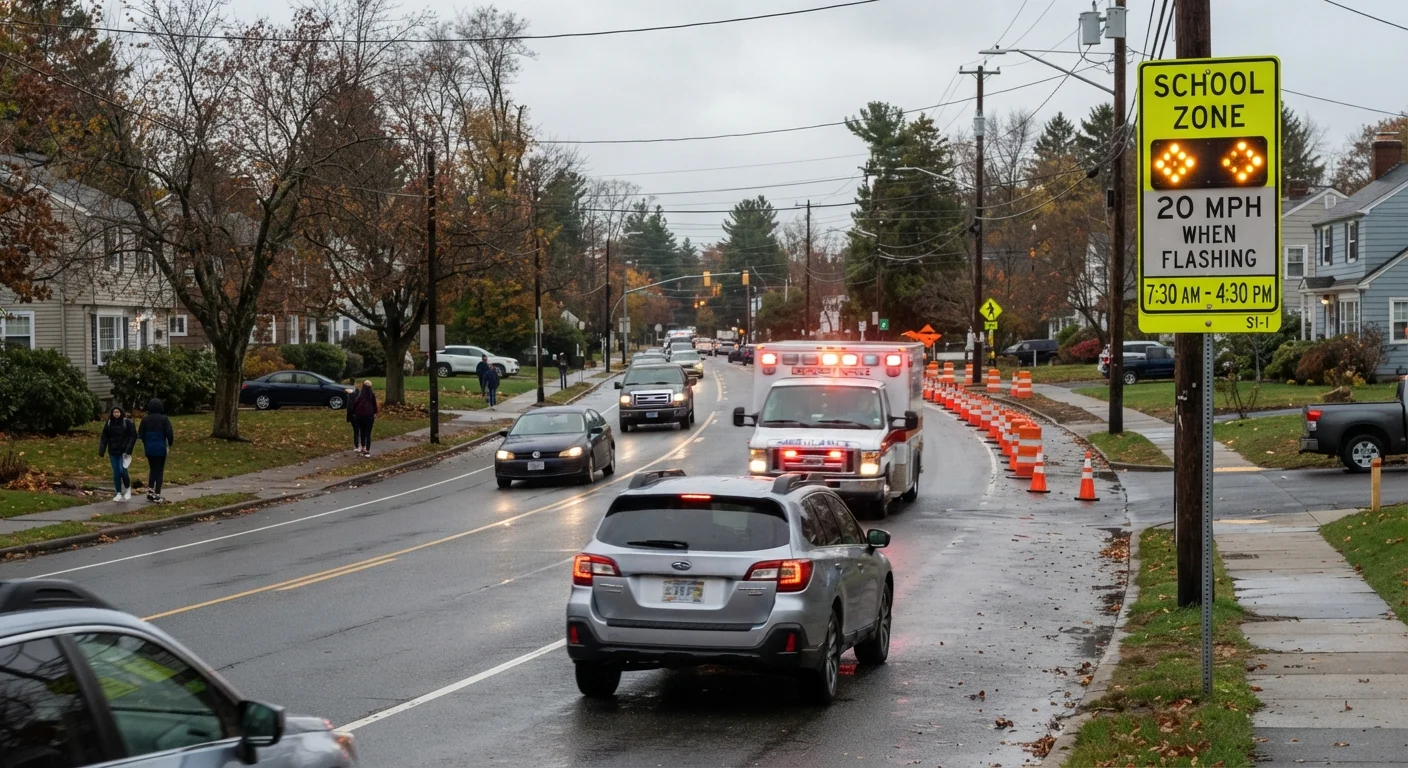
School Zones: Slower Speeds, Stricter Consequences
School zones are among the most regulated stretches of road in the United States. When children are present - typically during arrival and dismissal times - speed limits typically drop to between 15 and 25 mph, depending on the state and municipality. In many jurisdictions, these reduced limits are active only when flashing beacons are lit or when a posted schedule applies, so it's important to read signage carefully.
Violations in school zones carry elevated fines in most states, and some jurisdictions double or triple standard speeding penalties. Many states also require drivers to stop for school buses displaying a stop arm and flashing red lights, regardless of which direction traffic is traveling - with limited exceptions for divided highways, which vary by state law. Passing a stopped school bus is one of the most serious moving violations a driver can commit.
Situational awareness matters here more than anywhere else. Children are unpredictable pedestrians. Reduce speed before you enter the zone, not once you're already in it, and keep scanning for kids between parked cars or at crosswalks. For a broader discussion of navigating tight urban environments, see our complete guide to urban driving.
Construction Zones: Worker Safety and Doubled Fines
Work zones present a different set of hazards: narrowed lanes, uneven pavement, abrupt lane shifts, and workers on foot near moving traffic. Most states impose reduced speed limits through active construction zones and increase penalties for violations - fines doubled for speeding in a work zone are common, and some states add license points or mandatory court appearances when workers are present.
School zone
A designated area around a school where reduced speed limits and additional traffic rules apply, typically during school arrival and dismissal hours.
Work zone / Construction zone
A section of roadway where construction, maintenance, or utility work is underway, marked by signs, cones, and barriers. Enhanced penalties for traffic violations often apply.
Move Over law
A law requiring drivers to vacate the lane nearest a stopped emergency or roadside service vehicle, or to slow down significantly if a lane change is not safely possible.
Flagger
A trained worker in a construction zone who uses flags, signs, or paddles to direct traffic. Their instructions carry the same legal authority as posted traffic signs.
Stop arm
The red, octagonal arm that extends from a school bus to signal that the bus is stopped and children may be boarding or exiting. Passing a deployed stop arm is a serious moving violation.
MUTCD
The Manual on Uniform Traffic Control Devices - a federal standard governing the design and placement of road signs, signals, and markings, including work zone layouts.
The MUTCD - a federal standard that guides how states design work zones - requires advance warning signs, tapers, and buffer spaces to help drivers transition safely. Still, rear-end collisions are the most common work-zone crash type, largely because drivers fail to adjust speed early enough. Maintaining a larger following distance than usual is especially important here; see our article on following distance and tailgating for guidance on spacing your vehicle appropriately.
Key practices: enter the taper zone with your speed already reduced, avoid sudden lane changes, and watch for flagger instructions - flaggers have the same authority as posted signs under federal guidance. Never assume a work zone is inactive just because you don't see workers; posted speed limits in a construction zone often apply 24 hours a day.
Emergency Vehicles: Move Over and Yield Laws
When you see or hear an emergency vehicle - ambulance, fire truck, or police car - with lights and sirens active, the law requires you to yield the right of way in every U.S. state. In practice, this means pulling to the right edge of the road and stopping until the vehicle has passed, unless directed otherwise by an officer or road configuration.
Move Over Laws Apply Beyond Police Cars
Most drivers know to yield for police vehicles, but Move Over laws typically cover ambulances, fire trucks, tow trucks, highway maintenance crews, and even utility workers in many states. When in doubt, move over or slow down whenever you see flashing lights on the shoulder. Always confirm the specific requirements of the state you're driving in, as covered activities can vary.
Move Over laws, now in effect in all 50 states, extend this protection to stationary emergency and roadside service vehicles. When an emergency vehicle, tow truck, or highway maintenance vehicle is stopped on the shoulder with lights active, you are generally required to move one lane away from the stopped vehicle. If a lane change isn't safely possible, reduce your speed significantly below the posted limit.
Failing to comply with Move Over laws has resulted in fatalities among roadside workers and first responders, and violations carry steep fines and potential license suspension in many states. The specific speed reduction required when you cannot change lanes varies by state - check your state's DMV or motor vehicle code for the exact figure that applies where you drive. Poor visibility conditions make compliance even more critical; our piece on driving in rain, fog, and snow covers how to manage speed and awareness when sight lines are compromised.