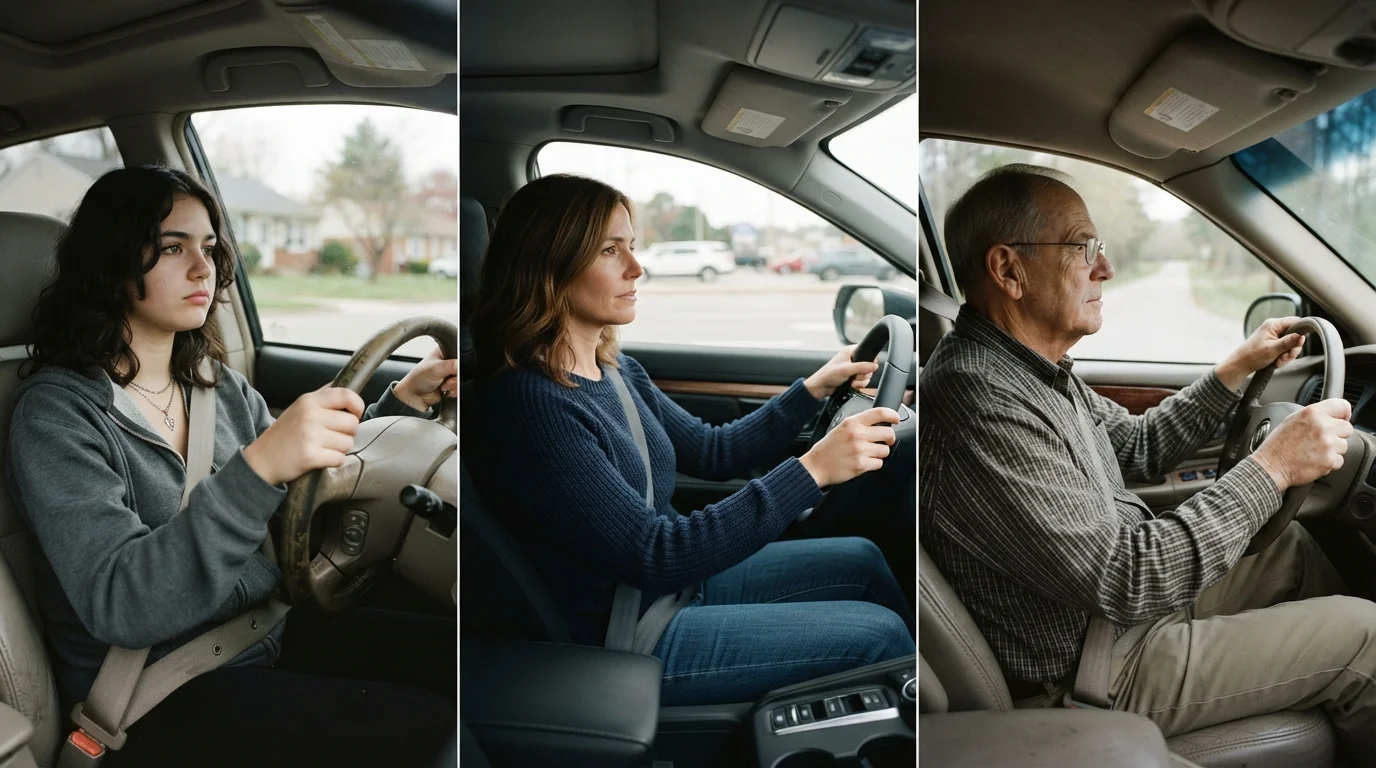
Why Age Is a Meaningful Factor in Crash Risk
Crash data consistently shows that driving risk isn't evenly distributed across the lifespan. Both the youngest and oldest drivers face elevated crash rates - but for fundamentally different reasons. Teen drivers lack the neural wiring and real-world experience that underpin sound judgment behind the wheel. Older drivers may carry decades of skill but face gradual declines in vision, reaction speed, and cognitive flexibility.
Understanding how risk profiles shift across age groups helps drivers, families, and policymakers focus safety efforts where they matter most. It also removes the stigma of age-based conversations - the goal isn't to restrict driving, but to support safer driving at every stage.
| Teen Drivers (16-19) | Middle-Aged Drivers (25-60) | Older Drivers (65+) | |
|---|---|---|---|
| Primary crash factor | Inexperience & risk-taking | Overconfidence & distraction | Physical/cognitive changes |
| Relative crash rate | Highest per mile driven | Lowest per mile driven | Elevated, especially at 80+ |
| Key risk behaviors | Peer distraction, speeding, night driving | Phone use, tailgating, complacency | Failure to self-assess declining ability |
| Vision concerns | Mostly minimal | Developing (glare, acuity) | Significant - glare, contrast, field loss |
| Recommended intervention | Graduated licensing, supervised practice | Defensive driving refresher | Medical/vision review, vehicle adaptation |
| Self-regulation tendency | Low - often overestimates ability | Moderate - experience breeds confidence | High - often avoids difficult conditions |
Teen Drivers: High Risk, High Stakes
The statistics on teen driving are stark. According to the CDC, motor vehicle crashes are a leading cause of death for teenagers in the United States. Drivers aged 16-19 are roughly three times more likely to be involved in a fatal crash per mile driven than drivers aged 20 and older.
The core issue isn't attitude - it's inexperience compounded by developing risk perception. Teen brains are still maturing, particularly the prefrontal cortex, which governs impulse control and consequence weighing. Add peer passengers (who measurably increase distraction and risk-taking behavior), nighttime driving, and unfamiliarity with high-speed or adverse conditions, and the hazard multiplies quickly.
Graduated Driver Licensing (GDL) programs, now standard in all 50 states, address these gaps with phased exposure - restricting night driving, passenger counts, and phone use during the learner and provisional stages. Research broadly supports GDL programs as effective at reducing teen crash rates. For new drivers preparing for highway travel, our guide to highway driving for first-timers is worth reading before heading onto a freeway.
Practice in Varied Conditions Early
Teen drivers who log supervised hours across a range of conditions - rain, night, highway speeds, and heavy traffic - build better hazard recognition than those who practice only in ideal settings. GDL programs recommend 50 or more supervised hours before solo driving. Don't count the hours; focus on the variety of situations encountered.
Middle-Aged Drivers: The Illusion of Mastery
Drivers between roughly ages 25 and 60 have the lowest crash rates of any age group. Experience, physical ability, and cognitive function converge during these years to produce generally reliable road performance.
But this safety record carries a hidden risk: overconfidence. Years of uneventful driving can breed the assumption that judgment is infallible and that certain shortcuts - rolling through stops, following too closely, checking a phone briefly - carry no real consequence. Research on driver behavior suggests that experienced drivers sometimes take greater risks precisely because prior miles have gone well.
Risky habits that experienced drivers overlook are worth examining honestly at this stage. Defensive driving course refreshers, even for long-licensed drivers, are a practical reset. Conditions like driving in rain, fog, or snow also deserve renewed attention - familiarity doesn't eliminate the hazard.
Familiarity Doesn't Equal Safety
Middle-aged drivers often underestimate how much habits have drifted over the years. Skipping mirror checks, underestimating following distance, or reaching for a phone during a 'quick' stop are patterns that accumulate quietly. A crash doesn't announce itself in advance - and years without one is not a guarantee that current habits are safe.
Older Drivers: Managing Change Without Losing Independence
Physical and cognitive changes associated with aging affect driving ability, though the timing and degree vary significantly from person to person. Common concerns include reduced range of motion (limiting head turns for checking blind spots), slower reaction times, increased sensitivity to glare, and medications that can impair alertness or coordination.
Importantly, older drivers as a group tend to self-regulate - avoiding night driving, high-traffic routes, or unfamiliar roads. This behavioral adaptation partially explains why per-crash-mile rates for older drivers, while elevated, are less extreme than those for teens. The challenge lies in distinguishing reasonable caution from denial of declining ability.
Annual check-ins with a physician, an eye doctor, and - when available - an occupational therapist specializing in driver rehabilitation can help identify changes early. Vehicle modifications such as wider mirrors, adaptive controls, or backup cameras can extend safe driving years. Families navigating these conversations should approach the subject with an awareness of the emotional dimensions that come with shifting independence later in life.
3×
Teen crash risk vs. older drivers
The CDC reports that drivers aged 16-19 are about three times more likely per mile to be in a fatal crash than those 20 and older.
75%
Of older drivers self-restrict driving
Studies on older driver behavior suggest the majority voluntarily limit night driving or high-traffic routes as they age.
Universal Risk Factors That Cut Across Every Age
While each life stage has its distinct profile, several hazards apply regardless of age. Distraction and fatigue are two of the most consequential - both impair reaction time and situational awareness in measurable ways. Understanding how distracted and drowsy driving compare as risks is relevant whether you're 19 or 79.
Alcohol impairment, speeding, and failure to use seat belts continue to appear across all age groups in fatal crash data. These are behavioral factors, not biological ones - meaning they respond to choices, not just aging.
Safe driving at every age comes down to an honest, ongoing assessment of ability and behavior - combined with the willingness to adapt. No driver, at any stage, is beyond the benefit of attention, reflection, and the occasional recalibration of habits.