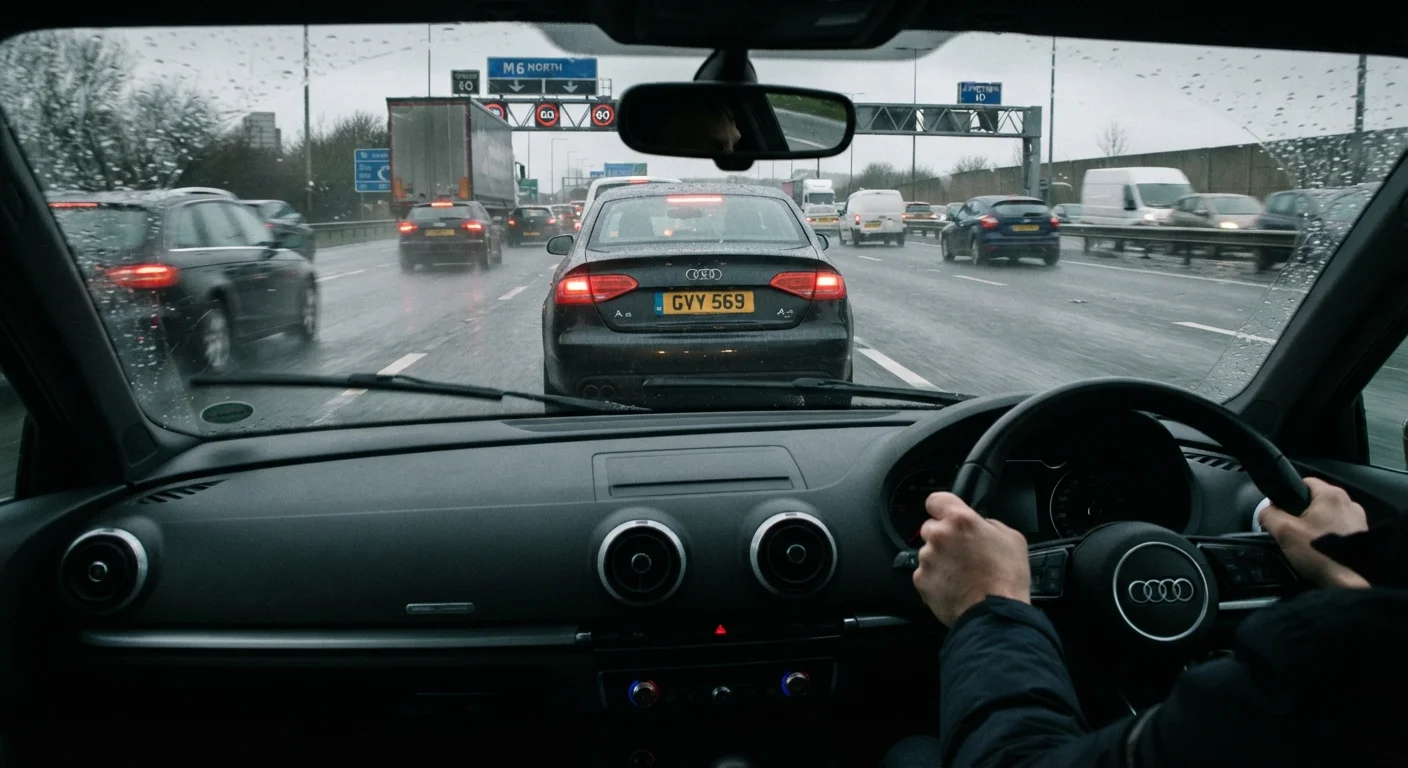
Why Following Distance Is a Safety Margin, Not a Courtesy
The space between your front bumper and the vehicle ahead isn't empty road - it's time. Specifically, it's the time your brain needs to recognize a hazard, decide to brake, move your foot, and let the car's braking system do its job. Collapse that gap and you eliminate your options before a crisis even develops.
Rear-end collisions are consistently among the most frequent crash types reported on U.S. roads, and following too closely is a leading contributing factor. Yet many drivers chronically underestimate how little distance they're leaving - especially at highway speeds, where a car traveling 65 mph covers roughly 95 feet per second.
Understanding how stopping distances actually work reveals why even a short delay in perception has outsized consequences. By the time an average driver perceives danger, decides to brake, and begins applying pressure, 1.5 to 2.5 seconds may already have passed - before the vehicle has slowed at all.
~29%
Rear-end crashes as share of all U.S. collisions
The National Highway Traffic Safety Administration (NHTSA) consistently identifies rear-end crashes as one of the most common crash types on American roads.
1.5 sec
Typical minimum driver perception-reaction time
Traffic safety research commonly cites 1.5 seconds as a baseline reaction time for alert drivers - a figure that increases with fatigue, distraction, or impairment.
2x+
Increase in stopping distance on wet roads
Stopping distances on wet pavement can more than double compared to dry conditions, according to general road safety guidance from state transportation agencies.
The Three-Second Rule: How It Works and Where It Falls Short
The three-second rule is a practical, speed-independent method for gauging following distance. As the vehicle ahead passes a fixed reference point - a road sign, a painted line, an overpass - begin counting. If you reach that same point before you count to three, you're too close.
This method works because it scales automatically with speed: at 30 mph you need fewer feet than at 70 mph, and the time gap adjusts accordingly. But three seconds is a minimum in good conditions. Several situations require more:
- Wet or icy roads: Braking distances can more than double on slick surfaces.
- Reduced visibility: Fog, rain, and glare slow perception time, so you need a larger buffer.
- Heavy or loaded vehicles: Trucks, SUVs towing trailers, and vans require significantly more distance to stop.
- Fatigue or distraction: Impaired attention delays your reaction, eating into whatever gap you've left.
- Following large trucks: Their height blocks your view of what's ahead, so you need extra distance to see hazards early.
Defensive driving principles treat following distance as one layer of a broader hazard-anticipation strategy - not a standalone rule to follow mechanically.
Recalibrate Your Gap on Every Drive
Make a habit of checking your following distance at the start of each trip by consciously applying the three-second count at your current speed. Many drivers set their gap during light traffic and never adjust when conditions change - speed increases, rain begins, or fatigue sets in. Treat the gap as dynamic, not a one-time setting.
Why Drivers Tailgate - and What's Actually Going On
Tailgating is rarely a calculated choice. More often it's a behavioral response to frustration, urgency, or habit. Common psychological drivers include:
- Time pressure: Running late compresses a driver's perceived margin, leading to risk-taking behavior that research consistently shows provides minimal time benefit.
- Frustration with slower traffic: When a driver ahead is moving below the pace of surrounding traffic, tailgating often functions as an aggressive signal - not an actual strategy.
- Normalization: In dense urban traffic, very short gaps become normalized. Drivers calibrate their sense of 'normal' distance to what they see every day, even when that norm is unsafe.
- Overconfidence: Experienced drivers sometimes assume they'll react quickly enough regardless of gap - a pattern explored in risky assumptions seasoned drivers overlook.
When tailgating becomes intimidation or deliberate pressure, it crosses into aggressive driving - a precursor to road rage escalation that rarely ends well for anyone involved.
Tailgating Laws Vary, but Liability Is Consistent
Every U.S. state prohibits following too closely, though the specific statutory language differs. In practice, if you rear-end the vehicle ahead, you will almost always be considered at fault - regardless of what the lead driver did. Insurance claims and traffic citations reflect this consistently. This article provides general information, not legal advice; consult a qualified attorney for questions about your specific situation.
Maintaining Your Gap When Others Aren't
If someone is following you too closely, the instinct to brake-check them is both dangerous and counterproductive. A better response: signal and move right when it's safe, allowing the tailgater to pass. Keep your speed steady and avoid sudden changes that could trigger a collision.
Also worth noting: your following distance from the car ahead still matters when someone is behind you. If the vehicle ahead stops suddenly, you bear responsibility for your own reaction time - the tailgater behind you is their own separate problem, and riding their bumper doesn't make your situation safer.
In situations involving sudden, unexpected events - like a tire blowout at speed in the vehicle ahead - the margin provided by a proper following gap may be the only thing that prevents a multi-car pileup.
Following distance is one of the simplest, most controllable variables in safe driving. It costs nothing, requires no special equipment, and provides a buffer that defensive technique alone can't replicate.