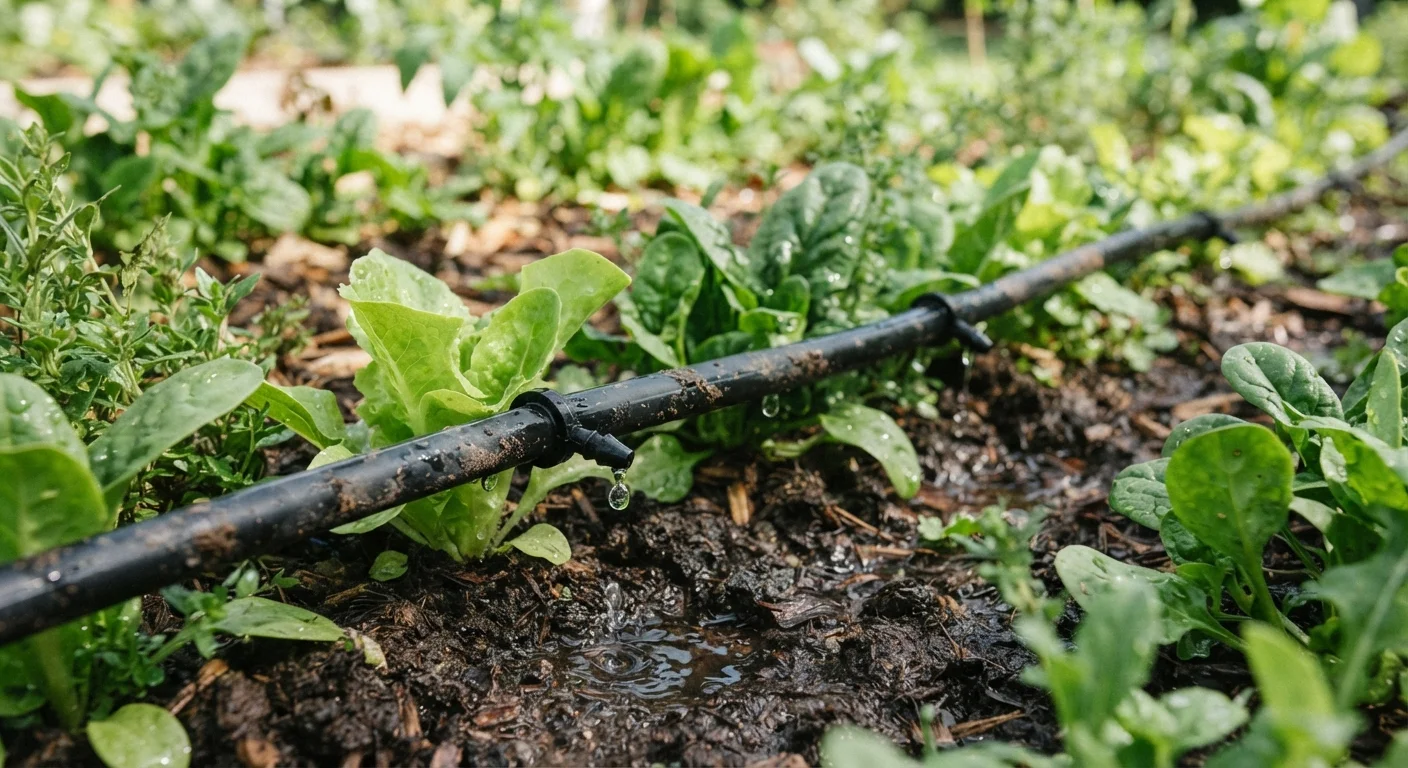
What Drip Irrigation Actually Does
Drip irrigation delivers water slowly and directly to the root zone of plants through a network of tubing and small emitters. Unlike overhead sprinklers, which wet leaves and surrounding soil, drip systems target water exactly where plants take it up. That fundamental difference drives most of the trade-offs covered here.
Home systems typically consist of a main supply line connected to your outdoor faucet, distribution tubing that runs between plants, and individual emitters rated by how many gallons per hour they release. A timer and pressure regulator — while sold separately — are strongly recommended to keep the system running as intended. Without them, pressure fluctuations can cause emitters to drip too fast or not at all.
Understanding how the system works makes the pros and cons easier to evaluate honestly. For more on how watering method affects plant health, see common watering misconceptions that affect many home gardens.
The Real Advantages
Delivers water directly to the root zone
Emitters place moisture exactly where plant roots take it up, reducing waste from runoff and evaporation compared to broadcast sprinklers.
Reduces fungal disease pressure on foliage
Keeping leaves dry eliminates a primary pathway for diseases like powdery mildew and blight, which thrive when foliage stays wet.
Can lower overall water consumption
When properly programmed and maintained, drip systems generally use less water per plant than overhead irrigation for equivalent growth outcomes.
Allows watering during any time of day
Because leaves stay dry, midday watering doesn't risk leaf scorch — giving gardeners more scheduling flexibility, especially with a timer.
Reduces weed germination in pathways
Water is delivered to plant root zones only, leaving surrounding soil drier and less hospitable to weed seeds that need surface moisture to sprout.
The water efficiency benefit is the most cited reason homeowners choose drip irrigation, and it holds up. Delivering water at ground level reduces evaporation losses that occur with sprinklers, particularly in hot, dry climates or during peak summer heat. Studies from cooperative extension programs consistently find drip systems use substantially less water for comparable plant growth outcomes — though exact savings depend heavily on soil type, plant density, and how the system is programmed.
Keeping foliage dry also matters for disease management. Fungal problems like powdery mildew, early blight on tomatoes, and black spot on roses are all encouraged by prolonged leaf wetness. Drip irrigation removes that moisture pathway almost entirely, which is a meaningful practical advantage in humid climates or densely planted beds. This connects naturally to how you structure your garden: see raised beds vs. in-ground planting for how bed design can compound these benefits.
Up to 50%
Potential water savings vs. sprinkler irrigation
The U.S. Environmental Protection Agency estimates that drip irrigation can use up to 50% less water than conventional overhead sprinkler systems when properly managed.
90%+
Water application efficiency for drip systems
University cooperative extension programs commonly cite drip irrigation application efficiency above 90%, compared to 50–70% for many sprinkler setups, depending on conditions.
The Honest Disadvantages
Higher upfront cost than basic watering methods
Purchasing tubing, emitters, a pressure regulator, and a timer adds up — installation in even a modest vegetable garden can require meaningful time and expense.
Emitters clog and require regular inspection
Hard water minerals and soil particles block emitter heads, sometimes silently. Plants can be underwatered for weeks before visible stress signals appear.
Tubing is vulnerable to rodent and UV damage
Rodents frequently chew through drip lines in garden settings, and plastic components degrade under prolonged sun exposure, requiring periodic replacement.
Inflexible for frequently changing garden layouts
Replanting, crop rotation, or rearranging containers means moving and reconfiguring tubing and emitters — a time-consuming process that erodes the system's convenience.
Requires separate zoning for mixed water needs
Plants with very different moisture requirements can't share one drip line effectively; solving this with multiple zones adds planning complexity and cost.
The most underestimated challenge is maintenance. Emitters clog — especially in areas with hard water or if sediment enters the line. Rodents chew through tubing with surprising regularity in garden settings, and UV exposure degrades plastic components over several seasons. A system that was working perfectly in May can be silently failing by July, underwatering plants without any obvious visible signs until damage appears.
Drip systems also don't adapt well to gardens in constant flux. If you replant frequently, move containers, or rotate crops through many different areas, repositioning tubing and emitters becomes tedious. For that kind of flexible growing, a straightforward watering approach may serve you better — including container setups on patios and balconies where hand-watering often remains more practical.
Where Drip Irrigation Fits — and Where It Doesn't
Drip irrigation performs best in fixed, defined growing areas: vegetable rows, raised beds, established shrub borders, and fruit trees. These situations reward the upfront setup effort because the layout stays relatively stable from season to season.
It's a poor fit for lawns, which need even coverage across broad surface areas that drip emitters can't deliver. It also requires more planning in mixed plantings with varying water needs — pairing drought-tolerant lavender with thirsty peppers on the same line forces a compromise that satisfies neither plant fully. Zoning separate lines by water need solves this but adds complexity and cost.
Pressure and Filtration Matter More Than Most Guides Admit
Most residential outdoor faucets operate at higher pressure than drip emitters are rated for, which causes emitters to discharge too quickly and can damage tubing connections. A pressure regulator — typically set to 25–30 PSI for drip systems — is essential, not optional. Pairing it with an in-line filter significantly extends emitter life by catching sediment before it reaches the small openings. These two components cost relatively little but have an outsized effect on how reliably the system performs over time.
For gardeners planning long-term planting schemes, the stability a drip system requires pairs naturally with perennial-focused design. Shrubs, ornamental grasses, and repeat-blooming perennials stay in place for years — the kind of fixed layout that justifies the installation investment. See planning a garden that works season after season to think through which plants suit your space before committing to a layout.