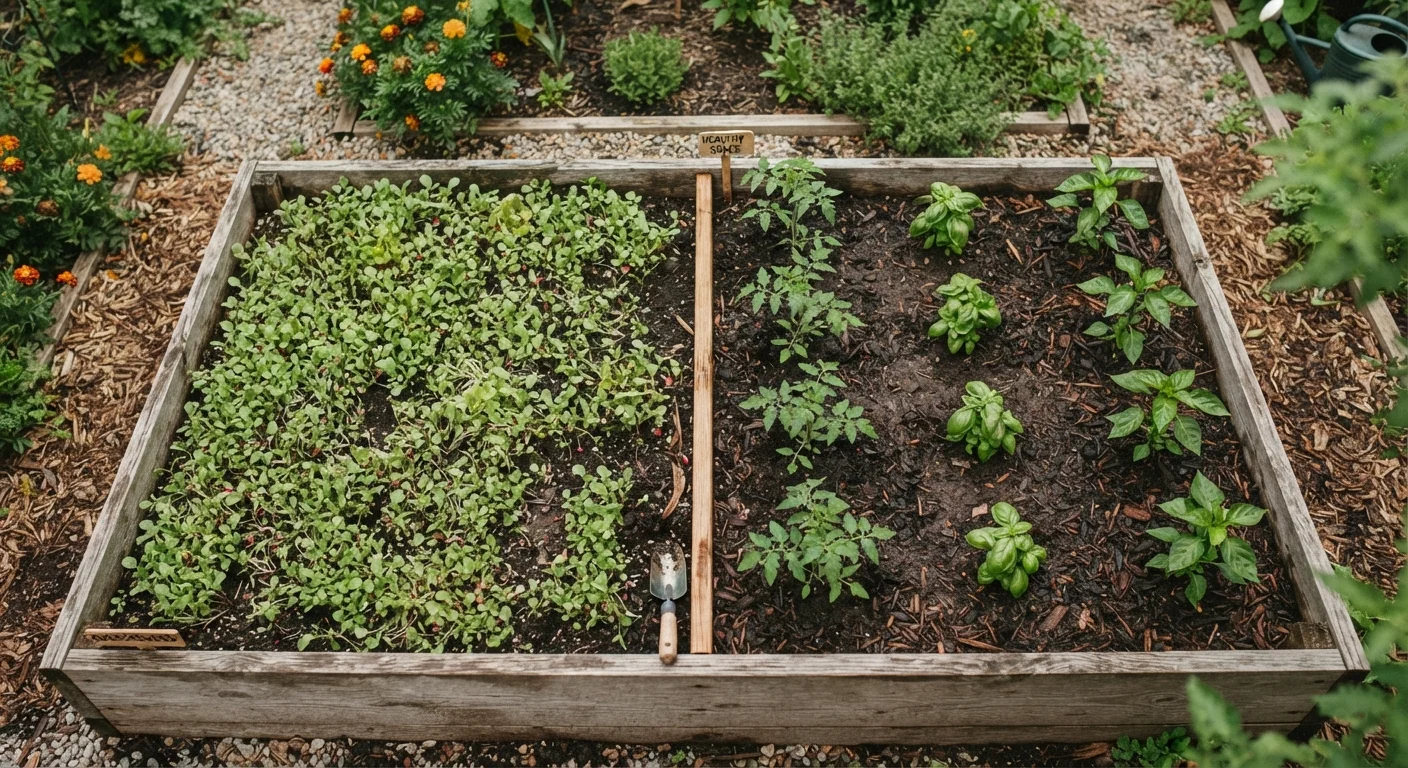
Why Overplanting Is So Easy to Do
A seed is tiny. A seedling is small. It feels almost wasteful to leave so much empty soil between them. This visual disconnect is the root cause of overplanting, and it catches nearly every first-time gardener off guard.
When you look at a freshly planted bed, generous spacing looks like failure — bare dirt where plants should be. But those gaps are not empty space. They are future canopy, future root zone, and future airflow. A tomato plant that fits in a four-inch pot at the nursery can easily reach three to four feet wide at maturity. A zucchini that looks modest in spring will spread to claim several square feet of bed by midsummer.
The problem compounds when gardeners start seeds indoors. Germination rates are uncertain, so beginners sow multiple seeds per cell as insurance — a sensible instinct. But they often transplant every seedling that sprouts rather than selecting the strongest one. For guidance on seed starting without this pitfall, see our seed starting indoors guide.
Planting based on seedling size rather than mature plant size.
Why it happens: Young plants look so small that their labeled spacing feels excessive. Beginners trust what they see now, not what the tag projects for later.
Transplanting every seedling that sprouts instead of selecting and thinning.
Why it happens: Sowing extras as germination insurance is good practice, but the instinct to save every seedling — not wanting effort to go to waste — leads to overcrowded transplants.
Ignoring row spacing and only following plant-to-plant spacing.
Why it happens: Seed packets list two measurements, and beginners often apply only the first one, leaving rows too close together to allow airflow or easy access.
Treating all varieties of a crop as having the same spacing needs.
Why it happens: "Cucumber" looks like one category, but bush and vining types differ substantially in spread. Beginners often don't register variety type as spacing-relevant.
Skipping a bed plan and planting by feel in the moment.
Why it happens: Drawing a garden plan feels like extra work when the urge to get plants in the ground is strong. Most beginners skip straight to planting.
Reading Plant Tags and Seed Packets Accurately
Spacing information is printed on nearly every seed packet and nursery tag, yet it is frequently misread or ignored. Understanding what those numbers actually mean makes an immediate practical difference.
30–50%
Yield reduction from overcrowded vegetable plants
University extension research consistently shows that plants grown closer than recommended spacing produce significantly lower yields due to competition for light and nutrients.
2–4 ft
Mature spread of a standard indeterminate tomato plant
Most indeterminate tomato varieties reach two to four feet wide at maturity — far exceeding the four-inch nursery pot they arrive in.
Spacing refers to mature size, not current size. When a tag says "space 18 inches apart," it means the plant will need 18 inches of clearance at full growth. Planting based on current size — which might be just a few inches — means your bed will be dramatically overcrowded in six to eight weeks.
Seed packets often list two numbers: the distance between plants within a row, and the distance between rows. Both matter. Row spacing accounts for working access, airflow between plant lines, and the spread of foliage. Ignoring it produces a tangled mass that is difficult to harvest and prone to fungal problems.
Some tags distinguish between "bush" and "vining" varieties of the same crop. A bush cucumber and a vining cucumber have very different space requirements. Treat variety labels as functionally different plants, not marketing distinctions.
If you are growing in a raised bed, you may be able to use block planting instead of rows, which allows slightly closer spacing in some cases. Our guide on raised beds vs. in-ground planting covers how bed setup affects spacing decisions.
Don't Trust Visual Spacing Alone
It is tempting to eyeball distance between plants, especially in a large bed. But human estimation at close range is surprisingly inaccurate and consistently skews too tight. Always use a tape measure, a marked stake, or a spacing tool for any plant with a listed spacing of 12 inches or more. A small investment in measuring saves weeks of recovery work later.
Practical Steps to Space Plants Correctly
Good spacing starts before a single seed goes in the ground. Lay out your bed on paper first, drawing each plant as a circle equal to its mature spread. When circles overlap, you have a spacing problem to solve now rather than in six weeks.
In the garden itself, use a tape measure or a marked wooden dowel to set spacing physically before planting. Push a small stake or popsicle stick at each planting point. This removes the guesswork and the temptation to squeeze in "just one more."
For direct-sown seeds, sow at the recommended rate, then thin decisively once seedlings emerge. Thinning — snipping or pulling the weaker seedlings to leave only the best-spaced survivors — is one of the most neglected tasks in beginner gardens. It feels counterproductive, but it is not. The plants you remove would have robbed the survivors of resources they need. Use scissors to snip at soil level rather than pulling, which can disturb roots of neighboring seedlings.
Spacing also interacts with companion planting strategies. Plants positioned too close together can negate the benefits that companion combinations are meant to provide. Our article on companion planting logic explains how proximity and arrangement work together. Similarly, overcrowded plants create humid microclimates that encourage disease — something to weigh alongside advice in our watering myths guide, which addresses how moisture management interacts with plant health.
Thinning Is Not Optional
Many new gardeners view thinning as wasteful or even cruel to plants. In practice, skipping it almost guarantees a poor harvest. Overcrowded plants produce more competition, more shade, and more disease pressure than any of them can overcome. Remove extra seedlings early — within the first two weeks of germination — when the impact on remaining plants is greatest and the work is easiest.
Planning for annuals and perennials together adds another layer. Perennials return and expand each season, so their spacing needs to account for multi-year growth. See our overview of annuals vs. perennials for help thinking through long-term bed design.