What Companion Planting Actually Means
At its core, companion planting is intentional plant placement. Rather than arranging a garden purely by aesthetics or convenience, you consider which plants support each other's growth — and which ones don't. The relationships at work fall into a few broad categories: pest management, pollinator attraction, soil improvement, and physical space-sharing.
This isn't a new idea. Indigenous farming traditions, particularly in North America, formalized companion planting centuries ago. If you're just getting started with food growing, our ground-up vegetable garden primer covers the foundational steps before you layer in companion planting strategies.
Science vs. Tradition in Companion Planting
Companion planting sits at the intersection of documented ecology and accumulated gardening lore. Some pairings are well-supported by research; others have been passed down through generations without formal study. Neither category is worthless — traditional practices often reflect real observation — but it's worth distinguishing between the two when setting expectations for your garden.
The Science Behind Plant Partnerships
Some companion planting mechanisms are well-established in horticultural research. Legumes — beans, peas, and clover — host bacteria in their root nodules that convert atmospheric nitrogen into a form plants can use. When legumes grow alongside heavy feeders like corn or leafy greens, that nitrogen becomes available to neighbors as roots break down.
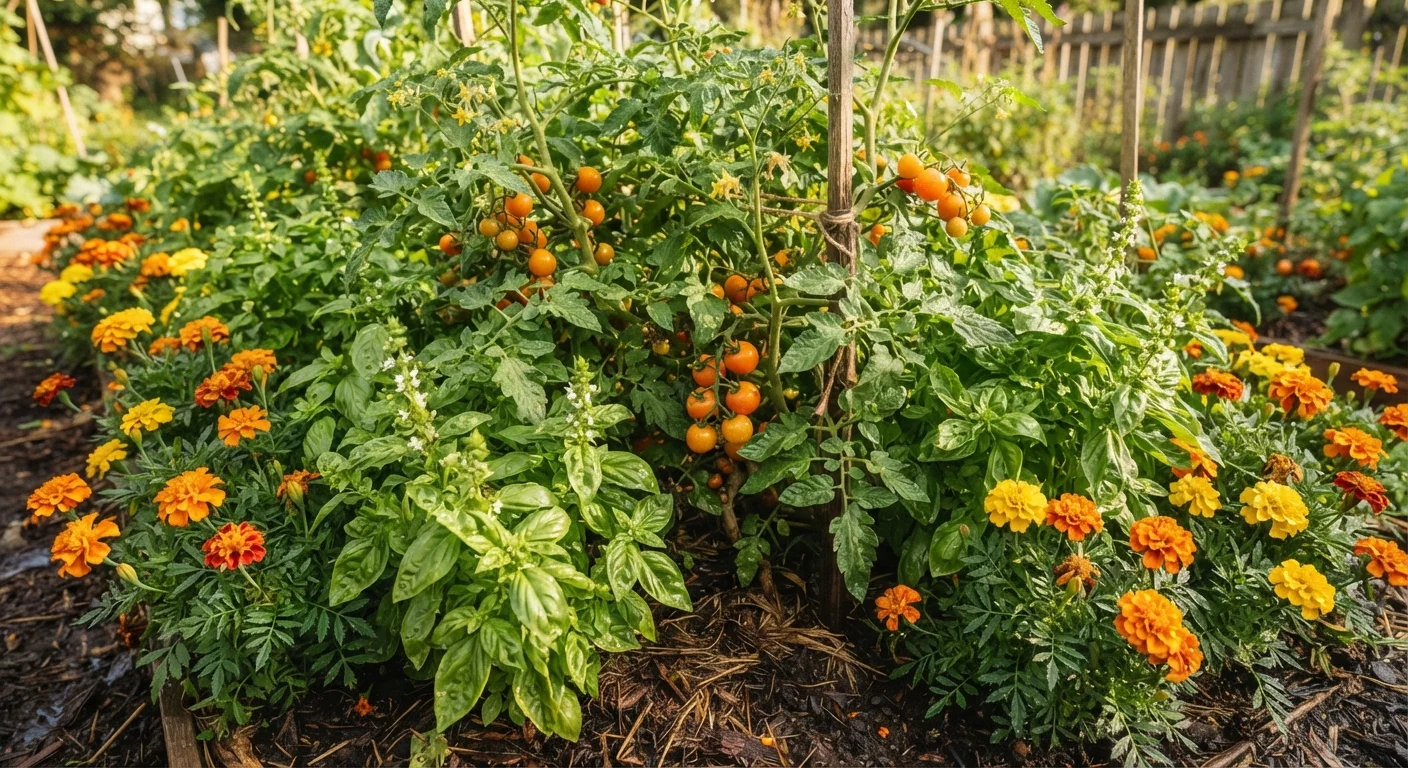
Allelopathy is another documented phenomenon: certain plants release chemical compounds through their roots or leaves that suppress nearby weeds or inhibit competing plants. Marigolds (Tagetes species) produce a compound called alpha-terthienyl that has shown effectiveness against soil nematodes in research settings — one reason they're so commonly recommended near tomatoes and squash.
~80%
of land plants that form mycorrhizal fungal networks
Research consistently estimates that roughly 80% of terrestrial plant species form symbiotic relationships with mycorrhizal fungi, a foundation for understanding how plants share resources and influence neighbors underground.
3–1
Yield advantage of polycultures over monocultures in some studies
Some agricultural research has found that diverse mixed plantings (polycultures) can outperform single-crop monocultures in total yield per unit area, partly due to complementary resource use.
Strong-smelling herbs like basil, dill, and lavender may confuse or deter certain pest insects, though research results here are more variable. Planting flowers that attract beneficial insects — such as parasitic wasps that prey on aphids — is another well-supported strategy. See our guide to natural pest control methods for how companion planting fits into a broader approach.
The Three Sisters: A Proven Classic
The most widely recognized companion planting system is the Three Sisters: corn, beans, and squash, grown together in traditional Indigenous agricultural practice. Each plant plays a distinct role. Corn provides a vertical trellis for climbing beans. Beans fix nitrogen, feeding both corn and squash. Squash sprawls low to the ground, shading soil to retain moisture and crowd out weeds.
This combination succeeds because the plants occupy different niches — vertical, climbing, and ground-covering — without directly competing. It's a useful model for thinking about companion planting in general: the most effective pairings tend to complement each other structurally as well as biochemically.
Start With Structural Companions
Before worrying about which herbs deter which pests, focus on structural companions — plants that occupy different vertical layers without competing. Tall plants paired with ground-covering ones, or climbers paired with support crops, tend to deliver the most consistent, observable benefits. Complexity can come later as you learn what works in your specific conditions.
What the Evidence Doesn't Always Support
Not every traditional pairing holds up under scrutiny. The claim that basil dramatically improves tomato flavor, for instance, is popular but not supported by controlled research — the two plants simply share similar growing conditions, making them practical neighbors rather than flavor-enhancers of each other.
Companion planting also doesn't override poor soil, overplanting, or neglect. A crowded bed of companion plants still suffers from competition for light, water, and air. Our article on why new gardeners overplant explains how spacing decisions affect plant health — companion planting works best when spacing is respected, not used as justification to crowd more plants together.
Soil health also underpins everything. Companion planting won't compensate for serious nutrient imbalances — our explainer on soil pH and garden chemistry shows why getting the basics right matters more than any single planting strategy.
How to Start Using Companion Planting in Your Garden
Begin with a few well-supported pairings rather than overhauling your entire garden plan. Interplanting marigolds along vegetable borders, pairing beans with corn or squash, and tucking herbs like dill or cilantro near brassicas to attract beneficial insects are low-effort starting points.
If you're growing in limited space, companion planting adapts well. Our container gardening guide covers how to pair herbs and vegetables in pots on patios or balconies — the same logic applies, just at a smaller scale.
Keep notes on what you try and what you observe. Gardening is inherently experimental, and your local conditions — climate, soil type, pest pressure — shape outcomes as much as any published pairing chart. Companion planting rewards curiosity and patience more than any rigid formula.